
Your employer is part of a foreign group and offers you the chance to join its ESPP (Employee Stock Purchase Plan): every month, part of your salary is used to buy shares in the parent company, at a reduced price. The offer is often attractive, but it raises tax questions that people usually discover when filling in their income tax return: is the discount taxable? When? And what happens when the shares are sold?
This guide explains simply, for an employee who knows nothing about it, how France taxes an ESPP, with a worked example from start to finish. It only deals with taxation in France of an employee who is tax resident in France; the rules of other countries are a matter for professionals in those countries.
In brief
- An ESPP allows you to buy shares in the group company at a discount (often 15%), through deductions from net salary.
- In principle, France taxes the transaction in two stages: the discount in the year of purchase, as salary; the capital gain in the year of sale, as a gain on securities.
- The discount is the difference between the value of the share on the purchase date and the price paid; in principle it bears income tax and social contributions, like salary.
- To calculate the capital gain, the starting point is the value on the purchase date, not the price paid: the discount is therefore not taxed twice.
- Other obligations: the foreign broker account is in principle declared every year (form 3916), as are any dividends.
- Depending on how the plan is drafted and on your career path (arrival in France, departure, mobility), the treatment may differ: it is advisable to have your situation analysed by a lawyer before any decision.
Contents
1. What is an ESPP?
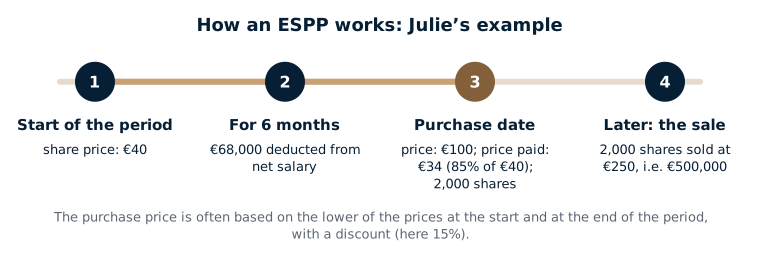
An ESPP is a share purchase plan reserved for employees. It is very common in American groups, and also exists in many European and Asian groups. It generally works as follows:
- Enrolment: the employee chooses to devote a percentage of their salary to the plan (for example 5% or 10%), within the limits set by the plan.
- The offering period (often 6 months): every month, this percentage is deducted from net salary and set aside.
- The purchase date, at the end of the period: the accumulated money buys shares in the parent company at a reduced price, for example 85% of the share price. Many plans use the lower of the prices at the start and at the end of the period (this is called a lookback).
- Holding: the shares are deposited in an account opened in the employee’s name with a broker, often abroad. The employee can generally keep them or sell them.
Unlike RSUs (shares delivered free of charge) and stock options (the right to buy later at a price fixed in advance), an ESPP therefore requires the employee to pay for their shares, with their own money, but less than they are worth. For the other schemes, see the guide on the taxation of RSUs and the article RSUs, stock options and free shares: the essentials.
| ESPP | RSUs / free shares | Stock options | |
|---|---|---|---|
| Does the employee pay for the shares? | Yes, at a discount | No | Yes, at the price originally set |
| What France taxes first | The discount, in the year of purchase | The acquisition gain (timing depends on the plan) | The exercise gain (depending on the plan and its date) |
| Then | The capital gain on sale | The capital gain on sale | The capital gain on sale |
2. What France taxes: two moments
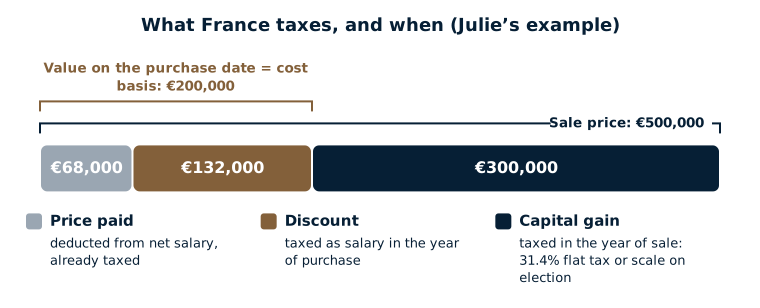
For an employee who is tax resident in France, an ESPP in principle produces two different types of income, taxed at two different times and under two different regimes. The diagram below shows them using Julie’s example.
3. At the time of purchase: the discount, an additional salary
How is the discount calculated?
The discount is the benefit obtained by the employee: it is the difference between the value of the shares on the purchase date and the price actually paid. With a purchase price based on the lowest share price of the period, the discount can be well above 15% when the share price has risen during the period.
How is it taxed?
In principle, this discount is an employment-related benefit, taxed as salary in the year of purchase:
- it is added to taxable salary and bears income tax at the progressive scale (with withholding at source);
- in principle it bears the social security contributions applicable to salaries;
- in practice, the French employer generally includes it in the payslip for the month of purchase, and it then appears in the pre-filled amount in box 1AJ of the income tax return.
If the discount does not appear on your payslips (for example because the plan is managed directly by the parent company), how to declare it deserves to be checked with a lawyer.
Special situations
- Plan drafted as an option plan: some plans are legally structured as a purchase option granted at the start of the period. Depending on the wording of the plan and the conditions laid down by French law, a different analysis may, in certain cases, be considered.
- International mobility: if you arrived in France, or left it, during the offering period, the share of the discount taxable in France may depend on the period of work in France; these situations call for a case-by-case analysis (see the page on French tax on foreign RSUs and stock options).
4. At the time of sale: the capital gain
The right starting point: the value on the purchase date
When the shares are sold, the gain is a capital gain on the sale of securities. Key point: the cost basis used (the “acquisition price”) is in principle the value of the shares on the purchase date, that is to say the price paid plus the discount already taxed as salary. This avoids taxing the same euro twice. Using the price paid by mistake would mean paying tax on the discount a second time.
For shares bought and sold in dollars, the acquisition price is in principle converted into euros at the exchange rate on the purchase date, and the sale price at the rate on the sale date: the movement of the dollar is therefore part of the capital gain or loss.
How is it taxed?
- in principle at the flat tax (PFU) of 31.4%: 12.8% income tax and 18.6% social levies, a rate raised from 30% to 31.4% by the 2026 Social Security Financing Act;
- or, on election, at the progressive scale of income tax (plus social levies); this election applies to all investment income and capital gains of the year, and is only worthwhile in certain situations; for shares bought since 2018, no holding-period allowance applies.
A capital loss (sale below the value on the purchase date) may in principle be set off against capital gains of the same kind in the same year and the following ten years. The sale is in principle declared on supplementary return no. 2042-C (box 3VG for a gain, 3VH for a loss), with, depending on the case, form no. 2074.
5. Julie’s complete example
Julie, a senior executive, works in Lyon for the French subsidiary of a foreign group. She devotes 15% of her salary to the ESPP. For simplicity, all amounts are expressed in euros.
| Step | Data | Amount |
|---|---|---|
| Deductions over six months of net salary | — | €68,000 |
| Share price at the start of the period / on the purchase date | €40 / €100 | — |
| Purchase price (85% of the lowest price) | 85% × €40 = €34 | 2,000 shares |
| Value of the shares on the purchase date | 2,000 × €100 | €200,000 |
| Discount taxed as salary (year of purchase) | €200,000 − €68,000 | €132,000 |
| Sale of the 2,000 shares two years later | 2,000 × €250 | €500,000 |
| Taxable capital gain (year of sale) | €500,000 − €200,000 | €300,000 |
| Tax and levies on the gain at the flat tax | €300,000 × 31.4% | €94,200 |
The €132,000 discount is added to Julie’s taxable salary in the year of purchase and bears social contributions and tax at the scale, like her salary. On the sale, only the increase above €100 per share is taxed.
Variant: the share price falls. If Julie sells her 2,000 shares at €45, i.e. €90,000, she makes a capital loss of €110,000 (€90,000 − €200,000), even though she paid €34 for them: the discount remains taxed as salary, and the loss may in principle reduce other capital gains. This is a point that many employees discover late.
6. The other obligations
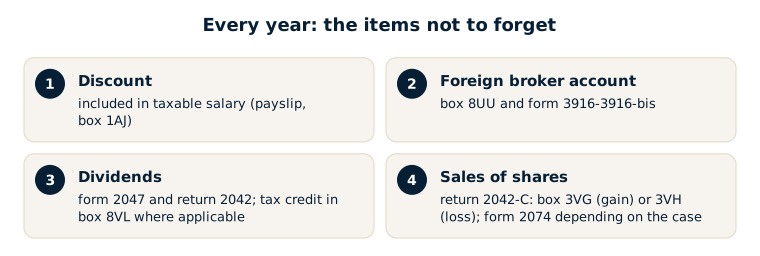
- The foreign broker account in which the shares are held is in principle an account opened abroad: it is declared every year with box 8UU and a form 3916-3916-bis. See the guide form 3916: how to declare a foreign account, step by step.
- Dividends paid on the shares are taxable in France: they are declared on form 2047 and then return no. 2042, with, where applicable, a tax credit provided for by the tax treaty (for example, for US shares, a credit equal to the tax withheld in the United States, up to 15%). See the page declaring foreign dividends in France.
- High earners may also be concerned by the exceptional contribution on high incomes and, depending on the year, by the differential contribution.
What I see in my cases
Like the other employee share plans I handle, ESPPs are rarely managed properly at employer level: payroll steps in France are not always carried out, and the errors then need to be corrected intelligently, without creating a tax problem. When the employee has worked in several countries, removing from the French tax base the portion not taxable in France is often a significant issue.
The tax authorities know these plans poorly. I therefore make sure returns are perfectly clear, and that the file is ready to answer simply if questions arise: the real work is not filling in boxes, but optimising the situation and securing it.
Each ESPP has its own particular features, specific to each company’s plan: as is often the case in this area, the devil is in the details. When the tax authorities ask questions, they mainly ask for the bank statements relating to the sales, sometimes the plan itself; as these subjects are unfamiliar to them, explanatory work is often necessary. Finally, clients sometimes consult me after a reassessment that has cost them a benefit: putting the situation right remains possible in some cases, not in all, hence the value of being advised from the outset.
The most common mistakes
- Believing that the discount is not taxable because the shares have not yet been sold.
- Calculating the capital gain from the price paid instead of the value on the purchase date, and thus paying tax twice on the discount.
- Forgetting to convert the purchase price and the sale price into euros, each at the exchange rate on the day of the transaction.
- Forgetting to declare the foreign broker account on form 3916.
- Forgetting the dividends, or the tax credit they may give rise to.
- Not declaring a capital loss, which could have reduced future capital gains.
- Overlooking the consequences of arriving in or leaving France during the offering period.
FAQ
Is the discount on my ESPP taxable if I have not sold my shares?
In principle yes: the discount is an employment-related benefit, taxed in the year the shares are purchased, even if they are kept. The later sale only concerns the capital gain made above the value on the purchase date.
Why does my payslip show an amount relating to the ESPP?
Because the French employer generally includes the discount in the salary for the month of purchase, in order to apply social contributions and withholding tax. This amount is not an extra sum paid to you: it is the value of the benefit obtained.
Which price should be used to calculate the capital gain?
In principle the value of the shares on the purchase date (price paid plus the discount already taxed), converted into euros at the exchange rate on the purchase date. The broker’s statements generally show this value; it is useful to keep them.
I sell my shares as soon as they are purchased: is there still any tax?
The discount in principle remains taxed as salary. On the other hand, the capital gain is then small or nil, since the sale price is close to the value on the purchase date; it is nevertheless declared, as is any capital loss resulting from fees or exchange rates.
Must my foreign broker account be declared?
In principle yes, every year, with box 8UU and a form 3916-3916-bis, even if the account only contains shares in your employer and even if there has been no sale.
I arrived in France during the offering period: is the whole discount taxable in France?
Not necessarily: the share taxable in France may depend on the period of work in France and on the applicable tax treaty. These mobility situations deserve a case-by-case analysis by a lawyer.
Reference texts
- French General Tax Code: Articles 79 and 82 (salaries, wages and benefits), Articles 150-0 A and 150-0 D (capital gains on the sale of securities and acquisition price), Article 200 A (flat tax), Article 1649 A (accounts opened abroad).
- French Social Security Code: Article L242-1 (basis of contributions), Articles L136-6 and L136-8 (social levies on investment income and their rates).
- 2026 Social Security Financing Act (increase in CSG on investment income).
- Tax treaty applicable between France and the State of the parent company, for dividends.
The wording of the plan, an offering period overlapping an arrival or a departure, a discount missing from the payslips, several purchases and sales to reconstruct: every ESPP deserves a precise analysis. Maître Uzan, a tax lawyer in Paris, analyses your plan and your career path, and helps you declare the discount, the sales, the dividends and the broker account correctly. See also the page on French tax on foreign RSUs and stock options, or book an appointment.