Have you kept an account in your home country, opened an account with a European neobank, received shares from your employer in an account with a foreign broker, or taken out a life insurance policy abroad? If you are tax resident in France, these accounts must in principle be reported every year to the French tax authorities, with your income tax return, using form 3916-3916-bis, often simply called “form 3916”.
This form is intimidating, although it is actually fairly short. This guide explains it step by step, without jargon: who is concerned, which accounts are covered, where box 8UU is, what to know about each part (the “sections” of the form), with concrete examples. It also shows what the form does not do: it does not calculate any tax, and the income from the accounts is declared elsewhere.
In brief
- Persons whose tax domicile is in France in principle declare every year the accounts opened, held, used or closed abroad: their own, those of their spouse or civil partner (PACS) and those of their dependants.
- This covers bank accounts, accounts with foreign neobanks, brokers or payment institutions, digital asset (cryptocurrency) accounts and life insurance or capitalisation contracts taken out abroad.
- The declaration is made with the income tax return: box 8UU (bank and digital asset accounts) or 8TT (life insurance), then one form 3916-3916-bis per account.
- The form mainly asks for identification details: account number, type, opening and closing dates, name and address of the institution, use, holder or power of attorney. No balance is requested for a bank account.
- Declaring an account does not in itself create any tax; the interest, dividends or capital gains of the account are declared separately.
- An omission is in principle subject to a fine of €1,500 per account (€750 for a digital asset account). Before taking any corrective step, it is advisable to consult a lawyer to analyse your situation.
Contents
- 1. What exactly is form 3916?
- 2. Who must fill in form 3916?
- 3. Which accounts must be declared?
- 4. When and how to declare?
- 5. Form 3916-3916-bis, section by section
- 6. A complete example: Claire and Marc’s household
- 7. Declaring the account is not enough: its income is declared too
- 8. What are the risks of an omission, and what can be done?
- The most common mistakes
- FAQ
- Reference texts
1. What exactly is form 3916?
Form no. 3916-3916-bis (Cerfa no. 11916) is an information return. It lets the French tax authorities know that a French resident has an account outside France. It is not used to pay any tax and, for a bank account, contains neither the balance nor the transactions of the year.
This obligation comes from Article 1649 A of the French General Tax Code (CGI) for bank accounts, Article 1649 bis C for digital asset accounts and Article 1649 AA for life insurance contracts. It has existed for a long time, but it has taken on new importance since foreign banks began automatically sending information on their clients: this is the automatic exchange of bank account information between tax administrations, in which France has taken part since 2017. In practice, the tax authorities can often know that an account exists; form 3916 allows taxpayers to declare it themselves, as the law provides.
A word of vocabulary: a “French tax resident” is a person whose home, main place of stay, main activity or centre of economic interests is in France (Article 4 B of the CGI). Nationality does not count. If in doubt, see our article can you be tax resident in two countries?
2. Who must fill in form 3916?
The obligation in principle concerns individuals whose tax domicile is in France, as well as associations and non-commercial companies established in France. For an individual, it covers the whole tax household:
- yourself;
- your spouse or civil partner (PACS), if you file your income tax return jointly;
- your children and other dependants, as well as adult children attached to your tax household.
An account may have to be declared in several capacities. The most common is being its holder, alone or with another person (joint account). But an account is also covered when you are its beneficial owner, that is to say its real beneficiary, or when you use it under a power of attorney, meaning that you carried out at least one transaction on it during the year, for example to pay the expenses of an elderly parent abroad. These last two situations often raise delicate questions, which call for a case-by-case analysis.
Conversely, a person who is not tax resident in France (for example an expatriate living outside France) does not in principle have to fill in this form for their accounts.
3. Which accounts must be declared?
The rule is broad: in principle it covers all accounts opened, held, used or closed during the year with an institution established outside France that habitually receives funds or securities on deposit. The diagram below summarises the reasoning.
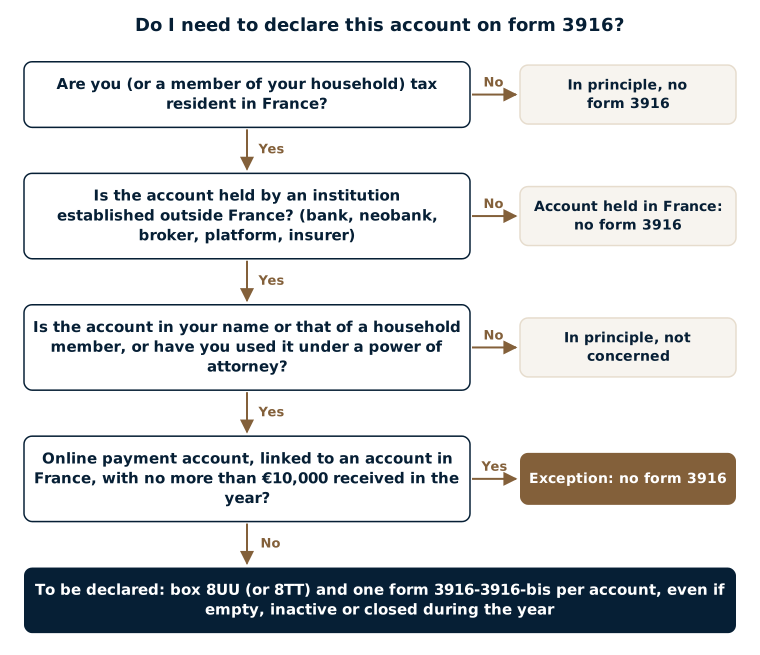
The accounts concerned, in practice
- Traditional bank accounts: current account, savings account, term deposit, foreign currency account, with a foreign bank.
- Accounts with a foreign neobank or payment institution (online banking apps established in another country), see our article on Revolut, N26, eToro, Wise or Degiro accounts.
- Securities and brokerage accounts abroad, including the account opened with a foreign broker to receive free shares, RSUs or stock options from an employer (see our page on the French tax on foreign RSUs and stock options).
- Digital asset accounts opened with a platform established abroad (also box 8UU, section 4 of the form).
- Life insurance or capitalisation contracts taken out with a foreign insurer (box 8TT, section 7 of the form).
The amount changes nothing: an almost empty account, a “dormant” account without any transaction, or an account closed during the year must in principle be declared for the year concerned. A closed account is declared one last time for the year of its closure, with the closing date, and then disappears from the following returns.
The exception for small online payment accounts
A foreign account does not have to be declared when three conditions are met at the same time:
- it is used to pay for online purchases or to collect the price of sales of goods made online;
- it is linked to an account opened in France (it cannot operate without it);
- the sums received over the year do not exceed €10,000.
This is typically the case of a payment account used for a few purchases on the internet and linked to your French bank account. If one of the conditions is missing, for example because the receipts exceed €10,000 in the year, the account in principle becomes declarable again.
What is not a foreign account
- An account opened in France with a French bank, even if it is denominated in dollars or pounds.
- A cryptocurrency key or wallet that you keep yourself (without a platform), which is not an account opened with an institution: in principle it does not come within form 3916-3916-bis, which does not exempt you from declaring any capital gains (see our page declaring crypto gains in France).
For borderline cases (account of a company of which you are a director, account of a foreign structure, neobank with a French IBAN…), the answer depends on the circumstances. Our article which foreign bank accounts must be declared? gives other examples.
4. When and how to declare?
The form is filed at the same time as the income tax return, in the spring, before the deadline set for your département. It concerns the past year: in 2026, the accounts opened, held, used or closed in 2025 are declared.
Step 1: box 8UU or 8TT
On income tax return no. 2042, two boxes indicate the existence of accounts abroad:
- box 8UU for bank accounts and digital asset accounts;
- box 8TT for life insurance or capitalisation contracts taken out abroad.
In the online return, these boxes appear among the miscellaneous information; once the box is ticked, form 3916-3916-bis opens as an appendix, to be completed account by account. The box is sometimes already ticked by the tax authorities, because they have received information from a foreign bank: our article on the pre-ticked box 8UU or 8TT explains what this means.
Step 2: one form per account
Each account has its own form. With three accounts abroad, the household therefore in principle completes three forms 3916-3916-bis. For a paper return, the form (which can be downloaded from impots.gouv.fr) is attached to return no. 2042.
The following diagram summarises the process each year.
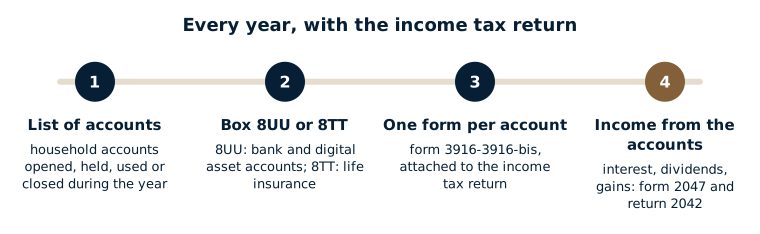
5. Form 3916-3916-bis, section by section
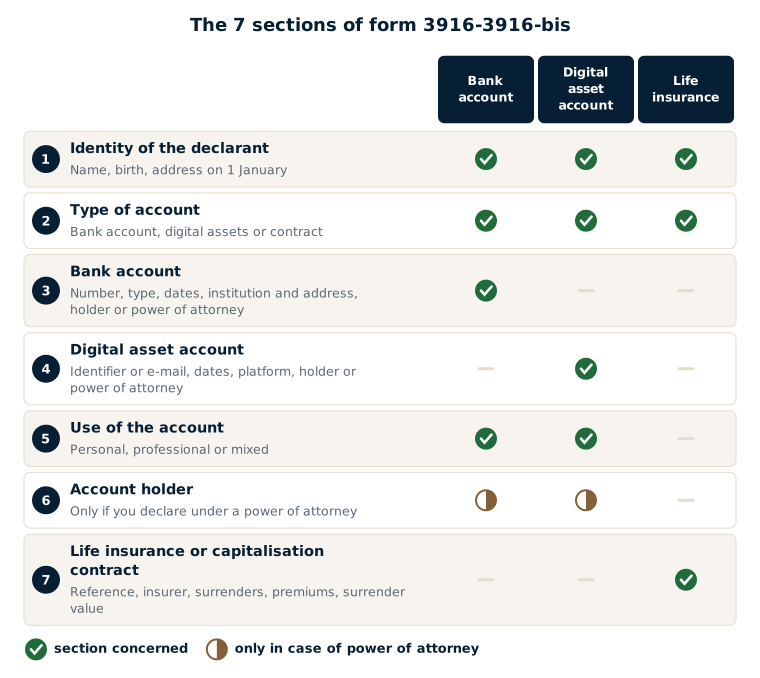
The form is divided into seven “sections” (“cadres” in French). They are not all completed: it depends on the nature of the account. The diagram below shows which sections concern which type of account.
Section 1: identity of the declarant
This section contains the surname, first names, date and place of birth, and address on 1 January of the person declaring the account: the holder, the person holding a power of attorney or the policyholder of the contract. If the account belongs to a member of the household (your spouse, a dependent child), it is in principle that person’s identity that is concerned. The items on legal form and SIRET number only concern sole traders for a business account and associations or companies.
Section 2: type of account
Three possible choices: bank account (sections 3 and 5 are then completed), digital asset account (sections 4 and 5) or capitalisation contract or similar investment, in particular life insurance (section 7).
Section 3: the bank account
- Account number: generally the IBAN, or the number shown on the statements.
- Characteristics of the account: current account, savings account or “other” (for example a securities account).
- Opening date and, where applicable, closing date: they generally appear on the account opening agreement, the statements or the closing letter; the institution can provide them.
- Name and address of the managing institution: the exact name of the bank or institution that keeps the account, and its address (number, street, city, country).
- Holding arrangement: “holder in own right” if the account is in your name (alone or as a joint account), or “holder of a power of attorney” if you can only use it.
Section 4: the digital asset account
For a cryptocurrency account opened on a platform established abroad, the form asks for the account number or identifier (or the e-mail address used to open it), the opening and closing dates, the platform (to be chosen from the list provided or entered: name, address, website) and the holding arrangement. Our article on declaring foreign cryptocurrency accounts covers this case in detail.
Section 5: use of the account
- Exclusively personal use: this is the case for the vast majority of individuals, including employees who receive their salary on it.
- Exclusively professional use: account used by a sole trader (trader, craftsman, liberal profession, farmer) for their business.
- Mixed use: account used both for private life and for the professional activity.
Section 6: the account holder, in case of power of attorney
This section is only completed if you declare an account as the holder of a power of attorney. It then identifies the real holder of the account: a person (surname, first names, date and place of birth, address) or a company (name, legal form, address of the registered office).
Section 7: the life insurance or capitalisation contract
For a contract taken out with a foreign insurer, more information is requested: name and reference of the contract, name and address of the insurer, effective date and term, partial or total surrenders during the year, premiums paid and surrender value on 1 January. See our article foreign life insurance policies: how to declare them.
6. A complete example: Claire and Marc’s household
Claire and Marc are married, tax resident in France, with a 15-year-old son, Léo. In 2025, the household had the following accounts. Here is how each account is in principle handled in the 2026 return.
| Account | To be declared? | Box and sections |
|---|---|---|
| Claire’s current account with a Spanish bank, kept since her studies in Madrid (balance: €300) | Yes, even with a low balance | 8UU; sections 1, 2, 3 and 5 (personal use) |
| Claire and Marc’s joint account with a neobank established in Lithuania | Yes, once for the household | 8UU; one form, holder in own right |
| Marc’s securities account with a US broker, where his employer’s shares are deposited | Yes | 8UU; section 3 (characteristics: “other”) |
| Léo’s savings account in Belgium, opened by his grandparents | Yes: Léo is a dependant, his account is part of the household | 8UU; one form in Léo’s name |
| Account in Portugal of Marc’s mother, on which Marc holds a power of attorney and which he used during the year to pay her bills | Yes, in principle, as holder of the power of attorney | 8UU; sections 3 (holder of a power of attorney) and 6 (his mother’s identity) |
| Claire’s online payment account, linked to her French account, €1,200 received during the year for sales of second-hand items | In principle no (exception of the three conditions) | — |
| Marc’s account in the United Kingdom, closed in March 2025 | Yes, one last time | 8UU; closing date indicated |
The household will therefore tick box 8UU and in principle complete six forms 3916-3916-bis. The income from these accounts (interest on the savings account, dividends on the shares) is declared elsewhere, as explained below.
7. Declaring the account is not enough: its income is declared too
Form 3916 only says “this account exists”. The income it produces is taxable in France if you are tax resident there, and is declared according to its own rules: foreign interest and dividends on form 2047 and then return no. 2042, with, where applicable, a tax credit provided for by the tax treaty (see our page declaring foreign dividends in France), capital gains on the sale of securities, etc. Our article foreign income: which returns to file in France? reviews these obligations.
8. What are the risks of an omission, and what can be done?
An omission is common, often in good faith: an old account, a forgotten power of attorney, a neobank account opened for a trip. The consequences provided for by law can nevertheless be significant:
- a fine of €1,500 per undeclared account and per year, increased to €10,000 when the account is located in a State or territory that has not concluded with France an administrative assistance agreement giving access to banking information (Article 1736, IV of the CGI); the same amounts apply to life insurance contracts;
- for a digital asset account, a fine of €750 per undeclared account (or €125 per omission or inaccuracy), increased to €1,500 (or €250) when the value of the accounts exceeds €50,000 during the year;
- if income from the account has not been declared, the corresponding tax, with late-payment interest and, depending on the case, surcharges;
- a reassessment period extended to ten years (Article L169 of the French Tax Procedure Code), except in particular when the total balances of the accounts concerned remained below the €50,000 threshold provided for by law: see our article on limitation periods.
The details of the penalties are set out in our article what fines for failing to declare a foreign account?
Before taking any step, it is advisable to consult a lawyer to analyse your situation and determine the most appropriate actions. Depending on the case, filing the missing forms 3916 and, if income was omitted, an amended return may be an appropriate solution; in other situations, particularly when the amounts are large or several years are concerned, a carefully prepared regularisation may be preferable. The choice depends on the origin of the funds, the amounts, the years concerned and whether an audit is under way. Our articles forgot to declare a foreign account: what to do? and request to regularise an undeclared foreign account present these options.
The most common mistakes
- Thinking that an empty, inactive account or one closed during the year does not have to be declared.
- Forgetting the accounts of the spouse, of dependent children or those on which one holds a power of attorney.
- Believing that a banking app is not a bank: many neobanks and online brokers are established outside France.
- Forgetting the account of the foreign broker that holds the shares awarded by the employer.
- Ticking box 8UU without completing a form for each account, or grouping several accounts on a single form.
- Thinking that form 3916 is enough and not declaring the interest or dividends of the account.
- Declaring the account one year, then forgetting it the following year: the declaration is renewed every year as long as the account exists.
FAQ
I only have a few euros in an old account abroad: do I really have to declare it?
In principle yes. The obligation does not depend on the balance: an almost empty account or one without any transaction remains an account that is “held”. Moreover, the form does not ask for the balance of a bank account. Depending on your situation, closing an account that is no longer useful may also be considered; it will then be declared one last time for the year of its closure.
My foreign account was closed last year: must it still be declared?
In principle, an account closed during a year is declared one last time for that year, with its closing date. It no longer appears in the returns for the following years.
My spouse and I have a joint account abroad: one declaration or two?
When both holders belong to the same tax household, the account is in principle declared once, on one form, with the joint return. If the joint holder belongs to another tax household (a brother, a business partner, an adult child who is not attached), each household in principle declares the account on its own side.
Must my online payment account be declared?
It is in principle exempt from declaration when it is used for online purchases or sales, is linked to an account opened in France and the sums received during the year do not exceed €10,000. If one of these conditions is not met, it in principle becomes declarable again.
My neobank has given me a French IBAN: is my account still a foreign account?
It all depends on the institution that actually keeps the account, in France or abroad. An IBAN beginning with FR is an indication, but it is not always enough to decide. If in doubt, it is useful to check the general terms and conditions of the account and to seek a lawyer’s advice; mentioning an account that did not need to be mentioned is in principle not penalised.
Does form 3916 mean that tax has to be paid?
No: it is an information return. It is the income from the account (interest, dividends, capital gains) that may be taxable in France, and it is declared separately, in particular on form 2047 and return no. 2042.
My children have accounts abroad opened by their grandparents: who declares them?
The accounts of dependent minor children, like those of attached adult children, are part of the tax household: they are in principle declared with the parents’ income tax return, one form per account.
Reference texts
- French General Tax Code (CGI): Article 1649 A (accounts opened, held, used or closed abroad), Article 1649 bis C (digital asset accounts), Article 1649 AA (life insurance and capitalisation contracts), Article 1736, IV and X (fines), Article 4 B (tax domicile).
- Annex III to the CGI: Articles 344 A to 344 C (content of the declaration of accounts and contracts) and Articles 344 G decies et seq. (digital asset accounts).
- French Tax Procedure Code (LPF): Article L169 (ten-year reassessment period).
- BOFiP: BOI-CF-CPF-30-20 (declaration of accounts opened, held, used or closed outside France).
- Form no. 3916-3916-bis (Cerfa no. 11916) and its notice, impots.gouv.fr.
Every situation has its own features: an old account never declared, a power of attorney, an account of a company or a foreign structure, undeclared income. Maître Uzan, a tax lawyer in Paris, analyses your situation, helps you complete your returns and, if an omission is found, examines with you the most appropriate solutions. See also our page declaring a foreign bank account in France (form 3916) and our article holding foreign accounts: the guide, or book an appointment.