
Obligations, Returns, Regularisation, Risks and Penalties
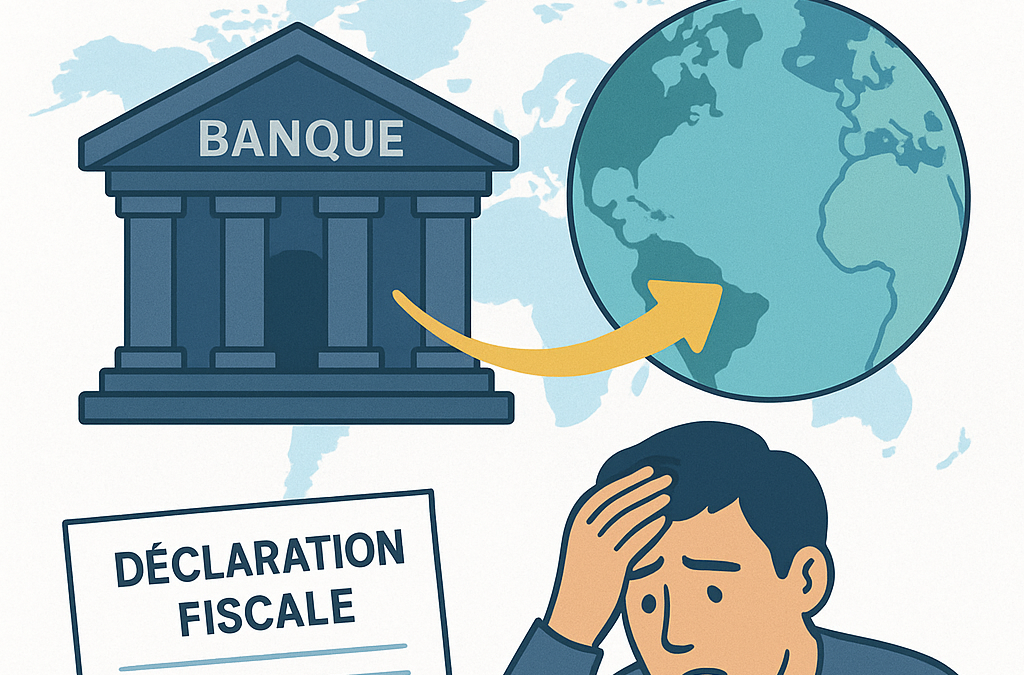
The obligation to declare foreign accounts has existed for a long time.
Income from accounts opened, held, used or closed abroad is, moreover, in principle taxable in France.
However, the obligations associated with holding foreign accounts are not always obvious to taxpayers, who are very often unaware of their obligations, at their own risk and peril…
It is therefore important to analyse your tax situation carefully, all the more so if you notice that box 8UU on your tax return form is pre-ticked.
When the French tax authorities (administration fiscale) have received information revealing that you hold one or more foreign accounts, this box is in principle automatically ticked by the tax authorities.
Subject to exceptions, you must then use form no. 3916 3916-bis to declare the foreign accounts, and form 2047 to declare taxable foreign income.
Find out about your legal obligations and the steps you need to take to declare accounts abroad.
Discover the risks incurred in the event of non-declaration and the penalties provided for.
There are also solutions that allow you to regularise your situation with the tax authorities.
Focus on the Regulations Governing the Holding of Foreign Accounts
As part of the fight against tax fraud, the public authorities have put in place numerous rules. This effort began with the circular of 21 June 2013, and it continues to intensify. Today, more and more foreign countries are transmitting and sharing banking information with the French tax authorities (on this subject, we can note that several are very active in this respect, in particular: Portugal, Israel, Spain, the United Kingdom, Switzerland, Luxembourg). The data shared generally indicates the account opening dates, the account balances, the account numbers, any income generated, etc.
French tax residents are required to declare accounts opened, held, used or closed outside France.
Article 4 B of the French General Tax Code (Code général des impôts, CGI) specifies which persons are considered to be tax resident in France. They are:
– Those who live in France;
– Those whose economic interests are mainly located in France;
– Those who carry on their main professional activity in France, whether salaried or not;
– Those whose household (spouse, children…) or main place of residence is in France.
Reporting Obligation: Which Foreign Accounts Are Concerned?
First of all, it should be noted that only French tax residents are concerned by the declaration of all foreign accounts. Since 1 January 2019 (Law no. 2018-898 of 23 October 2018), even unused accounts must be declared every year: even in the absence of any banking transaction on the accounts, the reporting obligation still applies.
The reporting obligation, which applies first and foremost to the account holder, also concerns persons to whom the holder has granted a power of attorney over the foreign account. The beneficial owners of these accounts must also declare them.
The reporting obligation covers bank accounts, capitalisation contracts, various investments, but also savings products, life insurance contracts taken out abroad, trading accounts, and accounts on foreign cryptocurrency platforms…
The declaration of each account must include the following information: the number of the account or contract to be declared, the name of the financial institution with which the account was opened, its address, and the opening date. The closing date must also be specified if the account was closed during the tax year.
The obligation to declare foreign accounts is not a new rule. It is in fact very old.
Inactive and dormant accounts have had to be declared since 1 January 2019.
Please note that some accounts you have opened may be located abroad. Many taxpayers do, in fact, hold foreign accounts without knowing it. For example, there are neobanks, which have developed apps and offer online management solutions.
Thus, if you have opened, held, used or closed an account with N26, Monese, Bunq or Revolut, for example, remember to declare them on form no. 3916. Accounts you opened in 2022 will have to be declared in 2023.
PayPal accounts are also in principle subject to the foreign account reporting obligations. Indeed, the head office of this institution is located in Luxembourg. That said, you can in principle benefit from an exemption from declaration if you only use the account for online payments. This exemption from declaration is granted if the account is used only to pay for purchases and to collect proceeds from the sale of goods. The PayPal account must be linked to an account opened in France. Finally, the total amount of sums collected (credited) during the reference year must not exceed 10,000 euros.
Accounts opened on trading platforms specialising in crypto-asset exchanges are among the foreign accounts that must be declared. Note that form no. 3916 Bis must be used to declare foreign cryptocurrency accounts. As with form no. 3916, you will need to indicate the account name, the name of the exchange platform, the address, the number and any other information about the account (opening date or closing date, if applicable).
Understanding the Taxation of Foreign Accounts to Be Declared
Declaring foreign accounts in accordance with the legislation in force does not mean that they will all systematically be taxed. Indeed, only certain categories of income from your accounts are taxable: mainly dividends, interest, capital gains and rents generated in a foreign country, as well as salaries and other professional income.
Depending on the agreements signed between France and the foreign country concerned, there may also be other types of income that can be taxed. These are less common types of income; however, if you overlook them, you expose yourself to penalties that can sometimes be heavy. Do not hesitate to contact a tax lawyer to better analyse your situation in light of the applicable tax treaty.
All income credited to bank accounts must be declared by completing form no. 2047 and/or form no. 2074 (for capital gains). Form no. 2074 is used to calculate the taxable capital gains and losses for the reference year. It makes it possible to determine the overall capital gain and thus to determine the tax. Form 2074 ABT may also be used to calculate any allowance applicable to you. Furthermore, in certain cases, in particular where your capital gains have been calculated by your foreign banking institutions, there is in principle an exemption from filing form 2074, the taxable capital gain then being reported directly and solely on forms 2042 / 2042 C.
Regularising Your Situation in the Event of Non-Declaration
If you have not declared your foreign accounts within the deadlines set by the tax authorities, it is in principle still possible to carry out a voluntary regularisation of your situation. Most of the time, preparing a regularisation file in the event of non-declaration of foreign accounts is a tedious, complex and time-consuming process. It also requires sound technical knowledge of French tax mechanisms in an international context.
In particular, the following key points need to be analysed:
1- Which Taxes Need to Be Regularised?
When you have received income, you must in principle pay income tax (subject to international tax treaties).
If the value of your assets exceeds the taxation threshold, you will also need to consider the wealth tax (Impôt sur la Fortune, ISF), replaced by the real estate wealth tax (Impôt sur la Fortune Immobilière, IFI).
It is also important to take into account the origin of the funds and, where applicable, any gift duties or inheritance duties that were “forgotten” (when the funds originate from a gift or a foreign inheritance, French tax residents very often fail to declare it in France, even though the gift or inheritance was in fact taxable in France).
2- Taxation Arrangements in the Event of Regularisation
The period to be regularised and the taxation arrangements vary in particular according to the total balance of the accounts concerned:
– Where the balance of the accounts is below 50,000 euros, the statute of limitations (délai de reprise) is in principle set at 3 years. On the other hand, if the balance exceeds this threshold, the statute of limitations is in principle 10 years;
– If you are subject to IFI (real estate wealth tax), and the stated deadlines are not met, you will have to pay an 80% surcharge. However, in most cases and subject to a sincere and well-constructed regularisation file, the rate of this surcharge may, depending on the case, be reduced to 40%;
– If you forget to declare accounts holding substantial assets, you are in principle exposed to heavy penalties in the event of a tax audit. If you opt for voluntary regularisation, the tax authorities will, in principle, considerably reduce the penalties incurred.
Today, the tax authorities have modern and more effective means of detecting accounts held abroad by French tax residents. It therefore seems increasingly strongly advisable to comply scrupulously with the regulations in force regarding reporting obligations and the payment of taxes.
If you have made a mistake or omitted information in your returns, it is generally preferable to take the necessary steps to carry out a regularisation. Where foreign accounts were not declared at the same time as your income, remember to regularise them as soon as possible. If you are not familiar with the applicable procedures and rules, entrust this task to a tax lawyer. You will generally avoid heavy penalties in the event of a tax reassessment, and your penalties will very often be greatly reduced.
3- How Do You Know That You Need to Regularise?
Since 2018, the French tax unit dedicated to the voluntary regularisation of accounts abroad has no longer been in operation. Nevertheless, taxpayers can still carry out a voluntary regularisation of their undeclared foreign accounts.
It should be remembered that audits carried out by the tax authorities are increasingly frequent owing to the volume of banking data automatically received. Indeed, more and more information is being transmitted by foreign countries. In general, tax officials contact taxpayers to remind them of their obligations concerning their foreign accounts. At this stage, this is not yet an audit strictly speaking, but a kind of warning to encourage them to carry out a voluntary regularisation.
Taxpayers then receive one or more letters bearing the number 751-SD from an income and wealth audit unit (Pôle de Contrôle des Revenus et du Patrimoine, PCRP). This information appears at the top right and left of the page on the letter received.
If you receive this type of letter, it seems very strongly advisable to seek the assistance of a tax lawyer from the very start of the procedure. The file to be put together is indeed often heavy and complex, and numerous pitfalls must be avoided.
4- What Does the Regularisation of Foreign Accounts Actually Involve?
The taxpayer regularises undeclared foreign accounts when they decide to fulfil their tax obligations in order to comply with the regulations in force in respect of their past returns. The past returns will therefore be corrected and amended to include the foreign accounts and income. The taxpayer must initiate this regularisation procedure voluntarily. In other words, they must approach the tax authorities to declare, of their own accord, the assets they hold abroad. This step must be taken before any tax audit. Receipt of a 751-SD letter does not mark the start of a tax audit in the legal sense, so the regularisation process remains legally voluntary.
To begin with, the person must put together a sincere, complete and properly constructed foreign account regularisation file. The finalised file is then filed or sent to the departmental tax office to which the taxpayer reports (in the case of an entirely voluntary approach) or to the tax office that issued the 751-SD letter (where such a letter has been received). It should be remembered that receipt of the 751-SD letter requesting regularisation does not yet legally constitute a tax audit. If the regularisation process is undertaken after receipt of this letter, the voluntary nature of the process remains legally valid. In practice, receipt of this letter is regarded as the taxpayer’s last chance to carry out a voluntary regularisation. If they take no steps to regularise their situation, they incur heavy penalties. The tax authorities will generally contact the foreign bank directly so that all the statements are provided to them. The tax authorities will then correct the returns themselves, often with very serious consequences in terms of reassessments.
When preparing the regularisation file, all bank accounts and insurance contracts abroad must be mentioned. The file must indeed be sincere. Even foreign accounts not mentioned in the 751-SD letter must in principle also be regularised.
The regularisation procedure will, however, be very complicated, or rather very risky, in the – relatively rare – case where the taxpayer holds assets or funds generated by concealed or illegal activities. In such a case, there will indeed be a risk that the situation is characterised by the tax authorities as tax fraud, with all the possible criminal and tax consequences.
Once the regularisation is complete, the taxpayer will have to file the 3916 3916-bis forms again every year, together with the foreign income returns. All French tax residents with accounts opened, held, used or not, and closed abroad are indeed required to complete forms no. 3916 and no. 3916 Bis every year, at the same time as their income tax return, even if these forms have been completed in the past (this may seem a little silly, but the forms must be completed again every year).
5- How to Regularise Accounts Abroad
The difficulties encountered in completing the regularisation steps often discourage the taxpayers concerned. Indeed, first of all, it is generally difficult to find the supporting documents required to put together the regularisation file. However, it should be borne in mind that the penalties provided for in the event of a tax reassessment can be very heavy.
It therefore seems advisable to make this effort, in the taxpayer’s own interest. The documents may also be requested from the foreign banks, which are very often able to provide them for a 10-year period, even if the banks charge fees, sometimes quite high ones, for searching for the documents.
This is why regularisation should be carried out as soon as possible, as soon as you realise that you have forgotten to declare one or more foreign accounts. The assistance of a tax lawyer will enable you to benefit from all the favourable measures (tax credits, etc.), to put together a perfectly accurate and complete file and, above all, to avoid pitfalls that can be very costly… You will also limit the risk of possible errors that would then have to be corrected, with difficulty, later on.
Thanks to their very comprehensive tax knowledge (national and international), the assistance of a tax lawyer on this particular type of file aims to ensure that the regularisation file complies with the applicable regulations, which are often complex. You will also be able to take advantage of all the benefits to which you may be entitled: these include, among others, the foreign tax credit and a reduction of the penalties provided for (fines, surcharges, late-payment interest) provided that the file submitted is sincere and complete.
The involvement of a tax lawyer is not, however, mandatory. You can perfectly well work alone, or with a chartered accountant, for example, or any other professional who seems to you to be competent in this type of matter.
Indeed, in the case of small accounts, the steps are generally relatively simple and accessible when you can substantiate the origin of the assets held abroad. However, the involvement of a specialist lawyer will considerably facilitate the process and help you benefit from the applicable provisions.
6- A Procedure Applicable, Subject to Exceptions, to the Ten Years Preceding the Date of Regularisation
When a taxpayer initiates a procedure to regularise accounts abroad, the process must in principle cover the preceding decade. They are in principle required to analyse their situation carefully by listing the accounts opened, held, used or closed for each year during this period.
For example, if you decide to launch a regularisation in 2022, your process will in principle have to cover all accounts opened, used, inactive or closed since 2012: income tax from 2012 to 2021 inclusive, ISF from 2012 to 2017 inclusive, IFI from 2018 to 2022 inclusive. You will therefore not have to include the year 2011 and the years before it. Indeed, it is the legal rule of the statute of limitations (prescription) that applies and releases you from your obligations in respect of those years, which are time-barred. You are therefore no longer liable to a tax reassessment in respect of those years.
But be careful: the origin of the funds must always be justifiable, because it is not subject to the legal statute of limitations. In other words, if you are unable to prove the origin of the funds held in an account, you are not protected from punitive reassessments on all the assets, even if they are income received more than a decade ago.
Substantiating the origin of the funds does not simply mean providing explanations about the origin of the assets (a gift from an aunt, an inheritance from a parent, a capital gain on a foreign asset, etc.) but first and foremost being able to provide supporting documents: documents that back up your explanations (deed of gift, deed of succession, deed of sale, etc.). Of course, in cases where the origin of the funds is very old, the tax authorities will in principle be rather flexible regarding supporting documents, but a total absence of documents will in principle never be accepted by the tax authorities. At the very least, you will need, if not perfectly conclusive documents, a body of documents corroborating your statements: the foreign death certificate of the parent whose estate is claimed, a record of a transfer on a bank statement from the deceased parent’s account, an official document, even a very basic one, referring to the foreign inheritance, etc. Each case is specific.
When the tax authorities step in to initiate a regularisation tax reassessment, several parameters are taken into account. They check whether the taxpayer is liable to ISF or IFI. They also examine the income generated abroad. The origin of all the funds is carefully checked in order to determine whether it consists of professional income, rental income, an inheritance, a gift…
When the foreign account regularisation file is well prepared, the penalties may, depending on the case, be reduced. The surcharges applied in the context of a tax audit are 80%. But with a solid regularisation file, they may, depending on the case, be lowered to 40%.
It should be noted that the foreign account regularisation file may concern a wide range of taxes: wealth tax (ISF), real estate wealth tax (IFI), income tax, social security contributions (prélèvements sociaux), inheritance duties, gift duties…
The surcharge is calculated on the total amount of the tax reassessment. Thus, if after correction of the returns the taxpayer has to pay, for example, additional wealth tax of 200 euros, the total amount payable will be 200 euros of tax + 40% surcharge = 200 euros + 80 euros = 280 euros. Late-payment interest will be added to this (at a rate of 2.40% per year since 1 January 2018, i.e. 0.20% per month; 4.80% per year for earlier periods).
What If the Taxpayer Does Not Regularise Their Situation?
Where the taxpayer still does not declare their accounts and does not regularise their foreign accounts despite the 751-SD letter, the first action of the tax authorities will generally be to request the taxpayer’s bank statements for the last 10 years directly from the foreign bank. On the basis of these documents, the tax authorities will issue tax reassessments, which are often much heavier than in the case of regularisation.
It should be remembered that all countries that are signatories to the convention facilitating access to banking data are required to comply with the terms of this agreement. Once the tax authorities have gathered the necessary evidence, they send a request for explanations and justifications to the taxpayer. The taxpayer is required to respond as quickly as possible, providing detailed and clear answers. The tax authorities may also launch a more intrusive tax audit through lengthier procedures. The taxpayer will then have to react as quickly as possible.
1- Documents to Be Provided to Present a Complete File
The tax authorities request specific information and documents relating to undeclared accounts. In particular, you will need to state the account number, the financial institution and its address. You will also need to explain your situation (error, omission, etc.) and provide specific documents listed in the request for information letter. These include, among others:
– Documents substantiating the origin of the assets: all documents supporting your explanations as to where the assets came from (notarial deed, bank certificate, bank statement showing the origin of the transfer, etc.);
– A written statement setting out precisely and in detail where the assets you hold abroad come from;
• Regarding income tax, you must produce:
– Amended income tax returns. They must be dated and signed;
– Returns no. 2047 for income received abroad;
– Returns no. 3916 for each account opened abroad;
• Where you are liable to the wealth tax (Impôt de solidarité sur la fortune):
– Initial or amended ISF and/or IFI returns. Dates and signatures must appear on these documents.
• All supporting documents relating to the assets held abroad and to the income making up those assets over the period covered by the filing of amended returns:
– A certificate proving that you are the holder of the account, or the account opening agreement;
– In the event of closure, any document showing a closing financial flow;
– Statements of assets or wealth statements as at 1 January of each reference year or as at 31 December of the preceding year (these documents must be provided for the 10 years covered by the regularisation);
– Annual statements of income provided by the foreign bank or financial institution in order to prove the existence of gains, whether interest, dividends, capital gains or capital losses;
– Bank account statements for the 10 years covered by the regularisation (bearing in mind, however, that they are not systematically requested in 751-SD letters).
If no response is recorded after receipt of this request for explanations, the competent authorities will in principle initiate a tax audit. This procedure is arduous, lengthy and generally results in much larger reassessments.
Where the person is unable to produce the supporting documents needed to prove the origin of the funds held in their accounts, the tax authorities may, in certain cases, apply a 60% tax on their assets. This means that the tax authorities will claim from you 60% of the highest amount of assets held in your accounts over the last 10 years. If, for example, 5 years ago, at the peak of your foreign assets, you had 300,000 euros in your foreign accounts, the tax authorities will claim 180,000 euros, even though your current foreign assets may be much lower as a result of spending over recent years.
It therefore seems strongly advisable to react as soon as you receive a request for information. This is the last opportunity to initiate a regularisation process in order to avoid heavier penalties. Prepare a regularisation file by gathering all the supporting documents requested by the tax authorities.
Once the regularisation request file has been put together, it must be filed with the department that sent the request for information.
2- The Forms to Complete to Declare Income and Accounts Abroad
After this regularisation, the taxpayer must continue to declare these foreign accounts every year, at the same time as they declare their income. Here is the list of forms to be completed:
– Form no. 3916 for foreign accounts;
– Form no. 3916 Bis for crypto-assets (cryptocurrencies) on foreign platforms;
– Form no. 2047 for foreign income;
– Form no. 2074 for capital gains;
– Form no. 2042 for annual income;
– Form no. 2042 C for certain tax credits
– ISF and IFI returns, if you are liable to them
What Are the Penalties for Non-Declaration?
Whether or not it was intentional, penalties are provided for and will be applied. You will have to pay a fine of 1,500 euros per year for each account. This penalty is, however, only applicable over a maximum period of 4 years. The fine is therefore capped at 6,000 euros per account (4 x 1,500 euros) when the current year is not counted. Otherwise, the fine will be applied over 5 years.
Where the non-declaration concerns several accounts, the fines payable can be very high. Where these accounts are opened, held, used and closed in a country that is not a signatory to the convention facilitating access to banking data, this fine is in principle increased to 10,000 euros per year for each account.
If the taxpayer has really done everything possible to conceal their foreign accounts in order to avoid paying tax (a genuinely fraudulent intent), the tax authorities may refer the matter to the public prosecutor (criminal court) to bring proceedings against them. In such a case, they may indeed be charged with tax fraud. Where it is proven that the taxpayer did engage in unlawful conduct, they are liable to very severe penalties. Article 1741 of the French General Tax Code (CGI) provides that the fine payable may be as high as 3,000,000 euros (or even up to twice the proceeds derived from the offence). The criminal court hearing the case may also impose a prison sentence of up to 7 years.
This is also why the reporting obligations relating to foreign bank accounts must be fulfilled within the stated deadlines. In the event of failure to declare, regularising the situation as soon as possible often seems advisable in order to avoid heavy penalties. The assistance of a tax lawyer seems advisable where an error or omission is discovered late. This professional will assess and define the various possible courses of action with a view to regularising your situation. Their involvement will also very often make it possible to reduce fines and surcharges.
The Amended Declaration of Foreign Accounts in Detail
To complete your amended return successfully, you should start by consulting the returns you have already filed in the past in order to supplement them. Take into account all the information provided by your bank abroad so that each form is completed in compliance with the regulations in force.
When the bank sends you the annual income statements, you will find in them the different types of income you have received: interest, dividends, capital gains or capital losses. This income must be declared on forms 2047, 2042, 2074 and 2042 C.
Where the foreign bank has applied withholding tax, this amount will in most cases become a tax credit that will reduce the amount of tax payable in France. When you declare these types of income received abroad and the resulting tax credits, specific reporting rules apply.
The income tax returns will have to be amended to include the foreign income and the tax credits in order to meet the request for “amended income tax returns” that the tax authorities ask you to produce. To begin with, complete the blue form no. 2042, with which you are already very familiar, once again. Then, depending on the foreign accounts and the types of income to be declared, other forms will also have to be completed.
1- Form No. 2047 for Income Received Abroad
You must in principle use return form no. 2047 to declare the income you receive abroad. Foreign income appears both on form no. 2042 and on the return made on form no. 2047. This must be done every year, unless you do not receive any foreign income during the entire year concerned. However, this is an exceptional situation insofar as the contracts signed or accounts opened often generate annual interest. The bank or financial institution pays it into the account or into the life insurance contract.
2- Form No. 3916 3916-bis to Declare Each Foreign Account
For each foreign account opened, held, used or not, or closed, you must in principle complete a form no. 3916 3916-bis. In it, you will state in particular the following information: surname, first names, date of birth, address, details of the bank, the account number, etc. You will also need to specify the date the account was opened and, where applicable, the closing date. However, you do not have to enter the account balance. It should be remembered that a declaration must be made for each account.
An important question must then be resolved before declaring foreign accounts. Indeed, since one form is required for each account, what about sub-accounts? Will you be penalised if you do not declare them on a separate form?
As the fine provided for amounts to 1,500 euros per year for each account, you may be tempted to complete a single form no. 3916 for all your accounts in an attempt to reduce the total amount of fines payable. It is therefore important to understand clearly what a sub-account is in order to avoid making a mistake.
Where the following conditions are met, it would appear that, in most cases, the account can indeed be considered a sub-account: it has the same number root as the main account. Its opening date should in principle be the same as that of the main account. If these criteria are not met, a case-by-case analysis must then be carried out. The involvement of a tax lawyer can help you see things more clearly and better assess your situation, as well as the context of your regularisation request file.
It should be noted that a 3916 3916-bis form must be completed for each year of holding, and even for the year of closure.
For example, if you have opened an account with a bank and you also have a savings account: where, after analysis, this savings account cannot be considered a sub-account, you are in principle required to complete two forms no. 3916 3916-bis every year for these accounts. As the fine is capped at 4 years for each account, you would therefore incur a total fine of [(1,500 euros x 2 accounts) x 4] = 12,000 euros.
There is also an exception worth knowing about. An account may remain unused during certain years: the taxpayer will not pay a fine in respect of those periods provided that they are prior to 2019. An account is considered unused when no transaction (debit or credit) has been recorded during the year. The mere receipt of interest is in principle not regarded as use of the account: the account is then in principle still considered unused.
3- Declaration on Plain Paper for Insurance Contracts Abroad
If you have taken out one or more insurance contracts with a bank established abroad, you must draw up a declaration on plain paper (papier libre) for the years prior to 2020. From 2020 onwards, form 3916 3916-bis is in principle to be used.
4- Drafting a Written Statement on the Origin of the Assets
The written statement on the origin of the assets is one of the most important documents in your foreign account regularisation file. It should be noted that the origin of the assets will enable the tax authorities to determine:
• What your profile is: the tax authorities’ classification grid uses the notions of active fraudster and passive fraudster. The term fraudster may seem somewhat shocking, but this is indeed the terminology that was used by the regularisation unit;
• The extent to which the tax authorities will take an interest in your case: the tax authorities will monitor much more closely a taxpayer who has received undeclared sums from concealed activities. People who have concealed a distant inheritance will in principle be less troubled;
• The question of the double penalty of tax reassessments combined with criminal penalties (a fine only, or with a prison sentence): with the concealment of an inheritance, the risk of receiving a criminal penalty is much lower than in the case of unlawful activities that have generated substantial income over a long period;
• The total amount of the tax reassessments where the taxpayer received concealed income during the assessment period (the decade preceding the regularisation or the tax audit).
Draft a sincere written statement and always avoid lies.
Of course, while sincerity is essential, the truth must be presented with subtlety: you must not “shoot yourself in the foot”.
It should be noted that this written statement is the most important document in your regularisation file. It is advisable to take particular care in drafting this document. It should be noted that the statement on the origin of the assets must be substantiated by documents confirming your version. If the tax authorities consider that the supporting documents provided are insufficient, they will request other documents from you, which you will have to produce and submit to the department requesting them.
5- How to Substantiate the Origin of the Assets?
The tax authorities are entitled to ask taxpayers who have opened undeclared foreign accounts for a written statement substantiating the origin of the assets: this means the assets that are still in those accounts or that were held in them over the last 10 years.
If no supporting documents are submitted, or if they are insufficient to prove the origin of the assets, the tax authorities may claim a 60% tax. This is by virtue of Article 755 of the French General Tax Code (CGI). These duties are calculated on the highest value, known to the tax authorities, of the assets held in the account or life insurance contract during the ten years preceding the sending of the request for information or justifications.
Indeed, Article 755 of the CGI provides that assets held in a foreign account whose origin and terms of acquisition are not substantiated constitute, until proven otherwise, assets acquired free of charge. These assets are subject to gift and inheritance duties (droits de mutation à titre gratuit) at the highest rate (60%) upon expiry of the time limits specified in Article L23 C of the Book of Tax Procedures (Livre des procédures fiscales, LPF).
The tax authorities use the highest value recorded in the accounts over the 10-year period preceding the sending of the prescribed request to calculate the amount of these duties. The same Article L23 C specifies that in the event of non-declaration of a foreign account (at least once in respect of the 10 years), the tax authorities are entitled to request justification of the origin and terms of acquisition of the assets held in the account. Where the justifications are insufficient or non-existent, the 60% tax rate may be applied, by way of a presumption of a transfer free of charge.
The financial burden on the taxpayer is therefore very heavy. This is why it is strongly recommended to keep carefully all documents that make it possible to substantiate the origin of the assets.
• Where the assets derive from an inheritance, you can in principle substantiate them with the following documents: death certificate, deeds issued by foreign professionals, a copy of the will, if any, bank statements showing the origin of the financial flows, bank certificates, etc.
• If these assets come from a gift, you should in principle use the following documents to substantiate them: foreign deeds, bank certificates, private deeds (actes sous seing privé), bank statements proving the origin of the financial flows, etc.
• Where an activity was carried on abroad, you should in principle produce copies of all documents relating to that activity. Payslips, foreign tax assessment notices, certificate of professional registration with the local authorities, tax returns filed abroad…
6- Drafting a Sworn Statement
This document is not always requested in the 751-SD letter.
Where this document is requested, you will have to certify on your honour that the account or accounts you are now declaring in response to the tax authorities’ request for explanations is or are the only ones you have opened abroad. This means that you are no longer concealing any other accounts abroad.
Ask the foreign bank for the following documents to form the basis of your file: annual statements of assets, wealth statements, annual income statements with statements of gains and losses. Also remember to ask for an opening certificate for each account. If you have closed one or more accounts in the meantime, also request the account closure certificates.
Contact your bank to obtain a summary document setting out the annual movements for each year. This summary document should show the balance as at 31 December, the annual amount of each type of income, and its nature: interest, capital gains or losses, dividends, etc.
These documents will make it possible to produce the amended returns, in particular the income returns on form no. 2047 and form no. 2042. They will also help you complete the ISF or IFI (since 2018) returns, if you are liable to these taxes.
7- Bercy Handles Files Involving Assets Above a Certain Amount
Where the assets held in the foreign account exceed a certain threshold, the Ministry of the Economy and Finance (Bercy) takes over. Examine the letter you have received: the department that drafted and sent it is indicated at the top left.
In general, it is the local tax office that contacts you. But where your assets are very significant, the Ministry of the Economy and Finance may sometimes take charge of handling your file.
How to Respond to the 751-SD Letter?
When you receive a letter from the tax authorities, there is no point in panicking. You simply need to avoid “burying your head in the sand” and take matters in hand quickly.
1- What Should You Do?
Take the time to respond to every letter you receive. Prepare a response file with all the supporting documents requested in the letter. Your file must be well presented and all the documents produced must be clear in both substance and form.
Give preference to authentic documents signed and stamped by the bank or financial institution, or by the authorities of the foreign country. All the information requested must be provided in detail.
2- What Should You Not Do?
Avoid leaving letters unanswered and producing an incomplete file. If you are not certain that the information is accurate, do not send it. Do not send incomplete or inaccurate returns. In that case, you can try to obtain an extension of time to respond to the tax authorities, allowing time to put together the necessary file and complete your returns properly.
From a legal standpoint, holding undeclared assets abroad constitutes an offence under tax law. But the public authorities have, for the time being, still given taxpayers holding undeclared foreign accounts the possibility of carrying out a voluntary regularisation in order to benefit from more favourable conditions.
However, bear in mind that this is very often a last helping hand from the tax authorities. Indeed, the regularisation unit operated for 5 years, a relatively long period that gave taxpayers a window for voluntary regularisation. Yet some taxpayers did not seize this opportunity, their image with the tax authorities is therefore rather tarnished, and it is therefore advisable to enter this last-chance regularisation process quickly.
In any event, the tax authorities are, for the time being, still trying to settle the situation amicably by sending out the 751-SD letter. It should be remembered that, at the time this letter is received, the tax audit has not yet been launched from a legal point of view. Through this approach, the tax authorities give the taxpayer one last chance to regularise their situation amicably.
If the response to this letter is unsatisfactory, or if the taxpayer persists in not responding to it or in producing very incomplete documents, the inspector will generally initiate a genuine tax audit, with heavier consequences. The tax authorities may bring proceedings before the competent courts. You risk very high fines and, in certain cases of serious and proven fraud, even a prison sentence. At that stage, it will be much more difficult to defend yourself.
Thus, although the regularisation procedure is tedious and time-consuming, it is strongly recommended not to neglect it. You will thereby avoid heavy tax and sometimes criminal consequences. As the file and the follow-up of the procedure require specialist skills and experience, consider the advisability of entrusting this task to a tax lawyer. The expertise and experience of this professional will help you avoid the errors or pitfalls that would further complicate your situation.





0 Comments