
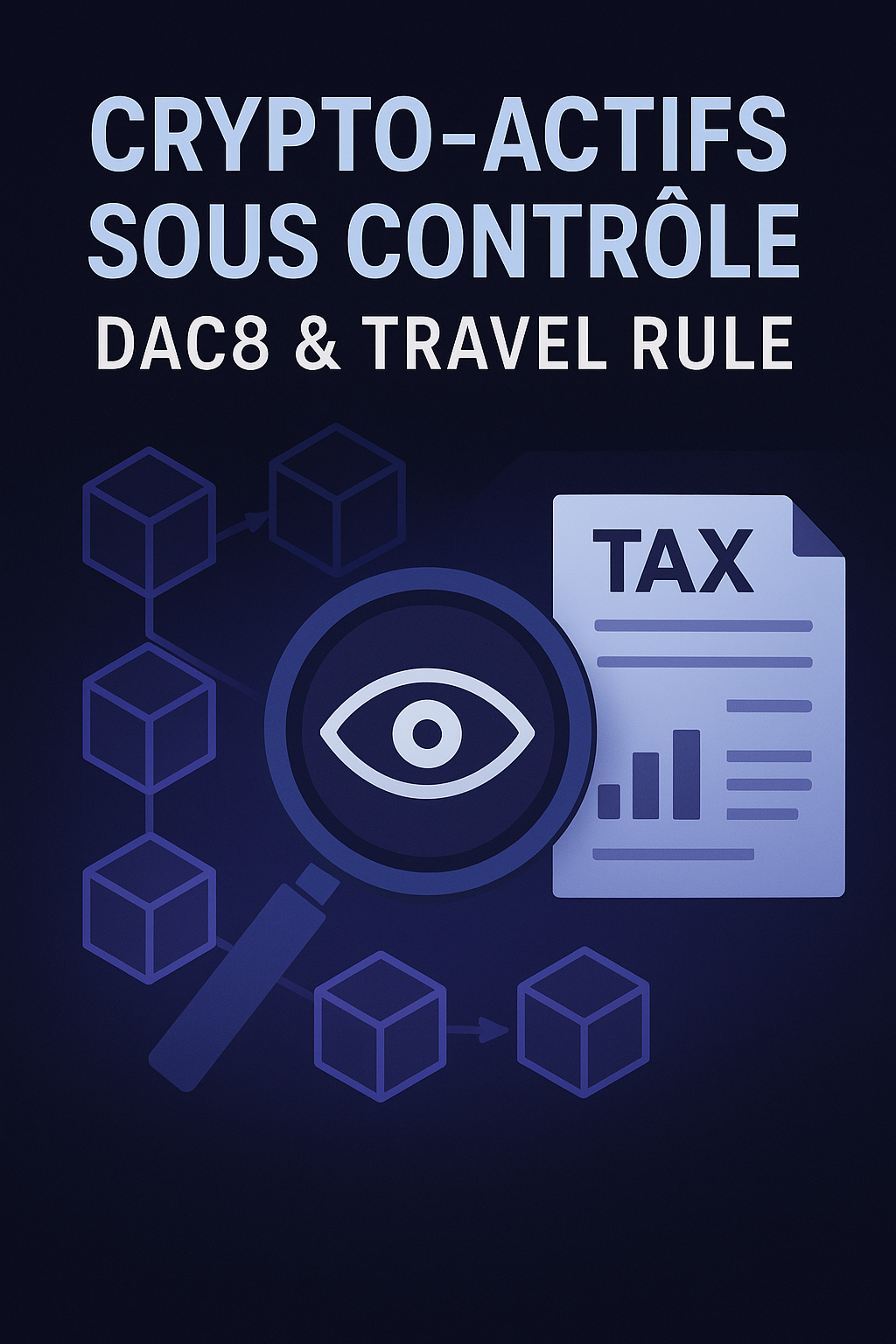
2025–2027 Guide – Understanding the risks and anticipating the arrival of the new European rules
Introduction: the end of crypto opacity is approaching
For a long time, crypto-assets enjoyed an image of anonymity and complete freedom. Many individual investors believed that their activities were difficult to trace.
But the reality is changing very quickly.
With the arrival of the Travel Rule and above all of the European DAC8 directive, crypto taxation is about to enter a new era: that of total transparency. And this means one very simple thing:
👉 From 2027 onwards, crypto tax audits are going to explode.
In this context, declaring your crypto capital gains is not just recommended: it is essential in order to avoid severe penalties.
1. Crypto Taxation in France: back to basics
Before discussing the new rules, let us recall an essential point:
crypto capital gains are taxable in France.
You are taxed as soon as you:
- sell crypto for euros, dollars, etc.
- buy goods/services with crypto,
- make cash machine withdrawals with a crypto card
All of this is taxed under the 31.4% flat tax (prélèvement forfaitaire unique, PFU).
Even a small sale must be declared on form 2086. However, if total sales are below €305 over the year, they will be exempt.
Accounts opened on a foreign platform must also be declared on form 3916-bis.
2. Travel Rule: full traceability of crypto transactions
The Travel Rule now requires crypto platforms to transmit the identity of users for every transfer of crypto-assets, with no minimum threshold (Regulation (EU) 2023/1113, applicable since 30 December 2024).
In practical terms, this means that:
- your transfers between platforms are recorded,
- your deposits/withdrawals are linked to your identity,
- personal wallets (self-custody) are monitored,
- exchanges can be traced by the authorities.
The Travel Rule puts a definitive end to the idea of “crypto anonymity”.
And this is only the beginning.
3. DAC8: the directive that will trigger an avalanche of tax audits
DAC8, adopted by the European Union, is the biggest revolution in crypto taxation to date.
Its objective? To enable European tax administrations to receive automatically all data relating to crypto-assets.
From 2027, platforms will have to transmit:
- users’ identity,
- asset balances,
- deposits and withdrawals,
- aggregated transaction data (by type of crypto-asset),
- gross amounts of disposals and acquisitions (capital gains still have to be calculated by the taxpayer).
This means that the French tax authorities (administration fiscale) will have their own “crypto dashboard” containing your detailed data, even if you use foreign platforms operating in the EU.
In other words:
👉 The tax authorities will no longer need to investigate: they will receive the evidence directly.
4. Crypto tax audits: why their number is set to explode
Today, crypto-related tax audits are based on indications: suspicious transfers, inconsistencies between income and assets, failure to file form 3916-bis…
But as soon as DAC8 is in place:
- audits will be automated,
- anomalies will be detected instantly,
- non-filers will be identified in a single click.
The tax authorities will be able to compare platform data → your returns → your assets.
The result:
⭐ An avalanche of crypto tax audits between 2027 and 2030.
⭐ It will be virtually impossible to fly “under the radar”.
⭐ Even small omissions will be spotted.
If you have not declared your capital gains… it will be immediately visible.
5. Failing to declare your crypto: the risks (which are often underestimated)
The idea that “the tax authorities will never find out” is becoming completely obsolete.
In the event of failure to declare, the penalties can be heavy:
- late-payment interest,
- 10%, 40% or 80% surcharges,
- reclassification of certain flows as income,
- fines for undeclared accounts,
- tax reassessment covering several years.
With DAC8, this is no longer hypothetical:
the tax authorities will know.
6. Declaring is good… but proving is better
During a crypto tax audit, the tax authorities require supporting documents.
You must be able to produce:
- your CSV exports,
- your purchase histories,
- your bank statements,
- your transaction fees,
- your transfers between wallets,
- the precise calculation of your capital gains.
Without solid evidence, the tax authorities may recalculate your gains unfavourably.
Preparing your supporting documents now means avoiding a painful audit tomorrow.
7. Why act now (and not in 2027)
Many taxpayers wait, out of lack of information or stress.
But waiting for DAC8 to arrive before putting your crypto accounts in order is like:
👉 waiting for the storm to repair the roof.
Good reasons to get started now:
- audits are likely to be carried out on a massive scale from mid or late 2027;
- voluntary regularisations are often better received;
- gathering supporting documents is easier when transactions are recent.
Anticipating means protecting yourself.
Conclusion: the era of crypto transparency has arrived. Better to be prepared.
Between the Travel Rule and DAC8, one thing is certain:
crypto taxation is set to become one of the most closely monitored areas for the French tax authorities, which will receive the information handed to them on a plate, without even asking for it (automatically). The database placed directly in the hands of the tax authorities will therefore represent a huge pool of easy and substantial reassessments for the French Treasury (Trésor public).
Declaring your crypto capital gains is therefore no longer just an administrative formality:
it is a genuine strategy for protecting yourself against the coming wave of tax audits.
👉 Organised and transparent investors will sleep soundly.
👉 Others will run the risk of being automatically flagged from 2027.
Key points:
- Crypto taxation is becoming increasingly transparent with the Travel Rule, applicable since 30 December 2024, and the DAC8 directive, under which the first data transmissions are expected in 2027.
- Crypto capital gains are taxable in France as soon as you sell, use or withdraw crypto-assets.
- The Travel Rule requires platforms to transmit users’ identity for every transfer, making crypto anonymity obsolete.
- DAC8 will enable the authorities to obtain data on transactions and users automatically, leading to an increase in tax audits.
- It is crucial to declare your crypto capital gains now to avoid heavy penalties, and to prepare your supporting documents to prove your returns.
Estimated reading time: 5 minutes





0 Comments