
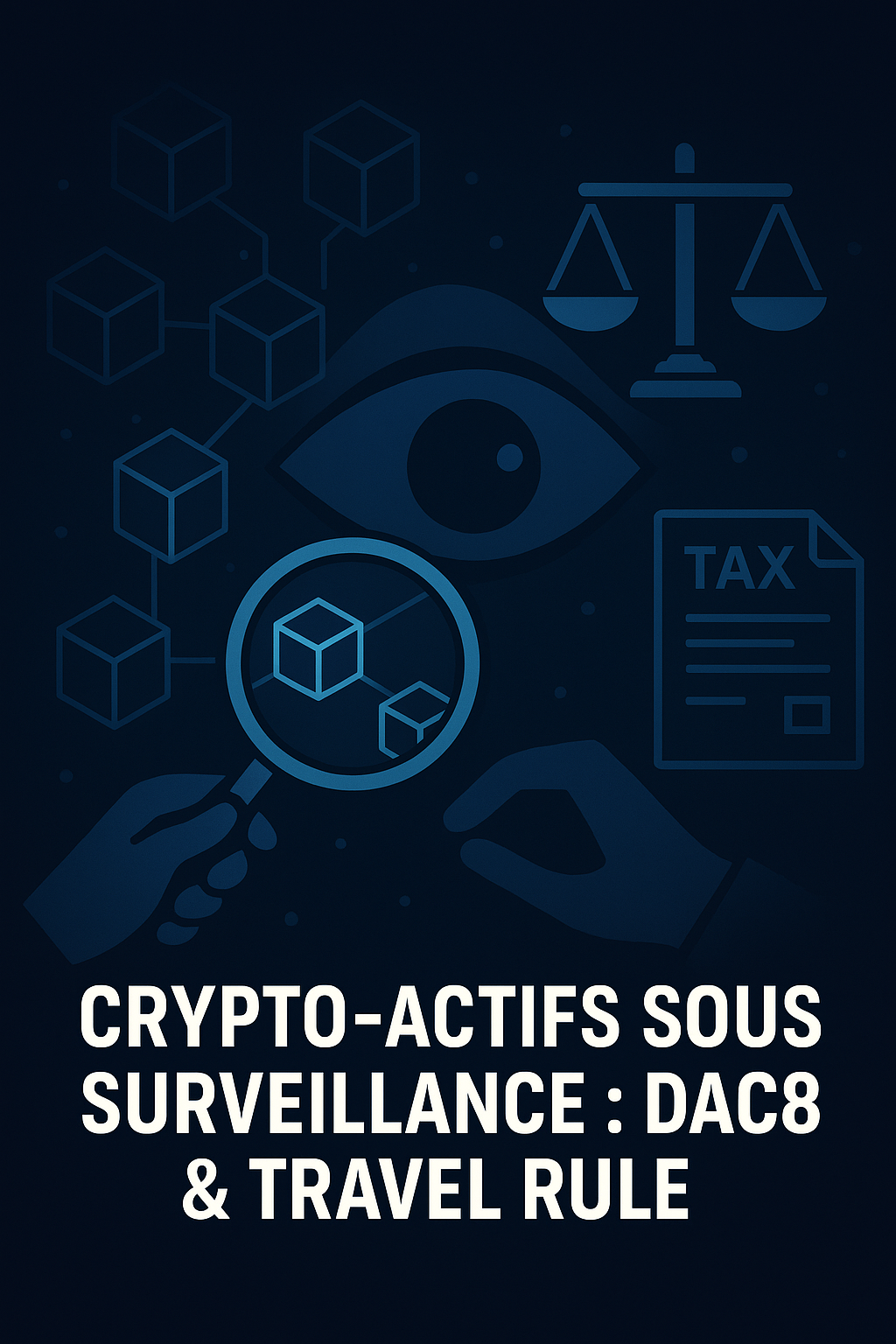
The taxation of cryptocurrencies is changing profoundly, and individuals who hold or trade digital assets need to understand that anonymity is gradually disappearing. Two major frameworks, DAC 8 and the Travel Rule, are going to transform the way your transactions are tracked and audited by the tax authorities (administration fiscale). If you do not prepare for this, the risk of penalties and tax reassessments will increase considerably.
Estimated reading time: 6 minutes
Table of contents
- 1. DAC 8 and the automatic exchange of information: enhanced surveillance
- 2. The Travel Rule: your transfers are now traceable
- 3. What are your current obligations?
- 4. Penalties for failure to declare
- 5. How to prepare in order to limit the risks
- 6. The avalanche of tax audits: why it is coming
- 7. Common mistakes to avoid
- 8. The combined effect of DAC 8 + the Travel Rule
- 9. Key takeaways for 2025-2027
- 10. Conclusion: vigilance is becoming essential
Key points
- The taxation of cryptocurrencies is evolving with DAC 8 and the Travel Rule, making transactions more transparent.
- For transactions carried out from 2026 onwards, platforms will have to automatically transmit information about your transactions to the tax authorities.
- The Travel Rule will require every transfer of crypto-assets to be recorded, making your transactions traceable.
- Failures to declare expose you to tax reassessments, fines and significant late-payment interest.
- It is becoming crucial to declare all your wallets and capital gains in order to avoid severe penalties.
1. DAC 8 and the automatic exchange of information: enhanced surveillance
For transactions carried out from 2026 onwards, all crypto-asset service providers (platforms, exchanges, digital wallets) will have to transmit detailed information on their clients’ transactions to the tax authorities. This data will then be automatically exchanged between European Union Member States.
In practical terms, this means that all your transactions will be scrutinised: purchases, sales, crypto-to-crypto exchanges, transfers to other addresses, and even transfers to so-called “self-hosted” wallets will be recorded. The tax authorities will be able to compare this information with your tax returns and identify omissions or discrepancies very quickly.
The timetable is simple:
- 2026: reference year for your transactions.
- 2027: platforms report your transactions and the data flows automatically between States.
The message is clear: it will no longer be possible to let undeclared gains or unreported wallets slip through without being detected.
2. The Travel Rule: your transfers are now traceable
Since the end of 2024, the Travel Rule has required service providers to transmit and retain precise information on the originator and the beneficiary of every transfer of crypto-assets. There is no threshold: all transfers are covered. For self-hosted wallets, specific verifications apply above €1,000.
In other words, if you send or receive cryptocurrencies through a service provider, your transactions are traced and retained, ready to be used in a tax audit. Even if you think you are keeping a low profile, the combination of DAC 8 + the Travel Rule makes such invisibility impossible.
3. What are your current obligations?
For individuals, several obligations already exist:
- Declaring gains arising from the sale of digital assets. Capital gains are taxed at around 31.4% (tax + social security contributions (prélèvements sociaux), since the 2026 Social Security Financing Act (LFSS 2026)), with a small exemption threshold for very low amounts.
- Declaring wallets held abroad. Every digital asset account opened, held, used or closed with a platform established outside France must be reported in your annual return (form 3916-bis). In the event of an omission, substantial fines may be applied, and they are increased if the wallet exceeds a certain threshold.
With DAC 8 and the Travel Rule, the risk of these failures being detected becomes almost certain. The tax authorities will be able to cross-check your returns against the data transmitted by the platforms and detect any inconsistency.
4. Penalties for failure to declare
Failing to declare your crypto-assets or your gains exposes you to:
- Tax reassessment, with recalculation of the tax on the undeclared gains.
- Late-payment interest, which is added to the tax due.
- Fixed fines for undeclared wallets.
- Additional surcharges (10%, 40% or 80%) depending on the nature of the failure (late filing, failure to file after formal notice, deliberate failure, fraudulent practices).
In practical terms, if you let a wallet or a gain go undeclared, your tax bill could skyrocket, especially from 2027 onwards, when DAC 8 comes fully into effect.
5. How to prepare in order to limit the risks
Here are the best practices for staying compliant:
- List all your wallets: whether they are on exchanges or self-hosted, in France or abroad.
- Keep a precise history: purchase dates, prices, fees, nature of the transactions (sale, exchange, transfer).
- Calculate your capital gains: distinguish between those falling under the standard regime and those linked to activities such as mining.
- Declare your accounts and gains correctly in your annual return.
- Anticipate DAC 8 checks: make sure your statements match what the platforms will have to report.
By following these steps, you greatly reduce the risk of penalties and tax reassessments.
6. The avalanche of tax audits: why it is coming
With DAC 8 and the Travel Rule, several factors are converging to create what might be called an avalanche of tax audits:
- Platform data will be automatically shared between countries, enabling rapid cross-checking.
- Every transfer will be traced and verifiable.
- The tax authorities will be able to target taxpayers who fail to declare their gains or wallets, rather than carrying out random audits.
- Penalties are tougher, including substantial fines and surcharges.
In short, the risk for those who do not become compliant will go from moderate to high, with much faster and more precise audits.
7. Common mistakes to avoid
Risky behaviours include:
- Failing to declare a foreign wallet or an account on an exchange not domiciled in France.
- Forgetting to complete the schedule for capital gains arising from disposals of crypto.
- Underestimating transfers to self-hosted wallets, thinking they are invisible.
- Failing to keep a precise record of your transactions, which complicates any regularisation in the event of an audit.
Even if the amounts seem small, the tax authorities have reliable and detailed data to detect omissions thanks to DAC 8 and the Travel Rule.
8. The combined effect of DAC 8 + the Travel Rule
The strength of these two frameworks lies in their combination:
- DAC 8 collects and centralises information from the platforms.
- The Travel Rule traces all transfers.
The result: every crypto transaction becomes visible to the tax authorities, and the slightest discrepancy can trigger an audit. The days when it was possible to slip through the net are over.
9. Key takeaways for 2025-2027
- 2025: preparation and regularisation of foreign wallets and past gains.
- 2026: DAC 8 obligations begin for service providers.
- 2027: first automatic transmission of data between States; large-scale audits possible.
- Since the end of 2024: Travel Rule in force for all transfers, with enhanced traceability.
Every individual must therefore plan ahead and document their transactions, or else face a significant increase in tax risk.
10. Conclusion: vigilance is becoming essential
Crypto taxation is evolving rapidly and the era of anonymity is coming to an end. DAC 8 and the Travel Rule mark a new era of transparency and tax scrutiny.
To limit the risks:
- Declare all your wallets, including those abroad.
- Declare all your capital gains and transfers.
- Keep precise and detailed histories.
- Anticipate the forthcoming cross-checks between authorities and platforms.
Ignoring these obligations can be very costly: fines, reassessments, surcharges and late-payment interest. It is therefore better to act now to secure your position and avoid unpleasant surprises from 2027 onwards.




0 Comments