
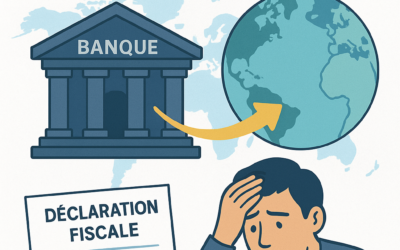
With the publication in December 2023 of a report on crypto‑assets, the French Court of Audit (Cour des comptes) is sounding the alarm ⚠️: the rapid growth of the crypto market, combined with regulatory and tax frameworks deemed insufficient, is creating a major “blind spot” for the tax authorities.
As the European DAC8 directive and the “travel rule” come into force, the tax authorities (administration fiscale) are about to gain unprecedented visibility 👀 — which could lead to a massive increase in tax audits.
This article breaks down the findings, the recommendations and the risks ahead, to help every crypto holder plan ahead.
Key points
- The Cour des comptes warns of insufficient regulation of crypto‑assets, which creates a tax blind spot.
- The crypto‑asset market has grown sharply, but few taxpayers declare capital gains.
- The current framework (PSAN) is deemed insufficient, with checks that are too weak and risks of fraud.
- The recommendations include stronger checks and a revision of the tax framework for better regulation.
- With DAC8 and the travel rule coming into force, it is crucial to review and document your crypto holdings.
Table of contents
- 1. Why did the Cour des comptes look into crypto‑assets? 🤔
- 2. What is the current framework (PSAN) — and why the Court considers it insufficient ❌
- 3. The recommendations of the Cour des comptes 📌
- 4. What this means in practice for users 🧑💻
- 5. Why the timing is critical ⏰
- 6. What to do today — practical advice ✅
- 7. Why the Court’s scrutiny matters 🌟
- Conclusion: an inevitable turning point — prepare before it is too late ⏳
1. Why did the Cour des comptes look into crypto‑assets? 🤔
1.1. A booming market — striking figures 💥
The Cour des comptes describes an increasingly large crypto‑asset market. At the end of 2023, the global valuation of crypto‑assets was estimated at 1,100 billion dollars, compared with only 18 billion in 2017.
In France, between 1.5 and 5 million holders are concerned.
➡️ In other words, the number of people involved is far from marginal.
1.2. A paradox: strong adoption but still light taxation and regulation ⚖️
Despite this massive adoption, the report notes a striking gap between the size of the market and the data available to the tax authorities.
In 2021, only 20,000 taxpayers declared capital gains arising from crypto‑assets.
⚠️ This means that a large proportion of crypto holders do not appear in the tax records — a genuine “blind spot”.
2. What is the current framework (PSAN) — and why the Court considers it insufficient ❌
2.1. The PSAN regime: mandatory registration + optional licence 📄
From 2019 to 30 June 2026, France regulated crypto‑asset service providers through a digital asset service provider regime (prestataires de services sur actifs numériques, PSAN) (replaced since 1 July 2026, the end of the transitional period, by the European MiCA authorisation as a crypto-asset service provider):
- ✅ Mandatory registration with the French Financial Markets Authority (Autorité des marchés financiers, AMF)
- ✅ Optional licence for those seeking enhanced supervision
2.2. Checks deemed too weak 👀
- Too many unauthorised or foreign-based service providers escape checks.
- Self‑hosted wallets (self-custody) remain completely invisible to the tax authorities.
⚠️ Seen by the Cour des comptes as a real risk of fraud, money laundering and non-declaration of gains.
2.3. Risks for investors and for the State 💸
- Money laundering and fraud
- High asset volatility
- Systemic risk if crypto becomes a major means of payment
3. The recommendations of the Cour des comptes 📌
3.1. Strengthening audit resources 💻
- More staff and specialised expertise
- IT tools to trace flows
- Development of national tools for greater independence
3.2. Revising the tax and reporting framework 📝
- Adapting taxation to actual uses
- Obligation to report self‑hosted wallets exceeding a threshold
- Better informing taxpayers of their obligations
3.3. Strengthening the regulation of service providers ⚖️
- Supervising PSANs and foreign service providers
- Harmonising the national framework with European standards (MiCA)
4. What this means in practice for users 🧑💻
4.1. For holders using PSAN platforms 🏦
- All transactions will be traceable 📊
- Capital gains will be harder to hide
- The risk of a tax reassessment increases ⚠️
4.2. For holders using self‑hosted wallets 🔑
- A reporting obligation is possible in the future
- “Private” use becomes less discreet 👀 because of the travel rule
4.3. For occasional investors 💰
- Even small amounts may be concerned
- Ignoring one’s obligations is riskier than before
5. Why the timing is critical ⏰
- Convergence of European reforms: DAC8, MiCA, travel rule
- Increased visibility and audit capabilities for the tax authorities 👁️
- Increased risk of reassessments and large-scale regularisations ⚠️
6. What to do today — practical advice ✅
- 📌 Take a complete inventory of your crypto holdings
- 🗂️ Retrieve all historical data
- ✅ Check your past tax returns
- 📁 Keep all supporting documents
- ✍️ Plan for a voluntary regularisation if necessary
- 🔄 Keep up to date with regulatory developments
- 👨💼 Call on a professional if in doubt
7. Why the Court’s scrutiny matters 🌟
- It pushes the tax authorities to increase the number and effectiveness of audits: recovering tax revenue for the State in a budgetary and political context that is more strained than ever
Conclusion: an inevitable turning point — prepare before it is too late ⏳
The report of the Cour des comptes marks a turning point: the crypto market will soon no longer be a tax “grey area”.
With DAC8 and the travel rule coming into force, it is time to:
👉 review,
👉 document,
👉 regularise.
This is no time for improvisation: it is better to act today than to be caught out tomorrow.
Estimated reading time: 5 minutes





0 Comments