
With the abolition (as of 1 January 2018) of the Services for the Processing of Amended Returns (Services du Traitement des Déclarations Rectificatives, STDR) and the end of the Cazeneuve circulars regime, individuals holding accounts abroad can no longer benefit from the tightly framed rules laid down by those circulars and now fall under the standard regularisation procedures. Since the voluntary regularisation procedure was introduced in 2013, the French State has collected several billion euros in revenue (more than €7 billion collected between 2014 and 2016 according to the Court of Audit (Cour des comptes)).
Moreover, the automatic exchange of banking information has been fully effective since 2018 between the countries that have signed this convention. It is now much easier for the tax authorities to detect taxpayers who hold accounts abroad and have failed to declare them.
It is therefore essential to carefully review your reporting obligations with a view to regularising your situation if you hold assets abroad that you have not yet declared. Find out about the risks you face in the event of a tax audit if you do not declare accounts opened, held, used or closed abroad.
A reminder of the legal provisions on the obligation to declare foreign accounts
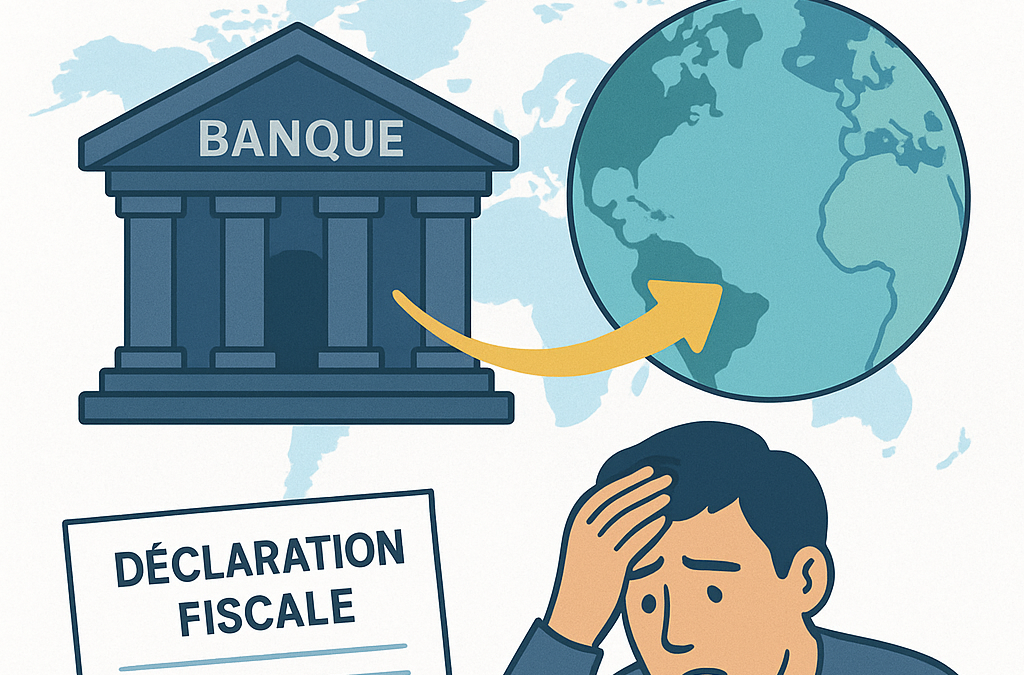
When you notice that the box for “Holding of accounts abroad” is pre-ticked on your form no. 2042, you need to fully understand what the law provides: individuals who are holders, joint holders, beneficiaries or beneficial owners of an account opened, held, used or closed abroad are required to declare it together with their income. To do so, form no. 3916 must be completed. This obligation is laid down by Article 1649 A of the French General Tax Code (Code Général des Impôts, CGI).
This obligation applies to all tax residents. Persons with dual tax residence are also among those who must comply with this obligation, even if they have already declared the accounts and paid tax in the other country.
As of 1 January 2019, this reporting obligation has been extended to inactive and dormant accounts abroad.
For PayPal-type accounts, holders are not required to declare them if they meet the following three cumulative conditions:
– The account is used to make purchase payments or to receive proceeds from the sale of goods;
– The account is linked to another account opened with a banking institution in France;
– The total amount received on the account must be less than or equal to €10,000 per year.
If these cumulative criteria are not met, the account holder must declare it by completing form no. 3916.
When the total credit balances of the foreign account are below €50,000 during the reference year, the limitation period is 3 years. However, if the total credit balances on the account exceeded €50,000 at any point during the year, the limitation period is then set at 10 years.
What penalties apply if the taxpayer does not voluntarily regularise their situation?
If the taxpayer decides not to declare one or more accounts abroad, they are liable to a fine of €1,500 per account and per year. This fine may be increased to €10,000 per account and per year where the account was opened with a banking institution located in a State that has not signed the administrative assistance convention which, in particular, facilitates exchanges of banking information with France.
Additional penalties are also provided for: undeclared assets may in certain cases be taxed with 80% surcharges.
The tax authorities may also initiate criminal proceedings for tax fraud: the taxpayer concerned may then be ordered to pay a fine of up to €500,000 (or twice the proceeds of the offence) and faces up to 5 years’ imprisonment, increased to €3,000,000 and 7 years in the event of aggravating circumstances (Art. 1741 of the CGI). The tax authorities are now required to refer such a case to the public prosecutor (procureur de la République) when they detect fraud and the amount of the reassessments exceeds €100,000.
If the taxpayer decides not to regularise their situation by not declaring their accounts abroad, the tax authorities may use the banking information collected from the countries that have signed the convention facilitating the exchange of information in order to send a request for information. The taxpayer is then required to provide precise answers as quickly as possible.
If the taxpayer does not provide sufficient evidence of the origin of the funds, they may in certain cases be required to pay a tax of 60% of the amount held in the account. Further penalties and surcharges may also be added. The total amount payable can therefore rise quickly if the taxpayer does not provide all the required supporting documents.
It should be noted that the request for information is an opportunity for the taxpayer to regularise their situation by gathering all the documents requested by the tax authorities. These documents must be sent to the Department that issued the request for information so that the taxpayer’s situation can be examined. Once the file is complete, it is filed with the Department responsible for reviewing it. Once the complete file has been checked, the officer in charge initiates the reassessment procedure if necessary.
How to carry out a voluntary regularisation?
The first step is not to untick the ticked box on the return. Next, form no. 3916 must be completed correctly. If you have foreign income such as interest on a savings account, you must declare it, in particular on forms no. 2042 and 2047.
The next step will be to carry out the regularisation of past years. A generally substantial file will need to be produced. The assistance of a tax lawyer is recommended. Please note that regularisation will not cancel fines and surcharges, but these financial penalties will often be lighter than in the event of a tax audit: for example, the 80% surcharge will often be reduced to 40%. Late-payment interest remains due at the rate of 0.20% per month, i.e. 2.40% per year (4.80% per year before 2018), but it may be reduced in the event of regularisation under certain conditions.
The tax authorities will only tax the income from the accounts and the funds deposited where the taxpayer has not justified their origin or where they constitute taxable income. Where the account has been declared correctly, without pressure from the tax authorities, the taxpayer will not be required to pay a fine.
Regularising accounts held abroad is a tedious process. You are entitled to call on the services of qualified experts such as tax lawyers to make sure that you put together a compliant file. The file required for the regularisation of accounts abroad must include numerous documents such as amended income tax returns, returns of foreign income (form no. 2047) and declarations of accounts opened abroad (form no. 3916). A written statement on the origin of the assets must also be provided: this is an essential document for the regularisation, and all documents that prove the origin of the assets must be attached to it. The file must also include statements of assets or wealth statements, as well as the annual income statements and annual statements of gains and losses that the foreign bank can provide to you. A sworn statement must also be attached, stating that the declared accounts are the only ones you have opened, held, used or closed.
What happens in the event of tax fraud?
Since 30 September 2018, the automatic exchange of banking information has been operating in practice: thousands of items of information can be consulted by the various States that have signed this convention. Banking secrecy is on the wane. The various tax administrations can now access banking databases and consequently detect tax evasion more easily. Taxpayers holding accounts abroad nevertheless retain the option of voluntarily regularising their tax situation.
If, despite being aware of these new provisions, the taxpayer persists in failing to meet their reporting obligations, they may, in the event of an audit or requests for information from the tax authorities, suffer tax and criminal consequences that are sometimes very serious.
In such a case, tax surcharges are indeed often substantial and criminal proceedings may in certain cases be initiated. In such a situation, the assistance of a tax lawyer appears highly advisable.
Indeed, where a taxpayer has fraudulently evaded or attempted to fraudulently evade the payment of all or part of their taxes, or has deliberately failed to declare their accounts or assets abroad within the prescribed time limits, has organised their own insolvency or has tried to avoid taxes through schemes, they may in certain cases be liable to the following penalties: 5 years’ imprisonment and a fine of €500,000. This amount may be increased to twice the proceeds of the offence. Where the offence was committed by an organised gang or was carried out or facilitated by opening an account abroad, the penalties may be more severe: 7 years’ imprisonment and a fine of €3,000,000, which may be increased to twice the proceeds of the offence.
The offence of tax fraud is established when the following constituent elements are present:
– The tax authorities must prove the existence of material facts that enabled the taxpayer to evade the payment of all or part of their taxes;
– The tax authorities must demonstrate that the taxpayer had a deliberate intention to commit fraud.
The offence of tax fraud is therefore established when the “material” and “intentional” elements are both present. The applicable tax procedure does not fall under ordinary law: the offence of tax fraud is not within the remit of the public prosecutor. The Tax Offences Commission (Commission des infractions fiscales, CIF), which has received the complaint from the tax authorities, must issue a binding opinion. Once this binding opinion has been received, the criminal court may be seized to hear the Minister’s complaint.
The tax authorities’ monopoly over prosecutions has, however, been withdrawn: Bercy must now report the most serious cases of tax fraud to the public prosecutor’s office. Without prejudice to the complaints it initiates itself, the tax authorities must report to the public prosecutor the facts they have established in the course of the audit carried out. Where the amount of the tax reassessed exceeds €100,000 and the following surcharges apply:
– Either a 100% surcharge
– Or an 80% surcharge
– Or a 40% surcharge where, during the previous six calendar years, the taxpayer has already been subject to a 40%, 80% or 100% surcharge or to a complaint for tax fraud
Accordingly, when the tax authorities learn of the existence of an undeclared bank account abroad, they do not need the favourable opinion of the Tax Offences Commission (CIF) in order to file a complaint reporting tax fraud to the public prosecutor, provided that the above conditions are met.





0 Comments