
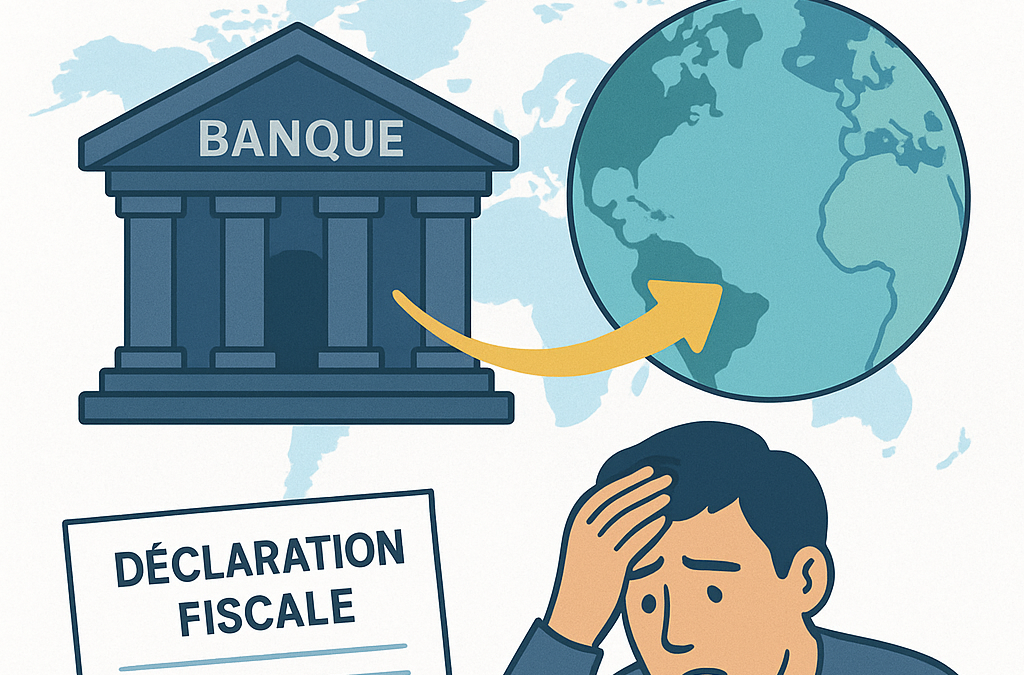
In view of the many changes introduced by the public authorities, taxpayers have legitimate questions about the new rules relating to the declaration of income and foreign accounts taxable in France.
When box 8 UU is pre-ticked, you need to analyse your situation carefully to determine whether you have opened an account abroad.
Be aware that the tax authorities automatically receive information from foreign banks.
This is the automatic exchange of information system (Common Reporting Standard, known as CRS).
Find out which types of accounts abroad must be declared on form no. 3916 and which foreign income is taxable.
With the signing of the agreement on the automatic exchange of banking data by some fifty States and territories, at the instigation of the G20, in October 2014 (Berlin multilateral agreement), exchanges of information between banks and administrations have developed considerably. The declaration of accounts opened abroad is increasingly monitored by the French tax authorities. Indeed, access to banking data in the signatory countries is now easier, or even automatic for the tax authorities.
What types of accounts held abroad must be declared?
Tax residents are required to declare all accounts opened, held, used or closed. Since the publication of the Law of 23 October 2018, these accounts must be declared even if the account is inactive and even if no transaction has been carried out during the year. The reporting obligation applies to the account holder, but also to persons holding a power of attorney over the account as well as to the beneficial owners of the accounts.
Capitalisation contracts and investments must also be declared. Savings products and life insurance contracts are also among the items to be declared. The taxpayer must in particular indicate the number of each account or contract, the bank with which it was taken out, its location, the date the account was opened and, where applicable, its closing date.
The obligation to declare accounts held abroad has applied for many years and, since 2019, it even includes inactive or dormant accounts. If an account is not declared, the taxpayer will incur fines generally amounting to €1,500 per year and per account. The fine may even be increased to €10,000 where the account is located in a State that has not signed a convention facilitating access to banking data.
Sometimes taxpayers are not really aware that they hold accounts abroad, particularly with the development of neobanks that have branches in France or offer online account opening. If you have opened, used or closed an account with N26, Bunq, Monese or Revolut, for example, you must declare them at the same time as your annual income tax return. Note that accounts opened, held or closed in 2019 had to be declared in 2020. If these accounts date from 2020, the declaration would only have to be made in 2021.
PayPal accounts are also considered to be accounts held abroad because they are registered in Luxembourg. However, since PayPal accounts are used as an online means of payment, the tax authorities provide for an exemption from declaration where the accounts meet the following three cumulative conditions:
• The account is used to pay for purchases or to collect proceeds from the sale of goods;
• The PayPal account is linked to another account opened in France;
• The total amount of annual receipts is less than or equal to €10,000 during the reference year.
Accounts opened, held, used and closed on trading platforms to carry out crypto-asset transactions are also among the accounts abroad that must be declared.
Foreign cryptocurrency accounts must also be declared on the new form 3916 Bis, which requires the same information as form 3916: account name, name of the institution, address, number, account characteristics, and opening date and any closing date.
How does the taxation of accounts abroad work?
It should be understood that the taxpayer will not necessarily be taxed on all the income from the declared accounts abroad. Only certain types of income are taxable in France. In general, these are interest, dividends, capital gains and rents received abroad. There are, of course, other types of taxable income. Consulting the tax treaties is essential in this area. The assistance of a tax lawyer is often recommended, as tax treaties are fairly difficult to understand.
Thus, if the taxpayer receives income on these bank accounts, they must declare it in particular on forms no. 2047 and, where applicable, no. 2074. As regards no. 2074, it should be noted that this is an even more complex process than no. 2047, because the capital losses and capital gains realised during the year must be calculated in order to obtain the overall capital gain or loss.
Forgot to declare accounts abroad: what should you do?
It should be noted that the tax regime in the event of regularisation depends in particular on the size of the account abroad:
– Where the total credit balances of the accounts abroad did not exceed €50,000 at any time during the year, the regularisation period is shorter: if the account generated gains, the reassessment period is limited to 3 years. However, it is always recommended to comply with the legal provisions on tax obligations in order to avoid any proceedings for non-declaration. When the taxpayer opts to come into compliance with the tax authorities, the amount of surcharges is in practice generally reduced, and they generally avoid the risk of criminal proceedings.
– Where the taxpayer is liable for real estate wealth tax (IFI) (or, for years prior to 2018, wealth tax (ISF)), the surcharges are in principle 80%, but here again a regularisation generally makes it possible, in practice, to reduce them to 40%
– In the case of accounts holding several million euros, criminal penalties are more likely to be triggered in the event of an error or failure to declare. In the context of a tax regularisation, the taxpayer may face criminal penalties and fines. It is therefore recommended to regularise voluntarily in order to reduce the risk of criminal penalties, which can unfortunately sometimes reach impressive proportions. Indeed, voluntary regularisation generally significantly reduces the risk of criminal proceedings
Today, the French tax authorities have more effective means of identifying accounts held abroad, and it is in particular for this reason that it is preferable to comply fully with the regulations in force by taking the initiative to declare all accounts or to regularise one’s situation in the event of an oversight. The regularisation file is often cumbersome and complex to put together; the assistance of a tax lawyer seems advisable.
What are the obligations when regularising accounts abroad?
If a tax resident holding accounts abroad has not yet declared them, it is generally recommended to carry out these regularisations as soon as possible. This should, however, be discussed with your tax lawyer before taking any regularisation steps. Whatever the purpose of opening these accounts, it is recommended to always comply with the tax rules in force to avoid a tax reassessment.
If the taxpayer has dual nationality but is a tax resident of France, they are still required to declare their accounts abroad and to regularise if the declaration was not made within the prescribed deadlines. It is indeed tax residence that is taken into account to determine in which State the person must file their return.
Regularising the declaration of accounts abroad is a process that can be tedious. The taxpayer may instruct a tax lawyer to carry out these steps on their behalf. It should be noted that the reassessment period covers 10 years where the assets have exceeded €50,000. Where the total credit balances of the foreign accounts did not exceed €50,000 at any time during the year, the reassessment period is 3 years.
When the taxpayer decides to carry out the regularisation steps voluntarily, the tax authorities are often more lenient in practice. In any event, in most cases it is recommended to regularise the declarations within the prescribed deadlines in order to limit the often severe penalties and additional fines proportional to the number of years. Consult a tax lawyer before initiating a regularisation procedure.
What are the risks incurred without regularisation of the declaration?
When the taxpayer does not regularise the declaration of their accounts abroad, the tax authorities may use the banking information found in the data collected from the countries where the accounts were opened and with which France is a partner. A request for explanations and justifications is then generally sent to the taxpayer, who must provide clear answers as soon as possible. It is strongly recommended to consult a tax lawyer when preparing your reply to the tax authorities. It is important to comply with the response deadline set by the tax authorities and to be precise, truthful and exhaustive in the answers provided, so as not to aggravate the situation and risk triggering a tax audit. At this stage, the tax authorities merely ask you for explanations by letter; this is not a tax audit, which is far more burdensome and intrusive.
The taxpayer is required to prove the origin of the funds; otherwise, taxation at 60% of the assets could be applied, which is generally catastrophic. The bill to be paid will then be exorbitant, particularly when the person does not provide a complete and clear file. The request for information is an opportunity that often makes it possible to reduce the tax and criminal impact of this failure to declare. The taxpayers concerned should therefore generally take advantage of it to regularise their situation and limit the penalties applied.
When a taxpayer receives a request for information, they must gather all the required documents to put together a complete regularisation file. The various supporting documents must be submitted to the department that issued this request for information so that the taxpayer’s situation can be properly analysed. This generally makes it possible to close the matter on less unfavourable terms than in the event of a tax audit.
Once the regularisation obligations have been fulfilled, the taxpayer must continue to declare all accounts held abroad every year, at the same time as their annual income tax return. Several forms must then be completed: these include in particular returns no. 3916, no. 3916 bis, no. 2047, no. 2074 and no. 2042.
Tax and criminal penalties for failure to declare accounts abroad
The fine for failure to declare, or an error in declaring, an account abroad amounts to €1,500 per account and per year. This fine applies over a maximum of four years: thus, if the taxpayer has never declared their account and this account still exists, they are liable to a maximum fine of €6,000, excluding the current year. Including the current year, the fine is applied over 5 years and if the taxpayer holds, for example, 4 accounts abroad, they risk paying a maximum fine of €30,000.
It should be noted that an account that existed during the reference year must be declared, even if it is an inactive account with no income. This rule has existed since 2019 (return for the year 2018). An account is considered inactive when it shows no entries. It should be noted that a savings account that only generates passive entries such as interest is not considered an active account.
It should be noted that the obligation to declare accounts abroad is a rule enforceable against all French taxpayers. Furthermore, when the tax authorities hold banking information communicated by the tax authorities of other States, they may pre-tick box 8 UU on the income tax return. At that point, it is preferable to check carefully whether you hold an account abroad that must be declared and to consult a tax lawyer to identify the course of action to follow.





0 Comments