
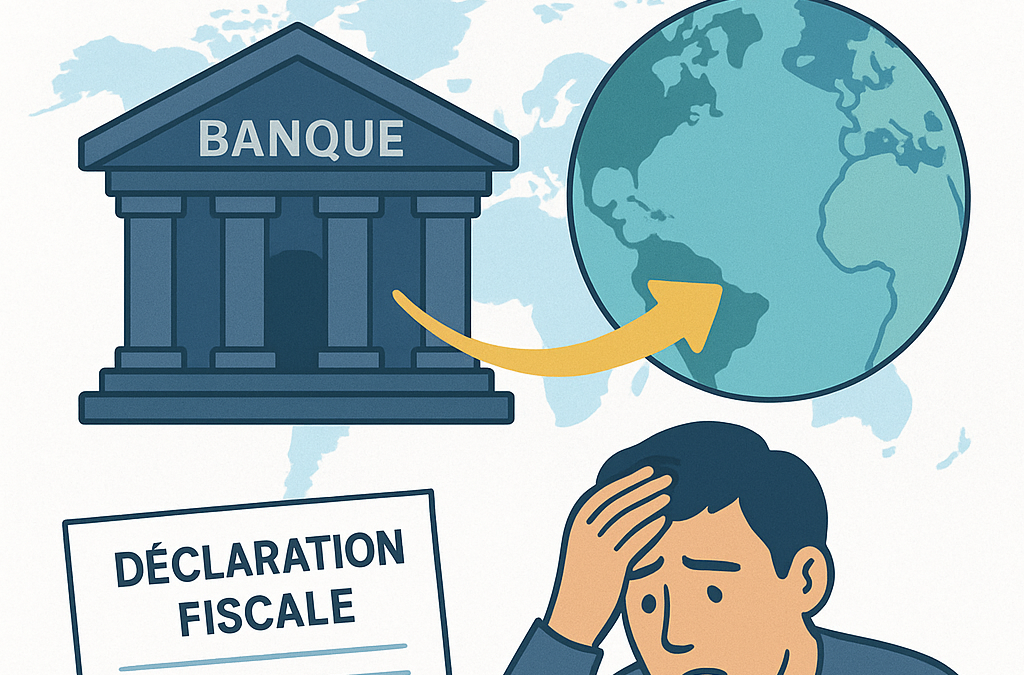
Have you forgotten to declare your foreign account?
Failing to declare one or more bank accounts held abroad has various tax, and even criminal, consequences. But solutions exist. Our tax law firm has attempted to describe, in simple terms, what is often a complex situation.
Understanding what is at stake with this omission
Holding a foreign bank account is, save for exceptions, not illegal.
What is illegal, however, is failing to declare it to the tax authorities (administration fiscale).
The declaration of foreign bank accounts must be made every year, using form no. 3916, and by ticking box 8UU on form no. 2042.
A certain amount of information is requested, such as your name, address, the bank’s address, the account number, its opening date, etc.
However, you are not asked for the balance of the account(s).
If you have forgotten, it is possible to regularise the situation voluntarily.
Please note that voluntary regularisation in no way exempts you from the various applicable penalties and surcharges.
The tax cost of this voluntary regularisation will therefore, broadly speaking, be fairly close to the tax cost of a tax audit. Only the late-payment interest will be reduced in the case of voluntary regularisation (late-payment interest of 0.20% per month, i.e. 2.40% per year since 2018, is reduced by half, subject to conditions, where an amended return is filed voluntarily). The penalties and surcharges will, on the other hand, be the same as in the case of a tax audit.
However, voluntary regularisation has 3 advantages:
- a reduced risk of criminal prosecution
- a more favourable tax context. In the case of voluntary regularisation, the tax authorities will, in principle, be less “harsh” than in the case of a tax audit (see the rest of the article, which explains the points on which the authorities may be more flexible)
- an end to the psychological stress caused by the failure to declare one’s foreign account and by the risk of a tax audit (which generally lasts a long time and is very often experienced as stressful by the taxpayer)
Please note, however, that the advisability of voluntary regularisation must be carefully assessed.
Although it is generally recommended to voluntarily regularise one’s foreign accounts, in some cases this regularisation can lead straight into a brick wall, mainly where proof of the origin of the funds cannot be provided (where you have no document proving the origin of the funds, which is quite rare); consult a tax lawyer to assess matters in your case.
Indeed, where the taxpayer is unable to prove the origin of the funds, there is a rule that allows the tax authorities to tax at 60% all of the foreign assets; the tax consequences are therefore enormous and amount, broadly speaking, to a kind of confiscation (because, in addition to the 60% taxation, there are fines, taxation of the income generated by the accounts each year for the past 10 years, any additional wealth tax (ISF) each year for the past 10 years, surcharges, etc.).
What should you do if you have forgotten to declare your foreign account?
Consult a professional, such as a tax lawyer, in order to assess whether, in your specific case, it is advisable to regularise the situation voluntarily.
Voluntary regularisation consists in voluntarily submitting to the tax authorities a file containing all of the omitted returns, together with other types of documents.
In most cases, this is a substantial, or even very substantial, file.
Indeed, this file must include:
- a written statement on the origin of the funds (explaining where the funds come from), accompanied by all of your supporting documents proving that origin
- a sworn statement (a document in which you affirm that you do not hold any other undeclared accounts)
- all of the “forgotten” income tax returns (foreign accounts have often generated income, such as interest, dividends and capital gains). All of the omitted 2047 and 2042 returns for the last 10 years will have to be produced
- any wealth tax (ISF) returns that are not time-barred (if your assets exceeded the threshold), the ISF having been replaced by the real estate wealth tax (IFI) in 2018
- all of the foreign account declarations for the last 4 years (3916 declarations)
- the statements of assets (bank document showing the balance at 31 December of each of the last 10 years)
- the summary statements of foreign income (bank document showing, for each of the last 10 years, the income generated by the account)
- where necessary, for example, any omitted gift, inheritance or real estate capital gains returns
As you can see, this is a substantial and technically complex file to produce.
However, it makes it possible to fully clean up your situation with the tax authorities.
The tax cost (i.e. the amount of the reassessments and fines) will depend on your specific situation. It may be high, or close to 0, depending on the case.
The greater the number of years to be regularised and the higher the amount of your assets in your foreign account, the higher the tax cost will be.
The tax cost of regularisation depends mainly on these two factors:
- the number of years to be regularised. Indeed, if your foreign account has existed for decades, the number of years to regularise will be high (10 years to be regularised). If your account was opened only a few years ago, the number of years to be regularised will be smaller, as will the tax cost of the reassessments; there are also other exceptions that may reduce the period, so consult your tax lawyer
- the amount of your assets abroad. The larger your assets, the higher the tax cost will, in principle, be
The two most problematic cases
All kinds of situations are possible depending on the history of your foreign accounts.
But two cases are much more problematic than the others:
- Where you are unable to prove the origin of the funds, i.e. where you have no document to justify the origin of your funds. In that case, the tax authorities may use an article of the French General Tax Code (Code général des impôts) that allows them to tax at 60% all of your assets.
- Where undeclared sums (for example, cash derived from a professional activity) have been paid into the foreign account during the last 10 years. In that case, the tax authorities are entitled to tax all of the amounts received (during the last 10 years only) and to apply substantial surcharges of 80%, as well as late-payment interest
Apart from these two cases, voluntary regularisation will generally be the right solution, even though its cost will generally remain significant.
The tax cost will consist of:
- fines for undeclared foreign accounts (€1,500 per year and per account, over 4 years)
- any additional wealth tax (ISF) due, from 2010 to 2017 (if we are in 2020)
- additional income tax, over the last 10 years, due on the income generated by the foreign account (interest, capital gains, dividends, etc.)
- possibly, “forgotten” gift tax if the funds come from a gift (subject to international treaties, which may in some cases spare you from paying this gift tax), “forgotten” inheritance tax if the funds come from an inheritance that took place less than 10 years ago (subject to international treaties, which may in some cases spare you from paying this inheritance tax), etc.
It is therefore advisable, before proceeding with a voluntary regularisation, to consult a professional so that they can quantify the cost of the regularisation. You will then be fully informed of the consequences of the regularisation and can make your decision without fear of any unpleasant surprises.
If you have forgotten to declare your foreign account: the firm’s advice
- meet a tax lawyer experienced in the regularisation of foreign accounts, in order to fully understand what is at stake in your specific situation and to assess the advisability of regularisation in your specific situation
- start gathering the main documents (or, if you do not have them, start requesting them from your bank): all documents showing the origin of the funds, and all of your foreign account bank statements for the last 10 years
- forget everything you may have read or heard in the media: every situation is different and the consequences vary greatly from one situation to another
- reduce the stress and move on to concrete actions (meeting a professional, starting to gather your documents, etc.)
Our tax law firm can assist you.




0 Comments