
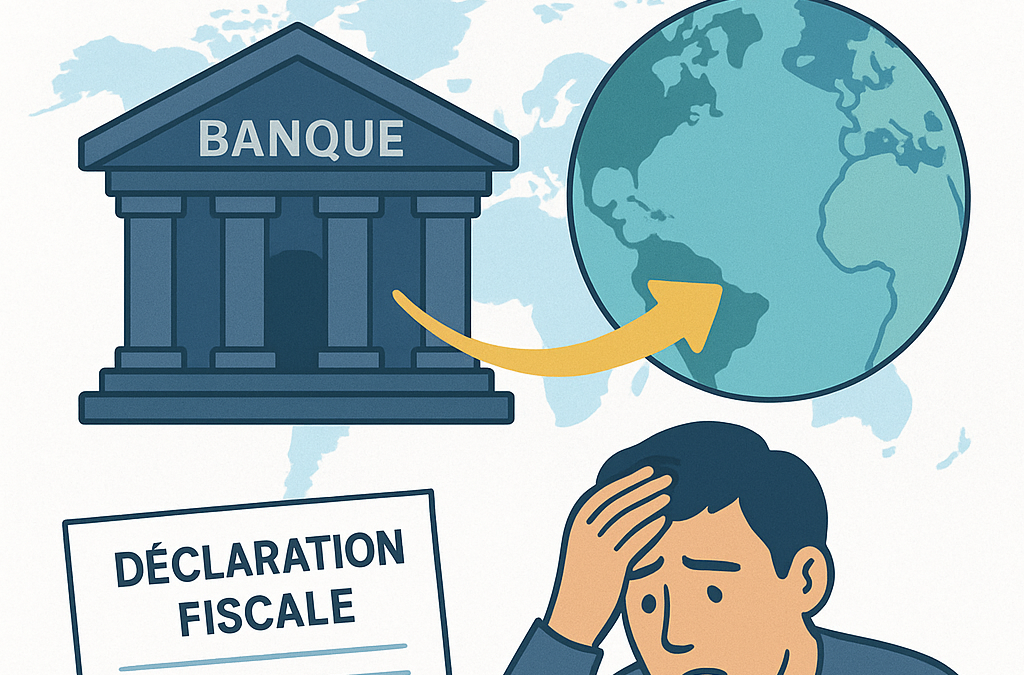
Opening an account abroad is entirely legal. What is far less so is failing to declare it to the French tax authorities (administration fiscale) if you are tax resident in France.
You must declare such accounts at the same time as your annual income tax return, using form 3916/3916bis. In addition, if the account generates income, you must also complete form 2047 in order to declare that income.
Be aware that the tax authorities of countries that have signed the international agreement on the exchange of banking information regularly send the French tax authorities information about the accounts you hold in their territory. The French tax authorities do not need to request it: this information is sent automatically. This is the automatic exchange of information system (Common Reporting Standard, known as CRS).
It is therefore advisable to properly declare your accounts located abroad in order to avoid any tax audit. You must declare all accounts opened in a foreign country, whether with a bank or with any other institution or person (stockbroker, notary, etc.), as well as life insurance policies.
1- Accounts Abroad: Automatic Exchange of Banking Data Between Countries
The 2008 financial crisis put the spotlight on the billions that escape states because of tax havens and offshore accounts. A majority of countries therefore decided to crack down on tax fraud by introducing laws (such as FATCA in the United States, or AEOI) enabling a country to automatically receive banking data concerning its tax residents.
There are currently around a hundred signatory countries. But does this mean the end of banking secrecy? Banks must now report the banking information of account holders on their soil if those holders are tax resident in another country. For example, a Spanish bank must identify its clients who are not tax resident in Spain, also identify the country in which each such client is tax resident, and then automatically send the client’s banking information to the country concerned.
If you wish to open an account abroad and that country is a signatory to the international agreement, the foreign bank will ask you to complete a tax self-certification form in order to identify your country of tax residence and your tax identification number. Should you refuse to provide this information, the opening of your account abroad may in some cases be refused.
In principle, banks must therefore report the surname and first name of the account holders, the account number, its opening date, its balance, and the interest, dividends or capital gains received. This information will be sent automatically to every signatory country one of whose tax residents opens a bank account abroad, in another signatory country. And this applies regardless of the size of the account balance.
So a low balance does not mean you need not worry about these formalities. This international agreement thus, in principle, puts an end to banking secrecy in order to curb tax fraud.
This new agreement (Common Reporting Standard, Norme Commune de Déclaration) therefore targets tax fraud or, at the very least, reporting negligence. Accordingly, if you hold an undeclared account abroad, you will in some cases (generally when the foreign assets are relatively large) find yourself at odds with the French tax authorities and will have to regularise your situation as quickly as possible, generally over a very long period (10 years). Even before it came into force, this agreement prompted a wave of voluntary regularisation, out of fear of tax audits. Penalties are not cancelled in the event of voluntary regularisation, but they are reduced.
The end of banking secrecy has therefore had tangible effects on tax evasion, but some countries are not yet signatories and do not transmit their banking data. It also remains difficult to trace the bank accounts abroad of certain companies or trusts.
2- Account Abroad: What Information Do the French Tax Authorities Have?
The tax authorities of each country that has signed an international agreement exchange banking information. The French tax authorities therefore have access to various information about your accounts located abroad.
This information is sent automatically without the French tax authorities needing to request it. Thanks to this information, the French tax authorities will in principle have access to the balance of your account abroad, the various income generated by the account (dividends, interest, etc.), the surname and first name of the holder and the account’s opening date.
They will not, therefore, have direct access to your account as they would for a bank account located in France. They cannot read and examine your bank statement if the account is located abroad without first submitting a request to the tax authorities of the other country. Such requests are very rare because they involve a lengthy procedure that is also cumbersome. Generally, this type of procedure is used if you are uncooperative during a tax audit or when the tax authorities ask you for supporting documents that you fail to provide.
3- Some Questions on the Taxation of an Account or Asset Located Abroad
When you have opened an account abroad or if you own an asset abroad, it is only natural to have questions about the taxation of that asset or account and how to declare it.
Inheritance, gifts, real estate wealth tax on property located abroad: it is normal to feel lost, as the subject is delicate and complex. To avoid making a blunder and risking trouble with the French tax authorities, find out about the rules in force.
The first question the French tax authorities will ask concerns the origin of your asset, bank account or income. How did you obtain them? Is it an inheritance? Is it a gift? Do you have income abroad? Has it been declared? You will therefore have to substantiate the origin of all your accounts or real estate so as to leave the tax authorities in no doubt as to the non-fraudulent nature of your assets.
You will no doubt be wondering whether an inheritance or a gift is taxable in France. Will you have to pay tax if you sell a property located abroad? Furthermore, is your income from abroad taxable in France even though you have already been taxed in the country concerned? Is real estate located abroad subject to real estate wealth tax (impôt sur la fortune immobilière, IFI)? Must you also declare your accounts abroad, as well as your life insurance policies or savings accounts?
a- Account Abroad: Tax Declaration
To begin with, if you hold an account abroad, you are required to declare it to the tax authorities in France when filing your annual income tax return, using form 3916/3916 bis. You must complete this form for each of your accounts located abroad, and do so every year.
If an account is closed, you must declare this on the same form. You will then no longer need to declare it in subsequent years, since it will have been closed.
Moreover, this declaration does not apply only to bank accounts; it is also required for a savings account, a capitalisation account, a life insurance policy, a trading account, a securities account, etc.
b- Failure to Declare an Account Abroad
If you have forgotten to declare one of your accounts abroad to the French tax authorities, you can in principle regularise your situation. Unfortunately, you will not be able to escape the fines that will generally be applied. In principle, they amount to €1,500/year/account (exceptionally, the €1,500 is increased to €10,000). Note, however, that the tax authorities cannot go back more than 5 years because of the statute of limitations. You will therefore be penalised over a maximum of 5 years. Finally, depending on your situation and the scale of your regularisation, additional taxes and penalties may be applied in respect of income tax (IR) and real estate wealth tax (IFI).
c- Refusal to Declare an Account Abroad
If you hold an account abroad, you are obliged to declare it every year to the tax authorities, at the same time as your usual annual income tax return. If you fail to comply with this obligation, you risk triggering audits by the tax authorities.
Furthermore, be aware that many countries have signed an international agreement allowing them to transmit, every year, a wide range of information about your accounts located on their soil without the French tax authorities having to request it. These are automatic exchanges of various banking data, including your account balance.
You are therefore at risk of being easily detected.
Accordingly, if the tax authorities uncover fraud, the consequences, penalties and fines may in some cases be high. You face a surcharge of around 80%, as well as criminal prosecution in the most serious cases of fraud.
If, however, the tax authorities consider that your failure to declare does not amount to tax fraud, your surcharge will generally be reduced to 40%, but you will still incur fines.
d- Regularising Your Tax Declarations for Accounts Abroad
To regularise your tax declarations concerning your accounts abroad, you will need to put together a file and submit it to the tax office. It is strongly recommended that you be assisted by a tax lawyer.
This file will include, in particular:
– A letter explaining the origin of all the foreign funds, together with the related supporting documents.
– All the various bank documents for the period covered by the regularisation.
– A statement of assets, also for the period covered by the regularisation.
– Finally, the amended tax returns for your income tax and, where applicable, the corrected wealth tax (ISF) or real estate wealth tax (IFI) returns.
Be aware that this file is relatively cumbersome and time-consuming to prepare. Putting it together will not spare you from having to pay surcharges. However, these will generally be halved.
e- What to Do if the Tax Authorities Have Sent You a Letter Requesting the Regularisation of Your Accounts Abroad?
First of all, if you have received such a letter, it is generally because: 1) the foreign bank has transmitted your banking information to the French tax authorities and 2) your foreign assets are substantial.
The stakes are therefore high, as is the potential tax reassessment. To avoid making a blunder when preparing the regularisation file, account for all your accounts, demonstrate your good faith, make full use of all the tax credits to which you are entitled under tax treaties, and adopt a well-thought-out strategic approach in how you present matters, particularly with regard to the origin of the funds. Do not hesitate to seek help and advice from a professional in the field, such as a tax lawyer. As an expert in tax law and in regularising declarations of accounts abroad, with long experience in this area, a tax lawyer will be able to guide you through these cumbersome and potentially treacherous procedures. If you prepare your regularisation file yourself, be sure above all to specify in the file the origin of each of the sums held in your accounts abroad. Above all, always tell the truth, but present matters intelligently. You must also be able to substantiate the origin of every sum in your accounts abroad, that is, provide supporting documents. You should also pay attention to the wording of what you write. To demonstrate your sincerity, use simple, clear and concise language. The tax authorities must be able to understand the situation immediately, without getting the impression that insufficiently clear or consistent points need to be dug into. Do not let one wrong word or one poorly worded sentence sow doubt in the minds of the tax authorities. In this way, you will avoid what are often severe tax consequences.
f- How to Declare Income from Abroad?
If you are a French tax resident, you must, in principle, declare annually all of your income, whether it comes from France or from abroad.
The following, in particular, are considered income from abroad:
– rents from real estate located abroad,
– investment income from your investments abroad (capital gains, dividends, interest, etc.),
– professional income from your salaries, and income from a business operation located abroad…
Generally, these various types of income are taxable in France if you are tax resident in France. However, there are numerous tax treaties with various countries that allow derogations from this French tax rule.
Thus, in most cases, tax treaties provide for various derogations:
– On foreign rents: they are generally taxable abroad and must be declared in France. However, the rents may be exempt or entitle you to a tax credit in France.
– On investment income: it is generally taxable in France. However, you can claim a tax credit in France with reference to the tax paid abroad.
– On professional income: this depends on the nature of the income. Taxation in France will differ depending on your particular circumstances. You may or may not be taxable in France.
To determine your situation, you will need to consult the tax treaty, if one exists with the country concerned.
To declare your income and your accounts abroad, you will have to complete various forms:
– Form 2047: declaration of income from abroad; in some cases, you can also use it to claim a tax credit in France with reference to the taxes you have already paid abroad. You can thus avoid or limit double taxation.
– Form 2042 or 2042 C
The boxes completed on form 2047 must then be carried over to other forms, such as the 2042 or 2042 C. Note that if you file your return online, you will be able to carry over the boxes completed on your form 2047 automatically. However, you must make sure this does not overwrite boxes already completed on your 2042. To avoid errors, it is preferable to fill in the boxes manually, even though this remains cumbersome and time-consuming. Your tax lawyer can also take charge of preparing your returns.
Be thorough when completing these various forms. Certain errors could cause you to miss out on certain tax credits, which would be a great pity for you. To avoid mistakes, and if the stakes are high, do not hesitate to seek advice from a tax lawyer, who can help you obtain the tax credits to which you may be entitled and will ensure the accuracy of your returns.
4- What Declaration Is Required When Selling an Asset Abroad?
If you are tax resident in France and wish to sell a property located abroad, you must in principle declare the sale to the French tax authorities if it has earned you a capital gain. However, do look into the matter, as many tax treaties have been signed between various countries that modify the terms of taxation in France.
If you find that the tax treaty signed by the country where your property is located requires you to declare your capital gain in France and that you will be taxed on it, you must then complete form 2048-IMM.
Do not put this task off. You will have one month from the date of sale of your property to submit this form. Moreover, this file is often long and cumbersome to put together. In particular, you will have to complete the form, write a letter explaining the situation and the context, and provide a deed of purchase and a deed of sale, as well as proof of the taxes paid. For further information and help in putting this file together, do not hesitate to contact a tax lawyer, who will be able to assist you with this task.
5- Real Estate Wealth Tax on Foreign Real Estate
Under French tax law, you will be liable to IFI if your net real estate assets exceed €1.3 million, whether located in France or abroad. Once again, consult a tax lawyer to find out the terms of taxation and the tax treaty of the country where your property is located, so as to know whether or not you must declare your real estate assets and whether you can benefit from a tax allowance. As each case is unique, if in doubt about the rules applicable to your specific situation, contact a tax lawyer to avoid making any mistakes.
6- Inheriting Real Estate Abroad: Taxation Rules in France
If you inherit real estate abroad from a deceased person who was tax resident abroad, and you are tax resident in France, you must comply with certain rules. The first is that all inheritances are, in principle, taxable in France, even if they took place abroad.
However, there are in particular two exceptions to this French rule:
– At the time of the inheritance you were tax resident in France, but you had not been so for at least six years during the ten years preceding the death of the relative from whom you inherited.
– A tax treaty on inheritance provides that real estate abroad is not taxable in France. Look into the tax treaty of the country where the property is located to find out whether or not you will be taxed on this inheritance. Some treaties eliminate all taxation in France on the inheritance of real estate located abroad, others eliminate it partially, and still others allow no elimination of the tax due in France.
If neither of these two cases applies to you, you must in principle declare to the French tax authorities the inheritance of real estate located abroad. However, the tax already paid abroad will be deducted from the tax paid in France. To do so, you must complete a specific form, the 2740-SD. The tax authorities will then be able to determine, if all the conditions are met, whether the foreign tax can be offset against the French tax.
You will also have to complete additional forms, notably the 2705-SD and 2705-S-SD. Form 2705-A-SD must be completed in the case of life insurance.
As always, these forms must be completed with the utmost care, as the tax authorities will determine the inheritance tax due in France on the basis of their review. Do not hesitate to call on a tax lawyer to advise you on your particular case. As an expert in tax matters, a tax lawyer will be able to examine the tax treaty of the country where the property you inherited is located.




0 Comments