
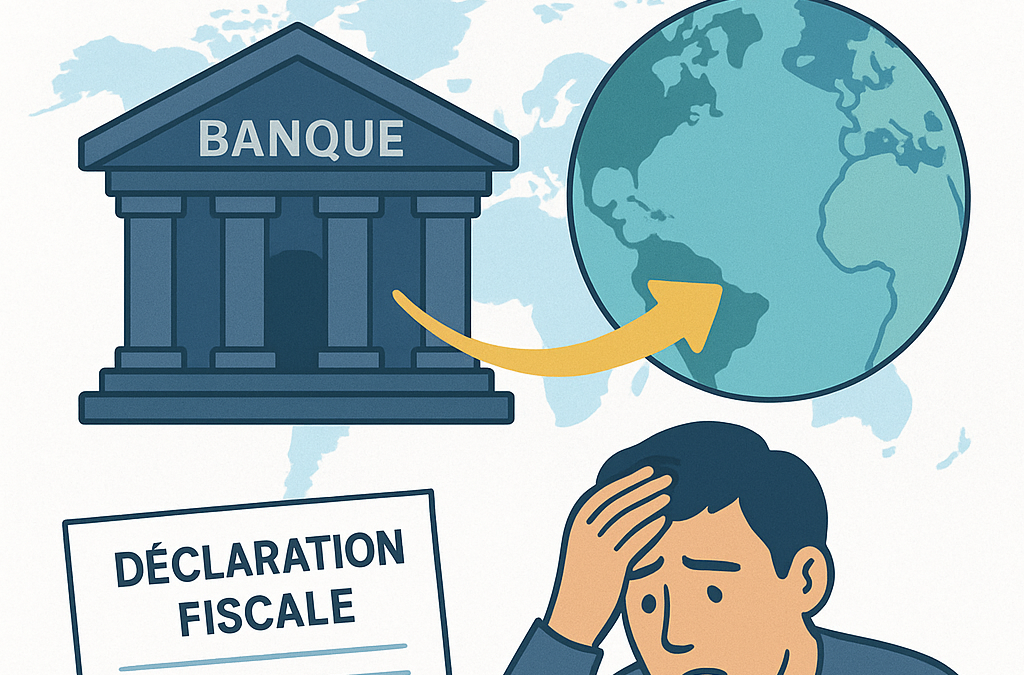
Every French tax resident must declare all bank accounts held abroad in order to comply with the reporting obligation laid down by the regulations in force, and must do so every year.
However, holding accounts abroad does not necessarily mean that you have to pay tax.
Indeed, taxation applies only to certain categories of income, such as capital gains, dividends, interest and rents received abroad, for example, as well as other taxable income defined in the tax treaties concluded between the States concerned.
If you have not declared accounts opened, held, used or closed abroad, you should consider regularisation.
Indeed, although the unit handling amended returns (Service de Traitement des déclarations rectificatives, STDR) was closed in 2017, you can still proceed with the voluntary regularisation of your accounts opened abroad. Above all, this step allows you to demonstrate your good faith in the eyes of the tax authorities (administration fiscale) and very often to avoid a tax reassessment, which may in some cases be accompanied by severe penalties.
Be aware that the tax authorities automatically receive information from foreign banks.
This is the myPOS system of the French tax authorities.
Voluntary regularisation to fulfil the obligation to declare accounts held abroad
It should be noted that the regularisation of accounts held abroad is a procedure which, in practice, requires the assistance of a tax lawyer. From a legal standpoint, you are fully entitled to file this application on your own, or with the assistance of any person of your choice, whether a lawyer of course, a chartered accountant or any other professional of your choice.
In practice, however, this is a demanding and technical file to put together, so it is advisable to call on a tax lawyer who is familiar with this type of procedure.
Whatever your purpose in opening one or more accounts abroad, it seems advisable to declare them. If the deadline set by the tax authorities has already passed, you will be able to regularise these accounts held abroad. However, be careful to assess the consequences of such a regularisation carefully in advance. You should not proceed with this type of procedure without having thought the consequences through, because once the file has been submitted it is no longer possible to turn back.
You should be aware that the obligations to declare and regularise accounts held abroad also apply to foreign nationals, to persons with dual nationality, and also to professionals who have pursued an international career. This declaration indeed applies to any person who is a French tax resident, regardless of nationality and even if they carry out part of their activity abroad.
At present, taxpayers should regularise their situation voluntarily as early as possible so that the fine payable is not high. Indeed, the amount of the fines payable is proportional to the number of years elapsed between the filing deadline and the date of regularisation.
If you hold small accounts, regularisation is generally fairly straightforward, provided that the origin of the funds can be substantiated. In any event, the assistance of a tax lawyer can ensure that the regularisation process is carried out under better conditions.
Can the tax authorities force you to regularise your accounts held abroad?
The tax authorities can initiate numerous procedures to identify and penalise taxpayers holding accounts abroad who have neither fulfilled their reporting obligations nor regularised their situation in the event of late declaration.
As a result of the automatic exchange of banking information, the tax authorities can nowadays collect an enormous amount of information. This is a convention providing for the automatic exchange of banking information between the signatory States.
The competent authorities may send individual requests or group requests to obtain information about one or more taxpayers. If you hold an account in Switzerland, for example, the French tax authorities can obtain information by sending individual requests since 2010 or group requests since 2013.
The French authorities may also send requests to obtain information on older accounts. It should be noted that the number of countries that provide, automatically or on request, the list of French tax residents who have opened an undeclared bank account in their territory increases every year. This is why it is strongly recommended to declare accounts held abroad or to proceed with a regularisation. The French tax authorities can trace this information more and more easily, so you run the risk of being severely penalised.
Once again, before embarking on a regularisation procedure, consult a tax lawyer to assess its consequences, because it is no longer possible to turn back once the file has been submitted.
Investigations and handling of regularisation files
For many years now, the competent authorities have held more and more information on accounts abroad that have not been declared. They obtain, directly or through an intermediary structure, the list of taxpayers domiciled in France for tax purposes who hold accounts abroad. For example, at the end of July 2019, the Swiss tax authorities, with the authorisation of their judicial authorities, handed over to France a document containing information on nearly 40,000 taxpayers holding accounts opened with a Swiss banking institution. These are accounts opened, held or used from 2010 to 2015.
An investigation was then launched in order to uncover the structures that had enabled the holders of these accounts to escape tax audits. Certain firms had devised tax schemes enabling their clients to avoid paying tax on part of their gains.
A severe sentence was handed down against a very well-known French company offering this type of “tax structuring” services, but there are many other structures that engage in this kind of activity and are currently the subject of investigations. Thanks to such investigations, the tax authorities have in particular obtained lists of taxpayers holding undeclared accounts opened in other countries such as Poland or Latvia.
A closer look at the handling of regularisation files for undeclared accounts abroad
When the tax authorities receive information about a taxpayer, requests for information are in principle sent to the taxpayer concerned (most of the time, these are 751-SD letters) and various departments may handle the procedure. Most of the time, however, it is the income and wealth audit units (pôles de contrôle des revenus et du Patrimoine) that issue them. These departments are in principle administered by the departmental directorates.
In the case of files of a certain importance, the departments of the national or regional directorates such as the DNVSF or the DIRCOFI are responsible for sending the requests for explanations. The DNEF (Direction nationale d’enquêtes fiscales, the National Directorate of Tax Investigations) handles requests relating to tax evasion when they require an investigation. The DNEF is the “police-like” department of the tax authorities.
In some cases, the procedures are even handled directly by Bercy. These are the most complex or problematic files, often involving large assets abroad exceeding one million euros.
It should be noted that the regularisation procedure does not change, regardless of which department issues the request for information.
It should also be noted that receiving a request for information does not mean that the taxpayer will necessarily be penalised. Receiving this letter means that you must provide precise explanations on certain points concerning the information obtained by the tax authorities and supply a list of documents, often a long one, mainly bank documents going back several years.
It is recommended that you reply to this request for information within the stated time limits, providing precise, truthful and detailed information. It sometimes happens that taxpayers who receive a request for information are unable to provide concrete evidence proving the origin of the assets in the undeclared account opened abroad. In order to limit the risk of being severely penalised by the tax authorities, it is recommended that you call on a tax lawyer to help you provide relevant explanations and a well-constructed file to the department that issued the request.
If the tax authorities receive no reply to their request for information within the prescribed time limits, they may initiate a tax audit, which is much more burdensome and coercive than the request for information. They may also, in particular where their letters go unanswered, in certain cases, tax the assets at a rate of 60%.
The reply to the request for information generally takes the form of a regularisation file. The documents required are identical to those you must provide in the context of a voluntary regularisation. The regularisation file must be submitted to the department that issued the request for information.
If the tax authorities require you to pay this 60% tax, you are entitled to initiate proceedings to challenge this decision. In any event, unless it is a special case, the tax authorities do not in principle apply this tax when the taxpayer responds to the authorities’ requests with a complete and well-constructed file.
Regularisation: a procedure in principle covering the last 10 years
The regularisation procedure in principle covers the ten years preceding the year of regularisation. For example, if you decide in 2020 to regularise your bank accounts opened, held, used or closed abroad, the regularisation period will concern accounts held since 1 January 2010.
In general, the tax reassessments claimed by the authorities upon regularisation vary according to many parameters: were you liable to wealth tax (ISF) ? Did you receive income abroad ? Is the origin of the funds an inheritance ? A gift? Income from a professional activity ? Furthermore, in addition to the taxes that should have been paid in the past, the tax authorities will apply surcharges. Depending on the case, these surcharges will be 80%, 40% or 10%. The cost of the regularisation procedure may therefore include back taxes in respect of income tax, wealth tax (Impôt sur la fortune, ISF) and social security contributions (prélèvements sociaux), but also surcharges, late-payment interest and the amount of the fines payable.
The cost of a regularisation will therefore often be quite high.
If you decide to regularise your situation voluntarily, the surcharges will in principle be reduced. This surcharge is calculated on the basis of the amount of unpaid tax and not on the assets held in the account.
The fine payable amounts to €1,500 per account per year in the case of an account opened in a country that has signed an agreement facilitating the exchange of banking information with France. The tax authorities may claim this fine over a period of 5 years (depending on how long the undeclared account abroad has existed), i.e. a maximum of €7,500 per account. Be aware that for undeclared accounts opened in a country that has not signed an agreement facilitating access to banking data, the fine may be increased to €10,000 per account, per year.
If the bank account abroad is an inheritance that has belonged to you for less than 10 years, or if it is a manual gift (don manuel) you received from a relative who died less than 10 years ago, you will have to regularise the inheritance or gift duties. In some cases, no tax is due thanks to the application of international tax treaties.
Criminal penalties may also be provided for in certain cases. The tax authorities may bring criminal proceedings where a taxpayer conceals accounts and investigations have established that tax fraud has occurred. In the event of fraudulent conduct, criminal proceedings may result, in the worst case, in a fine of up to €500,000 and a prison sentence of up to 5 years.
Article 1741 of the French General Tax Code (Code général des impôts, CGI) defines cases such as offences committed by an organised gang, for which these penalties may be increased to €3,000,000 and 7 years’ imprisonment. All accounts held abroad, even if they are not taxable in France, must be declared in order to avoid heavy penalties. If the accounts abroad have not been declared on time, consider proceeding with a regularisation, but discuss it first with a tax lawyer so that you know “where you are heading”.
How can you regularise your undeclared accounts abroad?
The first step of the regularisation consists of analysing the undeclared income abroad and filing any amended income tax returns.
If you have neither the time nor the expertise to do so, you can entrust this task to a tax lawyer who will ensure that this file is prepared in compliance with the rules.
The assistance of a tax lawyer is strongly recommended, in particular when your situation is delicate (large concealed assets, deadline for replying to a request for information exceeded, etc.). The involvement of a specialised firm in the regularisation of your undeclared accounts abroad may, depending on the circumstances, enable you to obtain a reduction in the penalties applied by the tax authorities.





0 Comments