
In recent years, the public authorities have introduced new provisions concerning the rules for declaring income and accounts held abroad that are taxable in France. Faced with these various changes, taxpayers sometimes feel lost.
Indeed, it sometimes happens that box 8 UU of their income tax return (form no. 2042) has already been ticked by the tax authorities. At that point, it is essential to check carefully that you do not hold any account with a bank domiciled abroad.
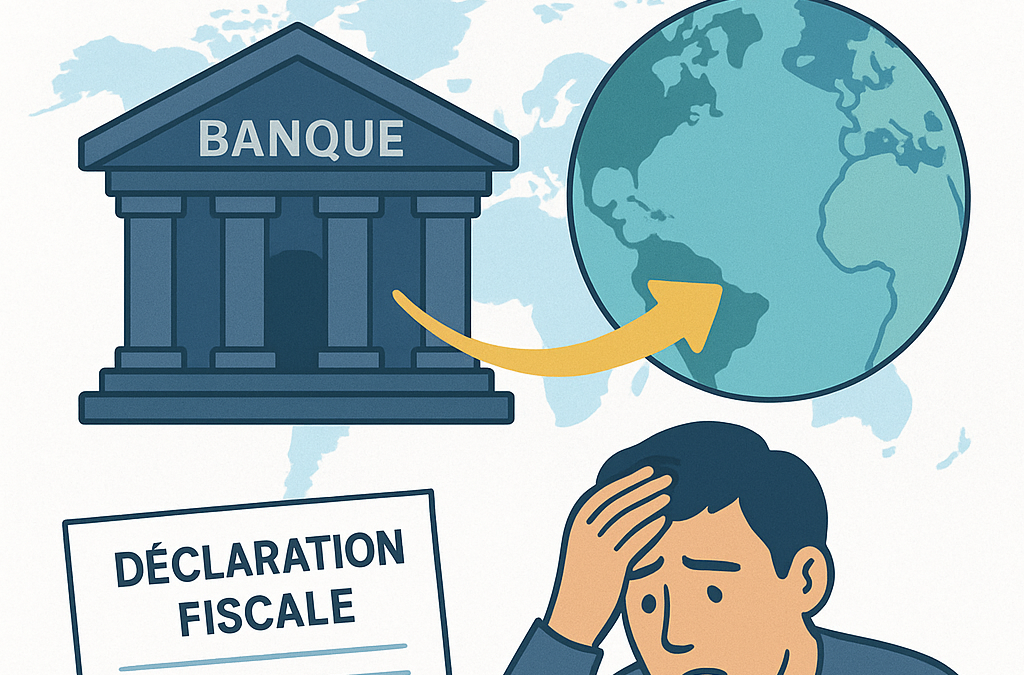
If you have opened one or more accounts in another country, even if they were opened through a branch in France or online, you must, save for exceptions, declare them by completing form no. 3916. Before you start, find out which types of accounts you must declare and which foreign income is taxable in France.
To make accounts opened abroad easier to identify, several States have ratified an agreement on the automated exchange of banking data. Since the signing of this agreement in October 2014 (first automatic exchanges in September 2017), tax authorities can easily access the banking information available in the States that have signed this agreement. The French tax authorities now have the means to better monitor accounts opened abroad by tax residents of France.
Reporting obligation: which accounts abroad are concerned?
The obligation for French tax residents to declare foreign accounts has existed for a long time.
It should be noted that this obligation has recently also covered inactive accounts, that is to say even where no transaction has been carried out on the account during the year. It should also be noted that this reporting obligation applies to the person who opened the account, to joint holders, to the person holding a power of attorney, but also to the beneficial owners of the account abroad.
Foreign investments, capitalisation contracts, life insurance contracts and savings products are also among the accounts to be declared. The following information must in particular be clearly stated in the declaration: the account or contract number, the name of the bank with which the account was opened or the contract was signed, its location, and the opening and closing dates, if the account has been closed or the contract terminated.
While the declaration of accounts abroad has been compulsory for a long time, it has only applied to inactive or dormant accounts for the past two years. Failure to declare accounts held abroad is penalised: the fine incurred amounts to €1,500 per account and per year, an amount that may in certain cases rise to €10,000 per account and per year.
Currently, with the presence of neobanks in France and of foreign institutions developing online account opening, it is not uncommon for taxpayers to be unaware that they have opened accounts abroad. Thus, if you have opened, hold, use or have closed one or more accounts with Bunq, N26, Revolut or Monese, for example, you must declare them at the same time as your annual income. If these accounts were opened, held, used or closed in 2019, they had to appear in your 2020 return. On the other hand, if they were opened in 2020, you must declare them in 2021.
It should be noted that PayPal-type accounts are also among the accounts abroad that must be declared, because the institution is based in Luxembourg. However, the tax authorities provide for a reporting exemption where the account is used to make online payments and the following three additional conditions are met:
– The account is used only to pay for purchases and to collect proceeds from the sale of goods;
– This PayPal account must be linked to another account held in France;
– The total amount of annual receipts must not exceed €10,000 during the reference year.
If you have opened, held, used or closed one or more cryptocurrency accounts located abroad, you must declare them by completing form no. 3916 Bis. In it you must in particular specify the account name, the name and address of the institution, the account number and characteristics, as well as the opening and closing dates, if the account has been closed.
How accounts abroad are taxed
It should be noted that not all declared accounts abroad will necessarily be taxed. Taxation only concerns a category of income such as dividends, capital gains, interest and rents generated abroad. There are still other types of taxable income, less common, but it is recommended to consult the tax treaties signed between the two States, or a tax lawyer, to identify them.
As regards income generated on bank accounts, you must declare it using, in particular, forms no. 2047 and/or no. 2074. Form 2074 is used to determine the taxable capital gains and losses during the year in order to arrive at the overall capital gain or loss before applying the tax rates.
How to regularise your situation if you failed to declare an account abroad in the past?
Putting together a regularisation file is in most cases a cumbersome and technical process. Various points must be examined, in particular which taxes to regularise (income tax, if income has been received? Wealth tax (ISF) / real estate wealth tax (IFI) if the assets exceed the taxation threshold? Gift and/or inheritance duties? etc.). The period over which to regularise is also one of the key points, since this period depends on the tax concerned but also on the total balance of the foreign accounts.
The taxation rules applicable to the regularisation vary according to the amounts in the account abroad:
• If the total credit balances of the accounts did not exceed €50,000 at any time during the year, the reassessment period is in principle 3 years for income tax. It is in principle 10 years otherwise.
• Where wealth tax (ISF) or IFI is payable, the taxpayer incurs an 80% surcharge. However, with a regularisation, these surcharges may, depending on the case, be reduced to 40%.
• In the case of accounts with assets of several million euros, an error or failure to declare may lead to heavy penalties and possibly also criminal penalties in the event of a tax audit. Thanks to voluntary regularisation, penalties may, depending on the case, be significantly reduced.
It should be borne in mind that the means available to the tax authorities to detect accounts held abroad are now much more effective. It therefore now seems even more important to comply with the regulations in force relating to the obligation to declare accounts abroad and to pay taxes.
In the event of an error or omission, you should consider whether it is advisable to regularise the accounts held abroad. To do so, contact your tax lawyer.
When accounts opened abroad have not been declared with your annual income, it is in most cases recommended to regularise as soon as possible. Do not hesitate to call on a qualified expert such as a tax lawyer to carry out the regularisation steps under the best conditions, in order to avoid a tax reassessment, the consequences of which are often more severe.
Remember that with assets not exceeding €50,000, the reassessment period for income tax is shortened to 3 years. If the assets exceed €50,000, the reassessment period is 10 years.
When the regularisation is carried out voluntarily, the tax authorities take this into account and generally reduce the penalties provided for. In general, the fines payable vary according to the number of years that have elapsed between the filing deadline and the date of regularisation. It is preferable to call on a tax lawyer to carry out the regularisation steps, which are technical and require a file that takes time to put together.
What happens if no regularisation of the declaration is carried out?
If the taxpayer does not declare and does not regularise the declaration of their accounts abroad, the tax authorities may find the banking information concerning them, in particular as a result of the convention signed to facilitate access to banking data. Most of the time, when this information is found, the taxpayer receives a request for explanations and justifications. They must then reply as soon as possible with precise and clear answers. The tax authorities may also initiate a tax audit, which is much more intrusive and lengthy than a request for justifications.
Make sure that the response deadline set by the competent authorities is complied with: give a precise, truthful and exhaustive answer in view of the risk of a tax audit. If you do not respond to this request for explanations, you run a high risk of triggering a tax audit, a procedure that is both burdensome and intrusive.
If the taxpayer is unable to justify where the funds come from, the tax authorities are in certain cases entitled to apply a 60% tax on the assets. This taxation can sometimes be even higher if the file required by the tax authorities is incomplete. When a request for information is issued, it is recommended to seize this opportunity to regularise one’s situation so that the penalties are reduced.
All the necessary supporting documents must be gathered as part of the regularisation file: the documents requested by the tax authorities must be submitted to the department that issued the request. Once the regularisation steps have been completed, the taxpayer remains required each year to declare all accounts opened abroad, at the same time as the annual income tax return. To do so, they must complete the following tax return forms : form no. 3916, form no. 3916 Bis in the case of cryptocurrencies, form no. 2047 for foreign income, form no. 2074 for capital gains and form no. 2042, or even 2042-C as well.
Failure to declare accounts abroad: liable to tax and criminal penalties
If you forget or if you have failed to declare an account abroad by mistake, you will be required to pay a fine of €1,500 per account, per year. This penalty remains applicable for a maximum period of 4 years. If the account opened abroad has never been declared, the maximum fine per account amounts to €6,000 (€1,500 x 4), if the current year is not taken into account. If the current year is included, the fine will apply over 5 years.
If the taxpayer holds several accounts, the amount of fines may ultimately be high. Moreover, this fine may in certain cases be increased to €10,000 instead of €1,500. For undeclared accounts abroad opened, held, used or closed in a country that has not signed a convention with France facilitating access to banking data, the fine may indeed amount to €10,000 per account, per year.
Thus, when the taxpayer holds accounts abroad or has taken out one or more life insurance contracts with foreign institutions, they must fulfil the reporting obligations provided for by the legal provisions in force. In the event of an oversight, contact your tax lawyer to assess your situation and your possible courses of action.





0 Comments