
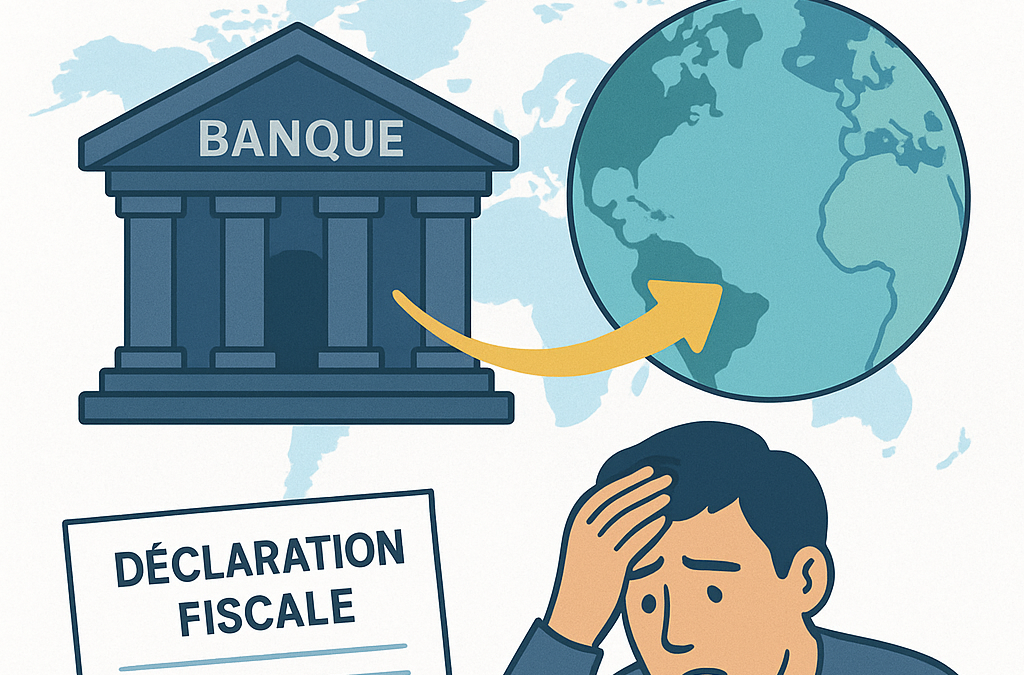
For a long time, the reporting obligation for accounts opened, held, used or closed abroad has applied to individuals, associations and non-commercial companies. Although it has existed for a long time, this obligation is often poorly understood by taxpayers. It should be noted, however, that even inactive or dormant accounts are concerned. French taxpayers who are tax domiciled in France must declare their foreign accounts every year at the same time as their income tax return.
Before getting started, it is advisable to check which types of accounts and which banking institutions are concerned. Also discover the different steps for properly declaring your accounts abroad. Remember that a fine of €1,500 per account and per year is provided for in the event of an omission. This amount may be increased to €10,000 in certain cases.
Declaring foreign accounts: why, and what are the consequences?
First of all because it is not optional: it is a tax obligation. The tax regulations in force provide for this obligation for all accounts opened, held, used or closed in another State. This obligation is laid down by Article 1649 A of the French General Tax Code (Code Général des Impôts, CGI). These accounts must be declared together with your annual income.
It is important to understand that the declaration is a mandatory formality, but declaring does not necessarily mean paying tax. However, if you decide not to declare your accounts abroad, you risk a fine of €1,500 per account and per year. This amount may rise to €10,000 per account and per year if the account is opened in a State that has not signed an administrative assistance agreement with France facilitating access to banking information (Articles 1649 A, 1736 IV). Your tax lawyer can advise you on this point.
It should be noted that in 2020, accounts opened, held, used or closed in 2019 had to be declared. If you opened the foreign account in 2020, you only had to declare it in 2021. It should also be noted that persons who do not pay tax or who are attached to their parents’ tax household are also concerned by the obligation to declare accounts abroad.
Which foreign banks are concerned by the reporting obligation?
In recent years, more and more individuals who are tax residents in France have been opening accounts with neobanks in order to benefit from better rates, more convenient virtual services through mobile apps, and modern features.
Neobanks such as N26, Revolut and Nickel each have more than one million customers in France. Orange Bank has attracted nearly 500,000 subscribers, and the new mobile banks are increasingly popular. These institutions are more attractive because an account can be opened in a few minutes, few supporting documents are required and the services provided are practically free.
However, most of these institutions are established abroad.
Although opening an account abroad changes nothing in your daily life, you must state in your tax return that you hold an account abroad when the bank is not domiciled in France (Revolut and Monese in the United Kingdom, N26 in Germany, etc.). Even if some neobanks offer their services in France, the accounts opened with them are considered foreign accounts. Thus, if a French taxpayer opened one or more bank accounts with one or more foreign neobanks in 2019, they must declare them in their annual tax return in 2020; these foreign accounts must always be declared even if they are inactive.
An exception is provided for PayPal accounts: PayPal is located in Luxembourg, but account holders are not required to declare their account when filing their income tax return if these accounts were opened in order to make online payments or receive payments in connection with the sale of goods. To benefit from this exemption, the taxpayer must meet the following three conditions:
– The PayPal account must be linked to another account in France;
– It must be opened in order to make or receive payments relating to the purchase or sale of goods;
– The total annual receipts on the PayPal account must not exceed €10,000.
What are the steps to properly declare foreign accounts?
Remember that the declaration of foreign accounts concerns the following persons, domiciled or established for tax purposes in France:
– Individuals, including the taxpayer, a member of their tax household or another person attached to that household;
– All associations without distinction; Operators of a sole proprietorship
– Non-commercial companies: i.e. all companies except those that are commercial by virtue of their form: public limited companies (SA), simplified joint-stock companies (SAS), partnerships limited by shares (SCA), limited liability companies (SARL), general partnerships (SNC) and limited partnerships (SCS).
You can file your declaration of foreign accounts online.
Here are the different steps that will enable you to meet your reporting obligations.
To declare accounts opened, held, used or closed abroad, you must tick the box corresponding to form no. 3916 relating to the “declaration by a resident of an account opened outside France” in the list of supplementary returns, at step 3 of the “Income and expenses” section.
To do so, you must log in to your personal space on the tax authorities’ website www.impots.gouv.fr, then click on “Access the online return” (« Accéder à la déclaration en ligne ») displayed at the top right, in the dashboard tab.
When you reach step 3 “Income and Expenses”, you must tick the box corresponding to “Accounts abroad”, in the “Miscellaneous” section. You will then need to complete Cerfa form no. 3916 concerning the declaration of an “account opened outside France by a resident” by clicking on the “Supplementary returns” tab. You can use the search engine to find the boxes you are interested in. You will then need to tick no. 3916 before confirming. Schedule no. 3916 then appears on the left of the interface, below the main return. You must click on the “Schedule no. 3916” tab to be able to complete this form. The help of a tax lawyer may sometimes seem advisable.
To complete form no. 3916, you must in particular state your identity, the name of the account to be declared, the address of the bank, the account number and its various characteristics (current account, savings account, securities account, etc.), the dates of opening and of any closure, your address, etc.
What happens if a foreign account is not declared?
When a tax resident fails to declare an account held abroad, the regulations in force provide for a fine of €1,500 per account and per year of non-declaration. It should be noted that this fine is in principle applied over four years when the account has never been declared. The taxpayer concerned will therefore have to pay a minimum of €6,000 per account. If the person holds 10 undeclared accounts, they will have to pay €60,000 in fines.
These penalties apply even if the account is inactive or generates no income. Indeed, since the 2018 income tax return, all accounts, even inactive or dormant accounts, must be declared. “Inactive account” is the term used to refer even to accounts that have recorded no transactions during a year. It should also be noted that a savings account that automatically generates income and accounts from which only management fees are debited are in principle regarded as inactive accounts. This subtlety no longer has any impact since even these “inactive” accounts are now covered by the reporting obligation.
Many French tax residents have not yet declared their foreign accounts because they are not yet aware of this new provision, or sometimes even because they do not know that they hold accounts abroad. Indeed, some taxpayers hold powers of attorney over foreign accounts, sometimes without even being aware of it, or have accounts with neobanks located abroad and do not know that the reporting obligation applies to these accounts.
As a result of the convention signed with a number of foreign States, the French authorities obtain information enabling them to detect tax residents who hold accounts abroad and to pre-tick box 8 UU on their income tax return. Will all taxpayers who see this box 8 UU ticked on their income tax return form be required to pay this sometimes exorbitant fine? At present, we do not have sufficient hindsight to confirm or deny this.
In addition, foreign income, in particular the investment income generated by the foreign account (interest, dividends, capital gains, etc.), must also be declared every year, in particular via form 2047. While the interest generated by a savings account abroad must be declared and taxed in the foreign country, this does not mean that it is exempt from tax in France. If the taxpayer is a tax resident in France, this income must in principle also be declared and taxed in France. Taxation in the foreign State will generally, in principle, give rise to a tax credit in France.
It should be noted that the fine of €1,500 per account per year may be increased to €10,000 per account and per year if the foreign State concerned has not signed an administrative assistance convention with France.
Two situations may arise when a taxpayer fails to declare their foreign accounts and does not provide tangible evidence that these accounts are not taxable:
– an 80% surcharge is in principle applicable to the amount of tax due on the unjustified sums.
– sums whose origin cannot be justified may in principle be taxed at 60%
If you are faced with this situation, it is strongly recommended that you seek the assistance of a tax lawyer in order to benefit from personalised support and, depending on the case, to reduce the applicable penalties.






0 Comments