
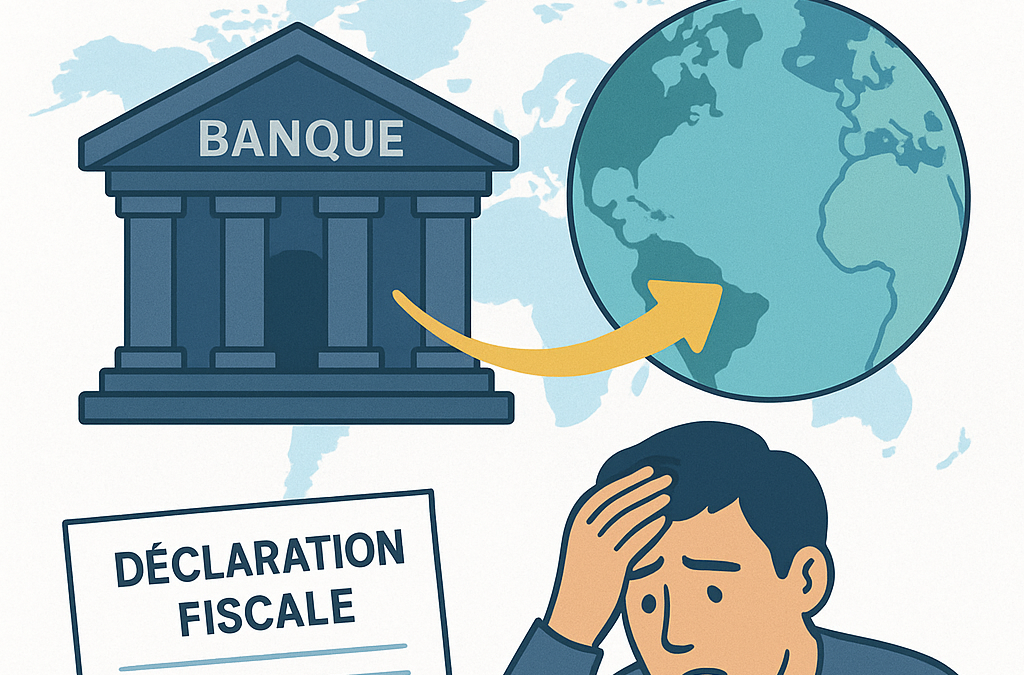
Holding an account abroad is perfectly possible.
However, you must make sure that the declarations are made correctly.
A regularisation can be carried out at any time in order to comply with the regulations in force. To do so, a specific procedure must be followed. Our tax law firm has conducted numerous procedures of this kind and is able to assist you whatever the State in which the foreign account is located.
Is it worth regularising your situation?
The answer to this question is generally a clear yes, since exchanges of information between countries can lead to an unexpected tax audit. Holders of accounts abroad can indeed be reported at any time by the country concerned.
It is therefore generally preferable to take the initiative.
The European Union has indeed generalised these exchanges of information in order to combat tax fraud more effectively. Some countries have even announced that clients who do not bring themselves into compliance with the tax rules of their country will have their accounts closed.
Automatic exchanges of banking data
To combat tax fraud, some countries have put in place agreements for the automatic exchange of data.
As soon as a bank account is opened abroad, the tax authorities of the country of origin are informed.
Switzerland and Luxembourg are among the countries that transmit banking data. Long regarded as tax havens, their determination to put an end to tax fraud is now established. Clients of these foreign banks therefore have every interest in declaring their accounts abroad. If they do not comply with the regulations in force, the banks holding their accounts will, for their part, report them to the competent authorities.
Preparing a regularisation file
Where you have not declared your account abroad, a regularisation file must be prepared before contacting the competent departments of the tax authorities; it is recommended that you discuss the advisability of doing so with a tax lawyer.
This file must in particular include supporting documents concerning the income as well as the capital losses and gains recorded over the last 10 years. The annual valuation of the assets must also be added to the file.
In addition, the taxpayer must state where the funds held in this foreign account come from. Supporting documents must be provided to prove these statements. The rules are more complex in the case of an inheritance or gift, since the bank holding the account may be required to provide a document proving that you have not added money to this account on your own initiative after being recognised as its official owner.
Wherever possible, a document proving that you are indeed the account holder is preferable. A credit advice or a notarial certificate may also be used for the file.
With regard to the income generated by the foreign account, the taxpayer must provide documents for each year over the past 10 years concerning interest, dividends, and capital losses and gains.
Given all the elements to be taken into account, the assistance of a tax lawyer is recommended.
Inheritances received abroad
A tax lawyer is particularly useful in the case of an inheritance abroad, since the declarations to be filed are generally complex. In addition, there are sometimes international conventions that must be interpreted in order to apply them to your specific case.
The lawyer is therefore there to advise the siblings and enable each of them to comply with the law. In particular, they may be advised to regularise as quickly as possible in order to avoid heavier penalties and fines.
A regularisation also limits the risk of criminal prosecution.
Taking the time to clean up your tax situation is always recommended. Foreign accounts can then be held with complete peace of mind. In particular, heirs will be able to freely enjoy their inheritance once the expected taxes have been paid. They will then be free to repatriate the funds to France in order to make investments there, for example in real estate, with complete peace of mind.
Calculation of fines and penalties
When you regularise your situation, you should expect to pay the taxes due plus penalties or fines.
These range from 40 to 80% depending on the taxpayer’s situation (in most cases the 40% surcharge is applied). The bill can therefore quickly rise for anyone who failed to file a declaration at the right time and concealed crucial information.
To avoid legal (criminal) proceedings, regularisation seems to have become almost essential.
Concealing accounts abroad may indeed be considered tax fraud. Where fraud is established, the criminal court (tribunal correctionnel) may impose a fine of up to €500,000 (or twice the proceeds of the offence) and up to 5 years’ imprisonment (Article 1741 of the French General Tax Code (Code général des impôts, CGI)).
Some situations may even lead to heavier consequences. Article 1741 of the French General Tax Code provides for up to €3,000,000 in the most serious cases, as well as 7 years’ imprisonment. All French tax residents are therefore required to declare their accounts and income held worldwide, even if they are not taxable in France, in order to avoid such penalties.
What will be the total cost of this regularisation?
If you are able to show clearly the origin of the funds and you have the necessary documents, the regularisation will involve a few fines for undeclared accounts, and additional income tax and possibly wealth tax (impôt de solidarité sur la fortune, ISF) (for years prior to 2018) or real estate wealth tax (impôt sur la fortune immobilière, IFI) (if you are liable to it), in principle increased by 40%, as well as late-payment interest at the rate of 2.40% per year (0.20% per month since 1 January 2018; 4.80% per year for earlier periods).
On the other hand, if you are unable to provide convincing supporting documents on the origin of the funds, you should know that the taxation may be 60% of all your assets, which is enormous.
This explains why declarations must be made as early as possible and supporting documents carefully kept.
A few periods of freezes on penalties and fines, or amnesties, have existed under the Fifth Republic. Under the presidency of François Mitterrand, the taxpayers concerned were able to regularise their situation with the assurance that taxation would be no more than 25%. When Edouard Balladur was Minister of the Economy and Finance (1986), the same type of operation was carried out with a rate of 10% for all. However, such amnesties are rare and no one can predict them. During the presidencies of N. Sarkozy and F. Hollande, a tax regularisation unit was set up, but it was abolished on 31 December 2017. A possibility of regularisation still exists, but under ordinary law, on less advantageous terms than before.
At present, conditions are becoming stricter in order to combat tax fraud and the flight of capital abroad.
It therefore seems advisable to regularise your situation as quickly as possible in order to avoid often heavier consequences.
Our tax law firm can assist you.





0 Comments