
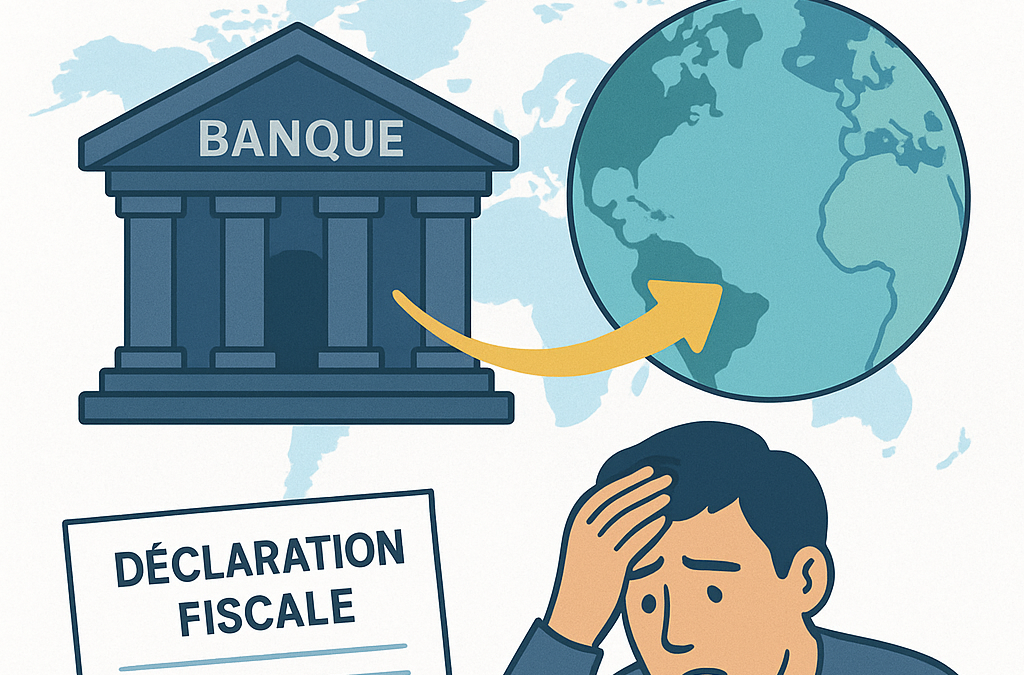
When a French taxpayer fills in form no. 2042 to declare their annual income, the tax authorities in some cases also invite them to declare their accounts abroad by completing form 3916.
The income tax return comes with several new features that individuals did not immediately understand. Most taxpayers noticed that the “Account abroad” box was pre-ticked and that it seemed impossible to untick it.
Be aware that the tax authorities automatically receive information from foreign banks.
This is the myPOS system of the French tax authorities.
The account abroad box: impossible to untick?
When filling in your online income tax return, you are sometimes surprised to find that in step 3, dedicated to the “Miscellaneous” (Divers) section, the box relating to accounts held abroad is ticked and greyed out: in other words, it is impossible to untick it with a simple click.
Especially when you do not hold (or believe you do not hold) any account abroad, you try to find a way to untick this box.
In general, you assume that it is an error on the part of the tax authorities or an IT malfunction. There is a way to untick this box, if you so wish (see the end of the article).
But the most important question is: why was this box pre-ticked in the first place?
This is not a matter of chance, nor, save in exceptional cases, an error by the tax authorities. In the vast majority of cases, this box has been pre-ticked because the tax authorities have information indicating that you may hold one or more accounts abroad.
You may of course be the direct holder of the account, but you may also hold a power of attorney over a foreign account or be its beneficial owner.
The international context of automatic exchanges of information, which has been in place for several years, enables the tax authorities to identify, in an increasing number of cases, taxpayers who hold accounts abroad.
What is the impact of these new arrangements on the French tax reporting system?
Before unticking this box, it is recommended that you find out carefully whether you hold an account with a foreign bank.
A closer look at the items appearing in the sections of interest to us
When you reach step 3 of the tax return form, you will see on the “income and expenses” line, in the “miscellaneous” section, that the “Accounts abroad, clawback of tax reductions or tax credits” box is already ticked. At this stage, it is not known whether this box is ticked for an account held abroad, for clawbacks of reductions or for a tax credit.
When you place your mouse cursor on the question mark on this line, around ten lines of information appear on the various sections of the return relating to foreign accounts and income. A little further down, there is another line on clawbacks of tax reductions or tax credits.
Once you access the page for declaring financial accounts opened, held or closed abroad, the list of applicable penalties will appear on the screen in the event of failure to declare a bank account, capitalisation contracts, life insurance and any other form of investment abroad.
The penalties are provided for by:
• Article 1649 AA and Article 1766 of the French General Tax Code (Code Général des Impôts, CGI): a fine of €1,500 is provided for per life insurance contract taken out with an institution abroad that has been modified or has been the subject of one or more redemption transactions during the tax year. This amount may increase to €10,000 in the case of a contract opened in a State that has not signed an administrative assistance convention with France to combat tax fraud and tax evasion. This convention is established to facilitate access to information on bank accounts;
• Articles 1649 A and 1736 IV of the General Tax Code: if a bank account opened, held, used or closed abroad is not declared, the taxpayer must pay a fine of €1,500. This amount may be increased to €10,000 where the account is opened, held, used or closed in a State that has not signed an agreement with France making banking information accessible;
• Article 1729-0 A of the General Tax Code: an 80% surcharge is in principle applied where the taxpayer fails to comply with the obligation to declare an account or a capitalisation contract or similar investment (life insurance) and does not declare the corresponding income and assets.
If the accounts abroad are linked to an account opened in France in order to make or receive payments for purchases or sales of goods, you are not required to declare them if the amount of annual receipts credited to the account and the sums relating to these sales do not exceed €10,000.
Thus, three situations may arise:
• You do not hold any account abroad;
• You may, at some point, have held an account abroad, but you are not sure (for example, you wonder whether you might hold a power of attorney over a relative’s account, or be its beneficial owner, or you wonder whether it might concern your spouse…);
• You hold one or more foreign accounts
You do not hold any foreign account
You may untick the box (see the procedure at the end of the article)
You do not know whether or not you hold a foreign account
You then need to make enquiries to be sure.
You may be a customer of a foreign “neo” bank, which explains why the box is ticked (N26, Revolut…).
You hold a foreign account
The tax rules relating to the declaration of accounts abroad are laid down in Article 1649A of the General Tax Code (CGI), which requires accounts abroad to be declared; at the same time, under the automatic exchange of information (CRS, known in French as NCD), financial institutions in participating States report to their tax authorities, which pass it on to France, information on the accounts of French residents;
– The second declaration must be made by the taxpayer domiciled or established in France who has carried out transactions abroad.
The reporting obligation applies to:
– Any natural person, in a personal capacity or under a power of attorney, or in a professional capacity. Where a professional activity is carried on, they must indicate their SIRET number in their declaration;
– Associations and foundations, in principle irrespective of the legal or tax regime chosen;
– Companies that do not have a commercial form, such as SCIs (non-trading property companies).
Commercial companies with share capital are not subject to this reporting obligation.
Persons who are not tax-domiciled in France are not subject to this reporting obligation.
Remember that the accounts to be declared are those opened, held or closed abroad during the previous year. The reporting obligation does not apply to accounts that meet the following conditions:
– Accounts opened abroad and linked to another account in France for the purpose of making payments for purchases or collecting receipts relating to sales of goods;
– and whose annual receipts relating to sales do not exceed €10,000 (these conditions are cumulative).
What should you do when the “Account abroad” box is pre-ticked?
Before unticking the “Account abroad” box, it is strongly recommended that you check carefully whether you really have no account abroad. Indeed, with the system of automatic exchange of banking information between several countries, the French tax authorities increasingly hold relatively precise information on the holding of one or more accounts abroad. This is in fact the reason why this box was pre-ticked.
With the development of online banks, it is becoming easier to open a bank account with a neobank not established in France, such as Revolut, N26 or Monese. You may also have opened an account with a crowdfunding company that had your assets deposited in an account opened in your name with a bank abroad. Accounts held abroad may also include those that AirBnb offers its members so that they can benefit from lower-cost payment solutions. Members thus hold a bank account in Gibraltar. It should not be forgotten that a PayPal account is also a bank account held abroad. It is therefore strongly recommended that you carefully analyse all the accounts you have opened before indicating that you do not hold any account abroad.
If you are certain that you do not hold any account abroad, or if the accounts held are not subject to the reporting obligation, you can choose between the following options:
– Declare the accounts in order to ensure transparency and be sure not to face a tax dispute (you believe you do not have to declare these accounts, but since the rules can be fairly complex, is your analysis really correct?); you can then fill in form no. 3916;
– Not make a declaration and untick the “Account abroad” box.
How to untick the box?
If you have chosen not to make a declaration because you have neither held nor closed an account abroad during the previous year, here are the steps to follow to untick the “Account abroad” box in the “miscellaneous” section of form 2042.
Most taxpayers do not manage to untick this pre-ticked, greyed-out box.
Go to step 3 of the 2042 return to find the “ANNEX Returns” (Déclarations ANNEXES) button.
When you click on this button, you access all the annex forms and you can then untick the line “Declaration by a resident of an account opened outside France”.
Once you have unticked this line, you will see that the “Account abroad” box is indeed unticked. You can then continue completing form no. 2042.
I hold a foreign account: how can I regularise my situation?
The holding of foreign bank accounts is most often linked to a personal or family history.
The same applies to foreign real estate assets, which quite often go hand in hand with holding a foreign account.
The regularisation will involve several important aspects.
The origin of the funds
The tax authorities pay very close attention to this point: the origin of the funds. You will need to be able to prove the origin of the funds, i.e. have a certain number of documents proving where the funds came from.
ISF and IFI
The reassessment period is 10 years. This means that it must be examined, for each of the last ten years, whether taking into account the foreign assets (accounts and real estate as well as any other taxable asset) results in additional wealth tax (ISF) and real estate wealth tax (IFI).
Income tax
Assets located abroad have very often generated income. Bank accounts have very often generated interest/dividends/capital gains and real estate, if let, has generated rents.
Although this income has often already been taxed abroad, it had to be declared in France every year. The reassessment period is in principle 10 years, unless the total credit balances of the accounts abroad remained below €50,000 throughout the year, in which case the period is reduced to 3 years. All the omitted returns for the past 3 or 10 years, depending on the case, will have to be redone.
Fines
In most cases, they will amount to €1,500 per year and per account, over 4 years.




0 Comments