
All persons who are tax domiciled in France, whether in mainland France or in the overseas departments and territories (Dom-Tom), are required to declare every account held abroad.
For a minor, a legal representative will handle the formalities to ensure compliance with the tax authorities.
Why do some French residents open a bank account abroad?
A bank account abroad can be useful in various cases. When a person works or has family in a foreign country, they may find that the banking offers there suit them better. They will also be able to receive funds, such as foreign salaries, and make payments in another currency. This avoids untimely currency conversions. Many cross-border workers open an account abroad for practical reasons.
People who are subject to a banking blacklisting are also often tempted to open an account abroad to get around the problem. Abroad, services are not restricted, and customers can therefore enjoy all the benefits of their new bank. Withdrawal and spending limits will often be more favourable, and a new chequebook may be issued to the customer.
A lack of confidence in the traditional banking system is also leading more and more taxpayers to turn to institutions perceived as more solid.
Switzerland in particular often appears to be a good alternative given its renowned banks, as do German and Dutch banks.
Since the introduction of the standard for the automatic exchange of bank account information at international level, tax evasion has been declining. Countries previously regarded as tax havens, such as Switzerland, now automatically communicate information about their new (and some of their existing) customers.
Banking secrecy is therefore disappearing worldwide.
There are, of course, still some States or territories that continue to apply banking secrecy, but these States and territories are often areas of great economic and political instability, which creates significant risks for any assets placed there.
The bank accounts concerned
Current or savings bank accounts must be declared to the tax authorities.
The law of 23 October 2018 extended the obligation to accounts merely held abroad on which no transactions have been carried out (inactive or dormant accounts).
The decree of 26 December 2018 set 1 January 2019 as the date of entry into force of the new obligation.
While it is not reprehensible to open an account abroad, it is essential to be compliant with the tax authorities. Our tax law firm regularly handles procedures of this kind and is able to assist you whatever the State in which the foreign account is located.
After opening this type of account, a declaration to the tax office is required.
Life insurance contracts must also be declared, whether they are active or were closed during the year. Supporting documents may be requested. It is preferable to keep all documents relating to this type of account.
Some accounts do not need to be declared, for example certain PayPal-type accounts. As long as their purpose is to make payments or purchases, or to receive amounts of less than €10,000 per year across all accounts, no declaration is required. However, if this threshold is exceeded, the tax authorities must be informed as soon as possible.
Declarations that increase every year
Aware of the importance of declaring their accounts abroad to avoid being regarded as fraudsters, more and more taxpayers are following the proper procedure in this area. The number of taxpayers declaring an account abroad has risen sharply since 2010.
Within the European Union, this trend is developing particularly in border towns. When the benefits are more attractive in another country, French taxpayers often prefer to open a current or joint account abroad. Lower bank charges manage to convince many customers.
Well informed by their new host bank, these taxpayers are, however, aware that the necessary steps must be taken to be in order with the tax authorities of their country. Declarations to the tax office are therefore made voluntarily from the year the bank account is opened.
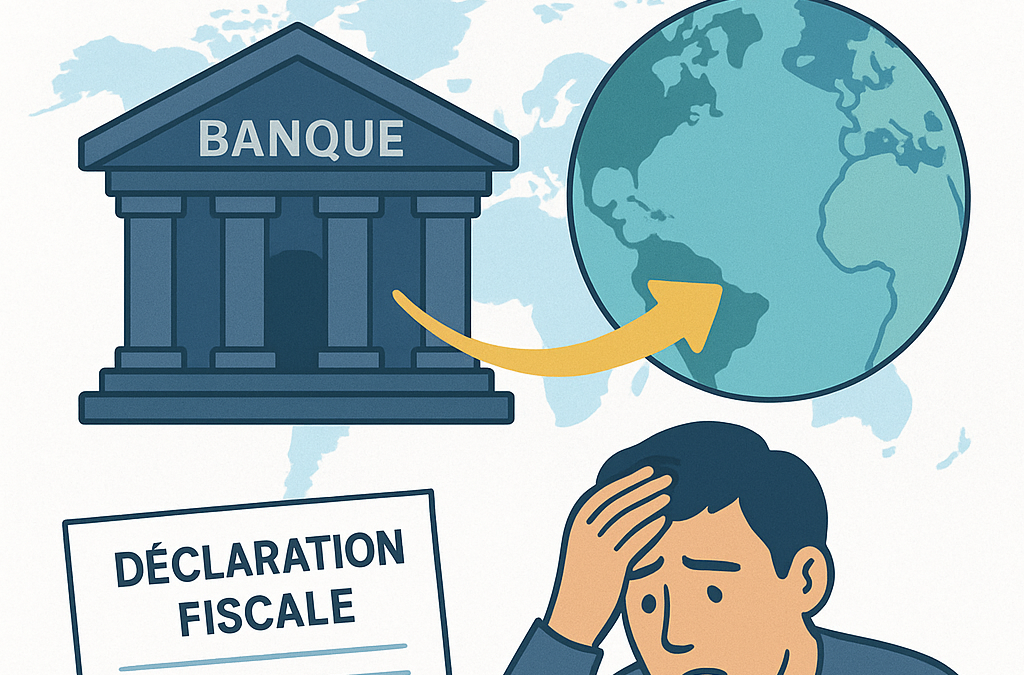
How to declare an account abroad?
To comply with the procedure, a taxpayer who holds an account abroad must use form no. 3916, which your tax lawyer can prepare, and tick box 8UU of return no. 2042.
All accounts abroad must be declared even if they have not been used at all during the year. The declaration is still required in the year the account is closed. Life insurance contracts must also be added to the declaration.
The declaration is annual, as for other types of income. A single declaration is sufficient for one’s own accounts abroad and those of one’s spouse.
Heavy penalties for non-compliance
In the case of undeclared foreign accounts (whose total balances reached €50,000 during the year), the tax authorities can go back over the last ten years.
The right of reassessment may be exercised for any failure to declare or any omission. This concerns income tax but also the IFI (real estate wealth tax, impôt sur la fortune immobilière; formerly the ISF, abolished in 2018), and inheritance and gift duties.
The taxes due are increased by 80% (Article 1729-0 A of the French General Tax Code (Code général des impôts, CGI)) if the tax office discovers hidden accounts abroad. These penalties are applied for a late declaration. It is therefore recommended to file your declaration as soon as possible.
If you have deliberately submitted an incomplete return, you are also exposed to certain penalties. The tax surcharge amounts to 40% in the case of deliberate breach. However, it rises to 80% in the case of abuse of law or fraudulent schemes (Article 1729 of the CGI). You must therefore be vigilant when declaring your accounts abroad. If in doubt, assistance from a tax lawyer is preferable.
A special unit for regularisations
To facilitate regularisations, Bercy (the French Ministry of Finance) had set up a specific unit (closed at the end of 2017, but regularisation remains possible). In this way, people who had forgotten to declare or had made errors in their returns could deal with contacts dedicated to processing their regularisation file.
This initiative was a success, as many holders of accounts abroad wished to regularise their situation. When the initial declaration did not comply with tax regulations, it is imperative to react quickly to avoid increasingly heavy penalties. Our tax law firm can assist you.
There is currently no longer a regularisation unit specifically dedicated to foreign accounts. But the regularisation procedure remains possible.
Finally, some countries regarded as tax havens, such as Switzerland, are putting pressure on their clientele to regularise their situation. Opening an account abroad therefore implies compliance with a number of tax rules, including the annual declaration of one’s foreign accounts and income.





0 Comments