
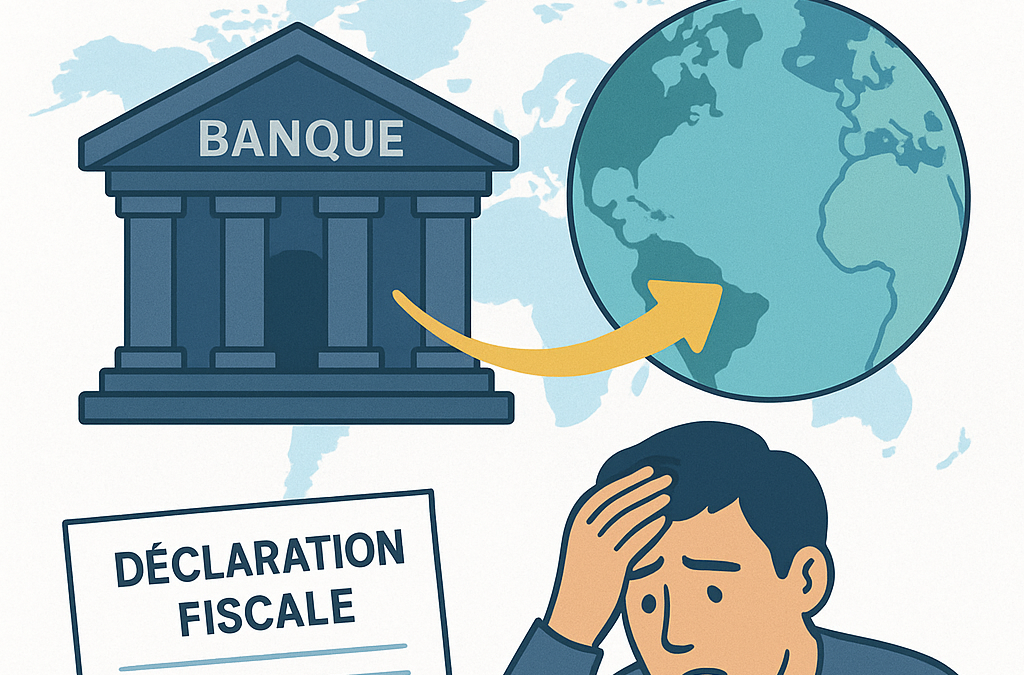
Accounts opened, held, used or closed abroad during the year concerned must be declared at the same time as taxable income. Because of the agreements on banking information that allow the tax authorities to collect banking information on French tax residents, some taxpayers may receive a tax return form with box 8 UU (the box corresponding to the holding of accounts abroad) already ticked.
Be aware that the tax authorities automatically receive information from foreign banks.
This is the myPOS system of the French tax authorities.
The taxpayers concerned must then carefully review their situation in order to declare all their accounts abroad. Be aware that failure to declare accounts abroad may expose you to heavy penalties. Furthermore, the agreements providing for the automatic exchange of banking information make it easier for the tax authorities to track down people who hold accounts abroad.
Find out about the various fines and penalties provided for by the regulations in force. Consider whether it is advisable to regularise your situation if you have forgotten to declare one or more accounts abroad, in order to fulfil your reporting obligations and to avoid, or at the very least limit, the risks to which you are exposed in the event of a tax audit.
What are your reporting obligations for accounts held abroad?
Every tax resident of France must declare, each year, the accounts they hold abroad.
However, some taxpayers have, deliberately or through simple oversight, failed to make these declarations.
When filling in your tax return form no. 2042, if you discover that box 8 UU corresponding to accounts held abroad is already ticked, this means in principle that the tax authorities have received information about you indicating that you may hold one or more accounts abroad.
Indeed, as the holder, beneficiary, joint holder or simply the beneficial owner of an account opened, held, used or closed abroad, you are required to declare it every year.
You must make this declaration by completing form no. 3916. If you are a tax resident of France or if you have dual tax residence, you remain bound by this obligation, even if you have already declared these accounts and even if you have already paid your taxes in another country.
Furthermore, since the beginning of 2019, you are also required to declare inactive accounts and dormant accounts held abroad.
Note, however, that PayPal accounts are accounts taken out with an institution domiciled in Luxembourg: they must therefore in principle be declared along with accounts abroad, unless the following three cumulative conditions are met:
• The account must be used to pay for online purchases or to collect receipts from the sale of goods;
• It must be linked to another account opened with a bank in France;
• The total amount received must not exceed €10,000 during the year.
If the PayPal-type account does not meet these three cumulative conditions, you must declare it on form no. 3916.
If you have not declared your account abroad within the deadlines set by the tax authorities, it may be advisable to carry out a regularisation in order to limit your exposure to the various tax and criminal penalties provided for. It should be noted that the limitation period is set at 3 years where the credit balances do not exceed €50,000 during the reference year. Above the €50,000 threshold, the limitation period increases to 10 years.
What fines and penalties apply in the event of non-declaration?
When you hold one or more accounts abroad and you decide not to fulfil your reporting obligations, or fail to do so through simple carelessness or lack of knowledge, the tax authorities may penalise you by imposing a fine of €1,500 per account, per year. Be aware that this fine may increase to €10,000 per account, per year, where the account was opened with a banking institution located in a State that has not signed an agreement with France facilitating access to banking data.
When you decide not to declare your assets, you are also exposed to other penalties such as an 80% surcharge in respect of wealth tax (ISF) (for years prior to 2018) or real estate wealth tax (IFI) and income tax and social security contributions.
If tax fraud is established following the investigation by the tax authorities, criminal proceedings may in certain cases be brought, and you are then in principle liable to a fine of up to €500,000 (€3,000,000 in the event of aggravating circumstances, or twice the proceeds derived from the offence) and a prison sentence of 5 years (7 years in the event of aggravating circumstances).
The legislation in force has recently required the tax authorities to refer cases to the Public Prosecutor (procureur de la République) when fraud is discovered with a reassessment amount exceeding €100,000. Below this threshold, the tax authorities retain the decision as to whether to refer the case to the prosecutor; they may therefore choose to refer the case to the prosecutor or not.
If you have not declared accounts abroad and you do not proceed with their voluntary regularisation, hoping that this will go unnoticed, it should be noted that banking information is increasingly accessible and various systems now enable the tax authorities to detect undeclared accounts abroad more quickly and more easily.
In general, when the tax authorities receive the list of French tax residents who have opened, hold or have closed an account abroad and these accounts have not been declared, a request for information is sent or box 8UU of form 2042 is directly pre-ticked.
The request for information is generally sent in respect of the “largest” accounts. For “smaller” accounts, the tax authorities most often simply pre-tick box 8UU of form 2042.
If you receive this request for information, it is strongly recommended that you reply within the deadlines set. Your reply must be clear and precise. It is strongly recommended that you contact a tax lawyer to assist you in drafting this reply, as your reply will bind you for the rest of the procedure.
You will in principle have to provide, in particular, concrete evidence explaining the origin of the funds held in the account, since, if you are unable to do so, you could in certain cases face a tax of 60% of the assets in the account. The tax authorities may also impose other penalties and surcharges on you, depending on the situation. It is strongly advised to gather all the necessary supporting documents in order to limit these penalties, as the total amount of fines/surcharges payable can quickly reach very high proportions.
If you receive a request for information (look at the top right-hand corner of the letter: the number is 751-SD), it seems in the vast majority of cases appropriate to seize this opportunity to regularise your situation by providing all the supporting documents required by the tax authorities. Your reply to the request for information and these various documents must be submitted to the department that sent you the request for information.
The officer in charge then carries out the review of the file.
Voluntary regularisation: a step generally recommended to limit fines and penalties
If the box corresponding to accounts abroad is pre-ticked on your tax return form, avoid unticking it if you are not certain that it is indeed an error on the part of the tax authorities. Carry out a thorough analysis to check whether you do in fact hold an account abroad. Next, you must in principle complete form no. 3916. Foreign income (interest on a savings account, for example) must in principle be reported on tax return forms no. 2042 and 2047.
Then, remember to regularise your accounts abroad for past years. This process requires the production of a file made up of numerous supporting documents. If you are not sure you can gather them, do not hesitate to seek the help of a qualified expert such as a tax lawyer.
It is important to understand that regularising accounts not declared abroad will not exempt you from the fines and surcharges provided for, but it will very often help to reduce them. Depending on the case, you may then be subject to a surcharge of 40% instead of 80% without regularisation, and to late-payment interest reduced by half.
The regularisation file for accounts abroad must be complete and comply with the requirements of the tax authorities. For example, you must generally provide the following documents:
• Amended income tax returns;
• Declarations of foreign income by completing form no. 2047;
• Declarations of accounts opened, held, used or closed abroad using form no. 3916;
• A written statement on the origin of the funds in the accounts abroad: you must provide all documents capable of proving the origin of the assets;
• Annual statements of income and statement of assets;
• Annual statements of gains and losses recorded on the accounts abroad;
• A sworn statement indicating that the declared accounts are the only ones you hold abroad.
Focus on the penalties applicable in the event of tax fraud
As a result of the recent international convention automating exchanges of banking information, the tax authorities now receive banking information from many countries. The tax authorities therefore find more easily taxpayers who hold accounts abroad. These various measures were introduced in order to reduce opportunities for tax evasion. In any event, taxpayers who have not declared their accounts abroad at the same time as their income can still carry out the voluntary regularisation of their situation in order to limit the penalties.
If the taxpayer does not reply to the request for information issued by the tax authorities, tax and criminal penalties may in certain cases be applied.
The tax authorities impose high tax surcharges and bring criminal proceedings against recalcitrant taxpayers who do not fulfil their legal obligations. Not only are the surcharges provided for very high, but the tax authorities in certain cases bring criminal proceedings, which taxpayers often find very hard to bear. If you find yourself in this situation, it is recommended that you call on a tax lawyer to help you limit the penalties.
In the event of a fraudulent attempt to conceal income abroad in order to evade tax obligations in whole or in part, the following penalties may be applied: a fine of €500,000 and a prison sentence of 5 years. It should be noted that the amount of this fine may be equal to twice the gains derived from the offence. Heavier penalties may be applied where the offence was committed by an organised gang or through the opening of an account abroad: the fine may reach €3,000,000 and the prison sentence may be increased to 7 years. It should be noted that the criminal court may increase the fine up to twice the proceeds derived from the offence.
The “material and intentional” constituent elements must be established for the tax authorities to be able to establish the offence of tax fraud. In other words, the tax authorities must:
– Provide evidence of the existence of material facts that enabled the total or partial non-payment of taxes;
– Prove the taxpayer’s deliberate intention to commit fraud.
In the case of the offence of tax fraud, the procedure does not fall under ordinary law; thus, except in cases of mandatory referral to the public prosecutor’s office (art. L228 of the Tax Procedures Handbook (LPF)), the Public Prosecutor may only bring proceedings upon a complaint filed by the tax authorities. The procedure is as follows: before filing a complaint, the tax authorities refer the matter to the Tax Offences Commission (Commission des infractions fiscales, CIF), which must issue a binding favourable opinion authorising the filing of the complaint. When the officer in charge receives this opinion, they may refer the matter to the competent criminal court: the complaint addressed to it is filed in the name of the Minister.
It should be noted that the most serious tax frauds must be reported to the public prosecutor’s office by the tax authorities.





0 Comments