
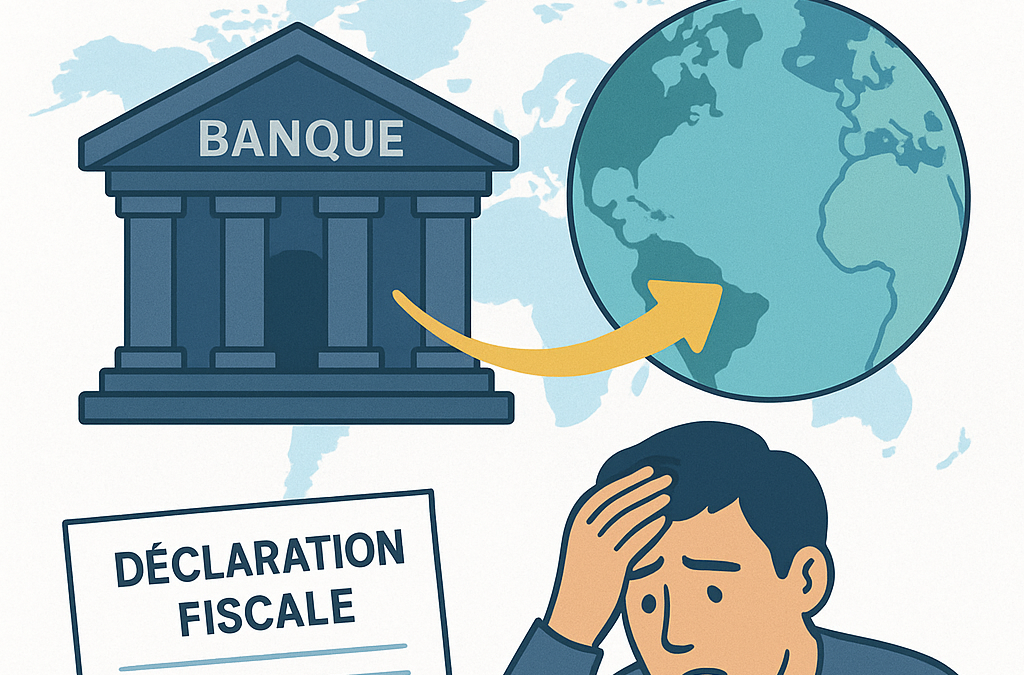
To carry out personal or business transactions abroad, benefit from an advantageous life insurance policy or trade currencies, you may need to open an account abroad. As a French tax resident, you are required to declare it every year to the tax authorities.
A systematic declaration of all your accounts
Whatever the reason for opening this account abroad, you should know that you are under a legal obligation to declare it every year to the tax authorities. The date the account was opened and, where applicable, the date it was closed must be stated, but the balance of the account is not required. This obligation has existed since 1 January 1990.
To make this declaration, you will need to obtain form 3916 and submit it with your usual income tax return. On this document, you will need to provide:
• Your surname, first names and date of birth if you are the direct owner of the account being declared. Otherwise, you must provide this information for the holder of the foreign account.
• The name and address of the financial institution with which the bank account was opened.
• The date the account was opened and, where applicable, the date it was closed.
• The corresponding account number, the type of account held, namely current or savings, and the intended type of use.
You will also need to tick box 8UU of return 2042 in the case of bank accounts and/or 8TT in the case of life insurance policies, and, in most cases, file a form 2047, which our tax law firm can prepare.
Penalties for failure to declare
This step is mandatory, so you expose yourself to heavy penalties if you decide to conceal this account from the tax authorities. The French General Tax Code (Code Général des Impôts, CGI) regards funds held in bank accounts as potential undeclared income.
In the event of an oversight or deliberate failure, you should be aware that you are liable to a fine of up to 10,000 euros. If other accounts are held, this measure applies to each of them. The income tax itself may be subject to a surcharge of up to 80%. However, the surcharge usually applied is 40%. To avoid this type of outcome, it is therefore strongly advisable to declare without fail any account held outside French territory; although preparing the returns remains fairly technical, you can ask a tax lawyer for assistance.
The case of life insurance policies
For this type of account abroad, the declaration procedure is somewhat different. You will therefore need to follow this procedure to the letter to be certain of complying with the regulations in force.
If you decide to complete the necessary formalities yourself, you will need to fill in form 3916 or make your declaration on plain paper.
As for a deposit or savings account, the declaration must include the name and address of the holder and the contact details of the chosen bank or insurance company. You must add the risks covered by this life insurance policy. The start date of the cover must also be provided.
Penalties provided for by the CGI for life insurance policies
Given the number of life insurance policies taken out abroad that are not declared, the 2013 Finance Act was intended to be stricter. It provides for a fine of 1,500 euros for each foreign life insurance policy that has not been declared in France. It goes further, since the penalty will reach 10,000 euros if the policy was taken out in a country that has no agreement with France for the exchange of banking information. “Tax havens” are in particular targeted by this measure.
To avoid this type of penalty, it is therefore strongly advisable to be transparent about this type of account held abroad. While they make it possible to benefit from advantageous terms, particularly in terms of returns, these policies can quickly become problematic for all holders who have chosen, or forgotten, to follow the tax rules in force. Warning: in the event of voluntary regularisation of these life insurance policies, a generally substantial file will have to be prepared, for which it seems highly advisable to use the services of a tax lawyer. Tax reassessments may sometimes be applied, in addition to the fines. You should contact a tax lawyer if you would like a specific review of your situation.
The countries that have signed agreements with France are increasingly numerous. These agreements allow the French tax authorities to be informed, on request, of any new life insurance account opened outside its territory. In this way, errors, failures to declare or oversights are more easily discovered. Penalties are quick to fall on all taxpayers who have not complied with the law in this area.
Holding an offshore bank account in 2019: between new legislation and tax risks
Despite their sulphurous reputation, accounts and companies based abroad are legal provided they are declared to the authorities. While it used to be fairly easy to escape French taxation by transferring one’s funds abroad, the new mechanisms make financial leakage considerably more difficult.
AEOI, or in its English version the AEOI for Automatic Exchange of Information, FATCA, the means used by tax auditors, international agreements: here is the essential information.
Bank accounts abroad: what do international conventions say?
Before 2014, tax havens represented a serious loss of revenue for France, which took matters in hand. Agreements were signed with the territories concerned and AEOI (échange automatique d’informations, EAI), the Automatic Exchange of Information, was introduced. A gigantic tracking system was designed to flush out fraudsters on a global scale.
2019: 102 AEOI jurisdictions, as many tax havens lost
Unlike its predecessor, the TIEA (Tax Information Exchange Arrangements), which allowed banks to wait for an official request before communicating information, AEOI requires each of them to report annually.
Since 2014, the Common Reporting Standard (Norme Commune de Déclaration, NCD; CRS in English) has committed Member States to transmitting their information in a universal format, which speeds up the detection of anomalies within the French tax services.
Each opening of a bank account in a foreign territory gives rise to a report to the tax authorities of the country of origin. Structures become more complicated since the signatory members also centralise their data: this is multi-jurisdictional exchange.
Call on an international tax expert for further details; countries that do not appear on the official list of AEOI jurisdictions (English acronym for EAI) are not necessarily exempt from obligations towards France. They have sometimes signed different conventions whose purpose is close to that of AEOI.
FATCA, the Foreign Account Tax Compliance Act, a law borrowed from the USA
Originally, FATCA is a US law aimed at detecting tax fraud on a global scale.
Adopted in the United States in 2010, it applies in France under the Franco-American agreement of 14 November 2013 (Law no. 2014-1098 of 29 September 2014), which enables the French Public Finances Directorate General (Direction Générale des Finances Publiques, DGFiP) to be notified as soon as one of its nationals attempts a transfer of undeclared funds via the United States.
The following are then communicated: the civil identity of the bank account holder, the detailed balance and the interest earned on it, the address provided… In short, everything needed to track you down.
The risks of opening a bank account in territories still regarded as “tax havens”
In principle, these countries will not report you to the French tax authorities. However, you should be aware that they are not a royal road to freedom. Apart from the fact that this is not legal from a tax perspective and is therefore very strongly discouraged (unless you declare it, but that will not be your objective), here is an overview of the pitfalls you may encounter.
Security and economic risks linked to logistics
Several practical problems arise. Opening an account discreetly means depositing money into it.
– by bringing it in person to territories that are sometimes politically unstable
– by sending it over the internet… with no certainty as to its final destination, since, after all, anyone can create an online storefront.
One bad investment, one careless click, and your assets vanish: you have no legal recourse.
Penalties increased since October 2018
The French General Tax Code provides for fines of up to €10,000 per account and per year. To this are often added tax reassessments in respect of income tax, or even wealth tax (ISF) (for years prior to 2018) or real estate wealth tax (IFI), increased by 40% or 80% depending on the case. Late-payment interest will also be applied, at the rate of 2.40% per year (0.20% per month; 4.80% per year for periods prior to 2018).
Finally, criminal penalties may in certain cases be added to the tax penalties.
Our tax law firm can assist you.



0 Comments