“Should I wait until 2027 to regularise my foreign account?” Since the French Government announced, in September 2026, a scheme for the regularisation of undeclared assets during 2027, this is the question being asked by many French tax residents who hold an account, a life insurance policy or a securities portfolio abroad without having declared it.
There is no single answer. This article sets out, in simple terms, the factors to be weighed up: what is known about the future scheme, what may argue in favour of waiting, the situations in which waiting can prove costly, and what can be prepared right now. It deals only with French taxation. Status as of 11 October 2026: the scheme has been announced, but no legal text sets out its conditions.
In brief
- The 2027 regularisation scheme has been announced, not created: neither the scale, nor the scope, nor the opening date is known to date.
- If the plan is confirmed, waiting may be preferable in many cases, because it should in principle offer rules known before any commitment is made.
- Waiting nevertheless has a cost and carries risks: late-payment interest continues to run, a further year of non-declaration is added, and the tax authorities may make the first move.
- Where a letter from the tax authorities requesting regularisation has already been received, waiting for 2027 is generally no longer an option: the letter sets its own time limits.
- Whatever the choice, reconstructing the origin of the funds often takes several months and may, depending on the case, be started without waiting.
- The decision depends on each situation and is taken after a lawyer has analysed the case.
Contents
- The starting point: a scheme announced, not yet created
- What may argue in favour of waiting for 2027
- Situations in which waiting may be risky
- Worked example: what a year of waiting costs
- Worked example: a letter received and the origin of the funds
- What can be prepared right now
- What I see in my cases
- The most common mistakes
- FAQ
- Reference texts
The starting point: a scheme announced, not yet created
On 17 September 2026, the French Prime Minister announced that taxpayers who hold undeclared assets, particularly abroad, would be able to put their affairs in order during 2027. The press kit for the 2027 budget, presented on 1 October 2026, refers to an “exceptional tax compliance mechanism” (mécanisme exceptionnel de mise en conformité fiscale). However, this mechanism does not appear in the Finance Bill (projet de loi de finances) introduced in the National Assembly (Assemblée nationale) on the same day. Its penalty scale, the assets covered, the department responsible and the opening date remain unknown.
The closest precedent is the STDR (service de traitement des déclarations rectificatives), the unit that handled amended returns, open from 2013 to the end of 2017. It was not an amnesty: the tax and late-payment interest remained due in full, and only the penalties were reduced, according to a public scale. This precedent provides reference points; it says nothing about the conditions that will be adopted in 2027. The status of the scheme, its timetable and the details of the 2013 precedent are followed on the page tax regularisation 2027: where does the scheme stand?, updated at each stage.
In the meantime, regularisation remains possible under the ordinary conditions, known to lawyers as the “ordinary rules” (droit commun): amended returns, payment of the tax and late-payment interest, then discussion of the penalties on a case-by-case basis, with no scale set in advance. These rules are set out in detail in the article forgetting to declare a foreign account: what can be done?.
What may argue in favour of waiting for 2027
Every case is different. Generally speaking, if the plan is confirmed, waiting for the 2027 framework may be preferable in many cases, for several reasons.
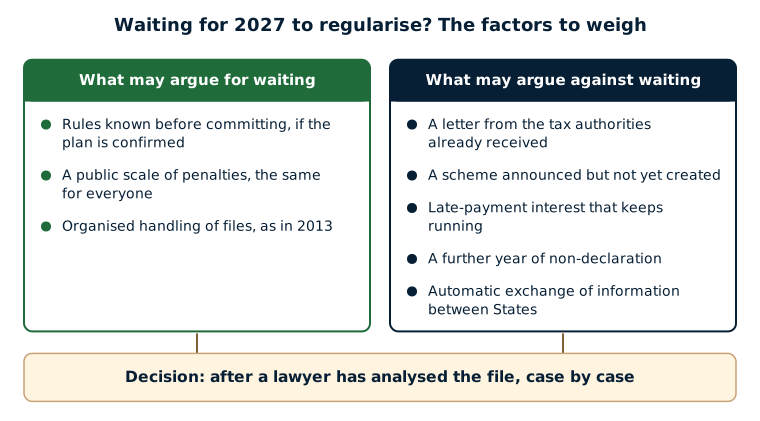
- Rules known in advance. A dedicated scheme in principle sets a public penalty scale, the same for everyone. Before coming forward, the person knows what they will pay on top of the tax and interest. Under the ordinary rules, penalties are discussed on a case-by-case basis, with no prior visibility.
- Organised processing. In 2013, a unit was set up to receive these files, with known supporting documents to provide and a known calculation method. A comparable framework would make it easier to prepare files, but nothing guarantees at this stage that it will be repeated.
- What is at stake with penalties. For a tax reassessment linked to an undeclared foreign account, the law currently provides for a surcharge that can reach 80% of the tax reassessed. On large amounts, the rate applied carries great weight; a public scale makes it possible to know it before committing.
Situations in which waiting may be risky
Several factors may, depending on the case, argue the other way. They are not mutually exclusive: a single file often combines several of them.
A letter from the tax authorities has already been received
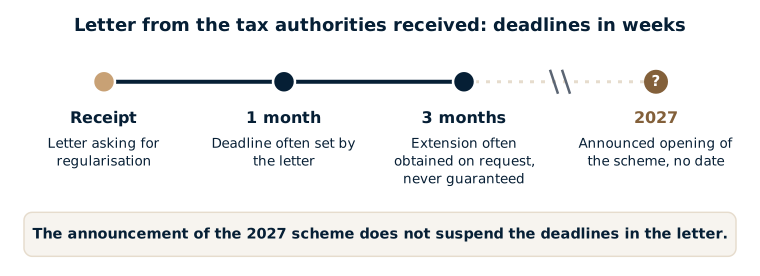
This is the clearest situation. Where the tax authorities have already written to request regularisation or explanations about a foreign account, the matter is no longer solely in the taxpayer’s hands: the letter sets a time limit for replying. In my practice, this time limit is often one month, and it is often possible to have it extended to three months. It is not a time limit laid down by law, and an extension is never guaranteed in advance: it has to be requested, generally in writing, before the deadline.
The announcement of a future scheme does not suspend these time limits. A failure to reply, or an insufficient reply, may lead the tax authorities to pursue the procedure. Where the request concerns the origin of the assets in an undeclared account (Article L23 C of the French Tax Procedure Code, livre des procédures fiscales), the law in principle provides for a period of sixty days, then thirty days after a formal notice; failing justification, the assets may be taxed as wealth received free of charge, at the rate of 60%. The 2013 scheme was moreover reserved for voluntary steps, taken before any procedure: if this condition were retained in 2027, which is not known, a person already questioned might not have access to it.
What may be done after such a letter is set out in detail in the article request to regularise an undeclared foreign account: what can be done and what to expect. In this case, consulting a lawyer as soon as the letter is received makes it possible to make the best use of the time available.
The scheme does not yet exist
An announcement is not a legal text. The mechanism may come into being in 2027, later, in another form, or not at all: it does not appear in the draft budget, the budget timetable is uncertain, and a presidential election is scheduled for spring 2027. Its conditions may also turn out to be less favourable than hoped, or exclude certain situations.
Late-payment interest continues to run
The 2013 scheme did not reduce late-payment interest. It is due, in principle, at the rate of 0.20% per month, i.e. 2.4% per year, on tax paid late, from the date on which it should have been paid. Each month of waiting increases it.
A further year of non-declaration is added
A foreign account is in principle declared every year, with the income tax return. As long as the situation has not been regularised, each new return filed without the account adds a year: a new fine of €1,500 per account (€10,000 if the account is located in a State that has not concluded an agreement on the exchange of information with France) and, where applicable, the income tax for the year. Conversely, the oldest year may fall outside the period during which the tax authorities can still claim the tax, in principle ten years for income from an undeclared foreign account: see the article on limitation periods. The net effect depends on each case.
The tax authorities may make the first move
Through the automatic exchange of information, the French tax authorities receive data every year on accounts held abroad by French residents: see also can the French tax authorities see your foreign bank accounts?. Nothing prevents the tax authorities from opening a file before the future scheme opens. If, as in 2013, the scheme is reserved for people who come forward of their own accord, a letter received in the meantime could close that door.
Worked example: what a year of waiting costs
A French tax resident has held an undeclared securities account with a foreign bank for more than ten years, worth €1,500,000. For the years the tax authorities can still audit, the unpaid income tax and social security contributions on the account’s dividends, interest and capital gains amount to €380,000. He has not received any letter and is hesitating about waiting for the 2027 scheme to open.
| Item | Calculation | Amount |
|---|---|---|
| Tax and social security contributions due | Years that can still be audited | €380,000 |
| Additional late-payment interest, per month of waiting | 380,000 × 0.20% | €760 |
| Additional late-payment interest for twelve months of waiting | 760 × 12 | €9,120 |
| Fine for a further year of non-declaration | 1 account | €1,500 |
| Surcharge at the maximum rate currently provided for an undeclared foreign account | 380,000 × 80% | up to €304,000 |
| Weight of 10 points of surcharge | 380,000 × 10% | €38,000 |
The cost of a year of waiting can be calculated: around €10,600 in this example, excluding the tax for the additional year. The possible gain, on the other hand, depends on a scale that nobody yet knows; all that is known is that each band of 10 points of surcharge represents €38,000 here. This calculation does not take account of the other factors to be weighed up, in particular the risk that a letter from the tax authorities arrives before the scheme opens. It shows why the decision is taken case by case, with figures in hand.
Worked example: a letter received and the origin of the funds
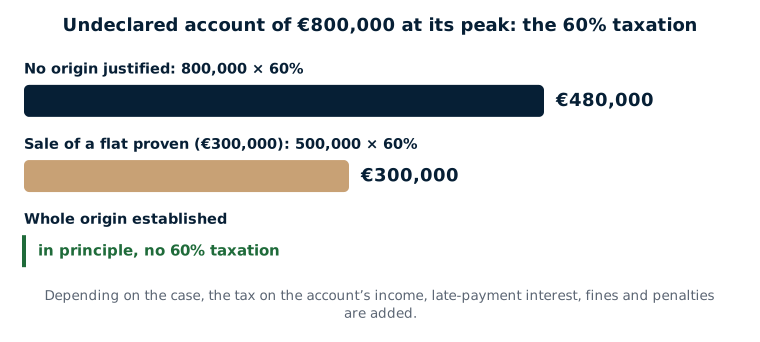
A French tax resident receives a letter from the tax authorities about an undeclared account held with a foreign bank, which reached a peak of €800,000 over the last ten years. She can prove that €300,000 comes from the sale of an apartment, with deeds to support it. For the remaining €500,000, saved a long time ago, she has no documents.
- If the origin of all the sums remained unjustified: 800,000 × 60% = €480,000.
- With proof of the sale of the apartment: (800,000 − 300,000) × 60% = 500,000 × 60% = €300,000.
- If the origin of the remaining €500,000 were also established: in principle, no 60% taxation.
Depending on the case, the tax on the account’s income, late-payment interest, fines and penalties come on top of these sums. In this situation, waiting for 2027 makes little sense: the time limit set by the letter is already running, and each document found during that period may change the outcome by several hundred thousand euros.
What can be prepared right now
Waiting for the legal text does not mean remaining inactive. Whatever framework is finally adopted, several tasks take time and may, depending on the case, be started right away, with the help of a lawyer:
- Gathering the account statements for the last ten years, which often takes several weeks with a foreign bank, longer if the account has been closed.
- Reconstructing the origin of the funds: an inheritance, a gift, income earned while the person was living abroad, the sale of an asset. This is often the longest task, as the facts sometimes go back several decades.
- Quantifying what is at stake: tax on the account’s income year by year, late-payment interest, fines, and possible taxation of the portion whose origin may not be justified.
- Comparing the options: regularisation under the ordinary rules now, waiting for the scheme, or replying to a letter already received, depending on the situation.
This preparatory work involves no commitment towards the tax authorities. It makes it possible, on the day the conditions are published, to decide quickly and with full knowledge of the facts. To be notified of that publication, the page following the scheme offers an email alert.
What I see in my cases
Since the announcement of 17 September 2026, this is the question I am most often asked by clients and by people who consult me: should they wait until 2027? My answer is as follows: every case is specific, but in general, if the plan is confirmed, it is better to wait until 2027. There will then, in principle, be a clear framework, with ground rules known before any commitment is made. This general answer does not replace the examination of each situation.
There is one situation in which I generally advise against waiting: where a letter from the tax authorities requesting regularisation has already been received. These letters often allow one month. In my practice, it is often possible to have this extended to three months, which leaves time to prepare a serious file; but this time limit should not be confused with the still unknown timetable of the future scheme.
I handled many regularisation cases at the time of the STDR, and I still handle them today. The main difficulty remains justifying the origin of the funds, which often goes back several decades, while the tax authorities ask for many supporting documents and are demanding on this point. This is why preparation time matters as much as the choice of timing. The people who consult me are often very worried; their situation generally seems more serious to them than it actually is, and a calm examination of the file often makes things clearer.
Lastly, the whole art of these cases lies in saying enough, but not too much, while always keeping to a truthful presentation of the facts: never a lie, which I very strongly advise against and will not accept. Knowledge of the tax authorities’ practices does, on the other hand, make it possible to present the file in the most favourable light, whether the regularisation takes place now or in 2027.
The most common mistakes
- Believing that the desk is already open, or that its conditions will be those of 2013: to date there is only an announcement, with no legal text.
- Letting the time limit in a letter from the tax authorities lapse while counting on the future scheme: the announcement does not suspend any time limit.
- Waiting without preparing anything: reconstructing the origin of the funds often takes several months, whatever framework is adopted.
- Thinking that 2027 will wipe out the tax: in 2013, the tax and late-payment interest remained due in full.
- Acting in haste, for example by filing incomplete amended returns alone, or by closing the account and transferring the funds without prior analysis: some choices are then difficult to correct.
- Relying on forums rather than on an examination of one’s own file: two situations that look similar may call for very different answers.
FAQ
Should you wait until 2027 to regularise a foreign account?
It depends on each situation and is decided after a lawyer has analysed the case. If the plan is confirmed, waiting may be preferable in many cases, in order to benefit from rules known in advance. But the scheme does not yet exist, late-payment interest continues to run, and a letter from the tax authorities received in the meantime may change the situation.
I have received a letter from the tax authorities asking me to regularise: can I wait until 2027?
Generally, no: the letter sets its own time limits, often one month in practice, which the announcement of the scheme does not suspend. An extension, often up to three months, can sometimes be obtained on request, without this being guaranteed. Nor is it known whether the 2027 scheme will be open to people already questioned by the tax authorities. Consulting a lawyer as soon as the letter is received makes it possible to make the best use of this time.
How much does a year of waiting cost?
At the very least, the additional late-payment interest (in principle 0.20% per month, i.e. 2.4% per year of the tax due) and, in the event of a further undeclared year, a fine of €1,500 per account (€10,000 for certain States). For €380,000 of tax due, this represents around €9,120 of interest over twelve months.
Will the 2027 scheme reduce the tax to be paid?
Nothing indicates that it will. The 2013 scheme reduced only the penalties; the tax and late-payment interest remained due in full. The conditions for 2027 are not known.
What can be done while waiting for the conditions to be published?
Depending on the case, preparing the file with a lawyer: gathering the statements, reconstructing the origin of the funds, quantifying what is at stake and comparing the options. This work involves no commitment towards the tax authorities and makes it possible to decide quickly on the day the conditions are published.
What if the scheme is not created after all?
Regularisation would remain possible under the ordinary rules, with penalties discussed on a case-by-case basis. The time that has passed would, however, have increased the late-payment interest and, where applicable, added years of non-declaration. This is one of the factors to be weighed up before choosing to wait.
Reference texts
- French Government, “Budget 2027” press kit, 1 October 2026 (“exceptional tax compliance mechanism”); Projet de loi de finances pour 2027 (Finance Bill for 2027), no. 3210, introduced in the National Assembly on 1 October 2026.
- Budget Minister’s circulars of 21 June 2013, 12 December 2013, 10 December 2014 and 14 September 2016 (processing of amended returns from taxpayers holding assets abroad).
- French General Tax Code (CGI): Article 1649 A (declaration of foreign accounts), Article 1727 (late-payment interest), Article 1729-0 A (80% surcharge), Article 1736 (fines for an undeclared account), Article 755 (60% taxation of assets of unjustified origin).
- French Tax Procedure Code (LPF): Article L23 C (request for justification of the origin of the assets), Article L169 (ten-year reassessment period).
Waiting for 2027 or regularising before then, replying to a letter, reconstructing the origin of the funds: these choices often involve large amounts and are made only after the situation has been analysed. Maître Uzan, a tax lawyer and member of the Paris Bar since 2008, has handled many foreign account regularisation cases, both at the time of the STDR and since. See also the page regularising an undeclared foreign account, the article on the fines for failing to declare, or book an appointment.