
“Can the tax authorities see my crypto?” With the European DAC 8 directive, the answer has changed. Since 1 January 2026, crypto-asset platforms have been collecting the identity of their customers and the details of their transactions, in order to pass them on to the tax authorities. The first data will reach the French tax authorities in 2027.
The same mechanism has existed for foreign bank accounts since 2017. In my cases, the first letters from the tax authorities arrived two years later, in 2019. This article explains in simple terms what DAC 8 provides for, what the tax authorities will and will not see, why first letters could arrive as early as the end of 2027, the risks of an undeclared crypto account, and what can be prepared right now. It deals only with French taxation. Status as of 11 October 2026: platforms have been collecting the data since 1 January 2026; the first transmissions to the French tax authorities are scheduled for no later than 15 June 2027 for platforms that report in France, and no later than 30 September 2027 for those in the other EU countries.
In brief
- DAC 8 extends to crypto-assets the automatic exchange of information that has existed for bank accounts since 2017: since 1 January 2026, platforms have been collecting the identity of their customers and the details of their transactions.
- This data reaches the French tax authorities in 2027: by 15 June at the latest for platforms that report in France, and by 30 September at the latest for those in the other EU countries. Other countries follow in 2027, 2028 and 2029.
- For bank accounts, the first letters arrived in my cases in 2019, around two years after the first exchanges. Since then, they have generally asked for the same thing: regularisation covering ten years and supporting documents on the origin of the funds.
- The same scenario could repeat itself, and faster: the tax authorities now have the experience and the channels of the automatic exchange of bank information. First letters could arrive as early as the end of 2027, with a probable ramp-up in 2028. No official timetable has been announced: this is a projection.
- Since 2025, the law has applied most of the rules for foreign bank accounts to crypto accounts opened abroad: audits possible over ten years, an 80% surcharge on tax reassessed, and 60% taxation of assets whose origin is not justified.
- In some of the cases I handle, in-depth audits have already taken place, without waiting for DAC 8. Each situation deserves to be analysed with a lawyer, to identify the most appropriate steps.
Contents
- What is DAC 8?
- The timetable: data in 2027, other countries afterwards
- The precedent of foreign bank accounts
- From the end of 2027: the first letters?
- What the law says: an arsenal very close to that for foreign bank accounts
- What I see in my cases
- Worked example: 2026 sales, declared or discovered
- Worked example: past gains and a lost history
- What can be prepared right now
- A few mistakes to avoid
- FAQ
- Reference texts
What is DAC 8?
DAC 8 is the common name for Directive (EU) 2023/2226 of 17 October 2023. It supplements the European directive on administrative cooperation in the field of taxation, known as the “DAC”, by adding crypto-assets to it. It incorporates a global standard adopted by the OECD in 2022, the Crypto-Asset Reporting Framework (CARF), which is modelled on the automatic exchange of bank information.
Each year, platforms report their customers’ transactions to the tax authorities of their own country. Those authorities then pass the information on to the authorities of the country where each customer is resident. A French tax resident who uses a platform established in another EU country will therefore have their transactions communicated to the French tax authorities.
In France, the directive was transposed by article 54 of the Finance Act for 2025, which created articles 1649 AC bis to 1649 AC sexies of the French General Tax Code. A decree of 19 December 2025 sets out the detailed rules: the platforms concerned had to register with the tax authorities before 15 April 2026, then file each year, by 15 June at the latest, the return covering the previous year’s transactions.
Which platforms are concerned?
The rules cover crypto-asset service providers: exchange platforms, brokers and, more broadly, providers that carry out purchases, sales or exchanges of crypto-assets for their customers. Staking and the lending of crypto-assets are expressly included. A platform established outside the EU that has customers resident in the EU must in principle also register and report in an EU country, unless its own country applies the OECD standard with an exchange agreement in force.
It is not for the customer to pass this information on to the tax authorities: the platform does so, provided that the customer is resident in an EU country. The customer gives the platform the information it requests, in particular their tax identification number; failing this, after two reminders and a period of sixty days, the platform must in principle prevent the customer from carrying out transactions.
What platforms report, and what they do not
| What the tax authorities will receive | What they will not receive |
|---|---|
| The customer’s identity: name, address, date of birth, country of tax residence and tax identification number | The purchase price of crypto-assets acquired before 2026, and the total acquisition price of the portfolio, in the tax sense |
| For each crypto-asset and for the year: total purchases and sales for euros or another currency (amounts, number of units, number of transactions) | The amount of the taxable gain |
| Exchanges of one crypto-asset for another, even when they are not taxable | The contents of a personal wallet, whose keys are kept by the customer themselves |
| Transfers, including to wallet addresses that are not linked to any platform | Transactions carried out before 2026, under DAC 8 |
| Certain payments for goods or services made in crypto-assets through the platform | The value of the account at the end of the year, which banks do report for bank accounts: DAC 8 covers transactions, not the assets held |
The tax authorities will therefore see sales amounts, not gains. A sale of €1,000,000 may correspond to a gain of €700,000, or to a loss. Only the taxpayer can establish their acquisition price, from their transaction histories and statements. This is why, with DAC 8, keeping documents takes on new importance.
The timetable: data in 2027, other countries afterwards
| Date | Stage |
|---|---|
| 1 January 2026 | Start of data collection by platforms, for 2026 transactions |
| Before 15 April 2026 | Registration of platforms with the French tax authorities |
| Spring 2027 | Declaration of 2026 income by taxpayers: gains (form 2086) and accounts abroad (form 3916-bis) |
| 15 June 2027 at the latest | First return filed by platforms that report in France |
| 30 September 2027 at the latest | First exchanges of information between EU countries |
| 2027 | First exchanges announced with a first wave of countries committed to the OECD standard, including the United Kingdom and the Cayman Islands |
| 2028 | Second wave announced, including Switzerland, Singapore, Hong Kong and the United Arab Emirates |
| 2029 | The United States, according to announcements |
Transactions carried out in 2026 are declared in spring 2027, with the income tax return, at the very moment when the tax authorities start receiving the platforms’ data. Matching the two may therefore begin as early as autumn 2027.
The precedent of foreign bank accounts
To understand what could happen, the simplest approach is to look at what happened with bank accounts. The OECD standard for automatic exchange, incorporated in the European Union by the directive known as “DAC 2”, led foreign banks to report every year the accounts of their customers resident in other countries. France was among the first countries to apply it: the first exchanges took place in 2017, for accounts held in 2016, and other countries followed from 2018 (see the article on the automatic exchange of bank account information).
What followed took place in three stages:
- End of 2017: the closure of the regularisation desk. The STDR (service de traitement des déclarations rectificatives), the unit opened in 2013 to handle amended returns relating to undeclared assets abroad, closed on 31 December 2017, owing to the entry into force of the automatic exchange.
- 2019: the first letters, in my cases. They arrived around two years after the first exchanges, sent to taxpayers reported by foreign banks. According to a ministerial reply, the revenue from the fine for undeclared foreign accounts rose from €3 million in 2018 to €17.5 million in 2019.
- Then: systematic matching. From the return for 2019 income, filed in 2020, the tax authorities automatically displayed annex 3916, the annex for accounts abroad, to taxpayers reported through the international exchanges. The online return cannot then be validated without completing the annex, and a person who deletes it is informed of the penalties incurred (see the guide to form 3916, step by step).
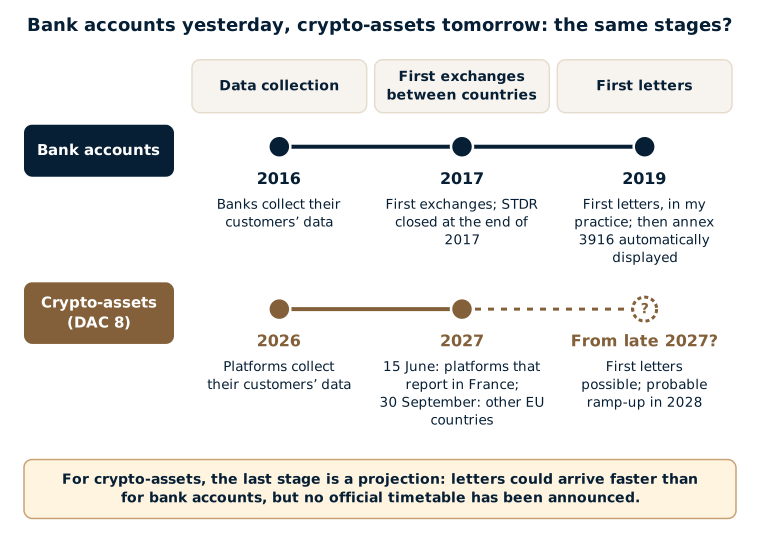
What this precedent shows: in my cases, these letters are not limited to the years reported by foreign banks; they ask for regularisation covering ten years and supporting documents on the origin of the funds.
From the end of 2027: the first letters?
Nothing has been officially announced. But if the tax authorities follow, for crypto-assets, the path they followed for bank accounts, several stages can be anticipated.
Matching data with tax returns
In autumn 2027, the tax authorities will have two sets of information for each reported resident of France: what the platforms reported for 2026, and what the taxpayer personally declared in spring 2027. Discrepancies may then easily come to light: an account opened on a foreign platform without a form 3916-bis, large sales for euros without a form 2086, repeated transfers to personal wallets…
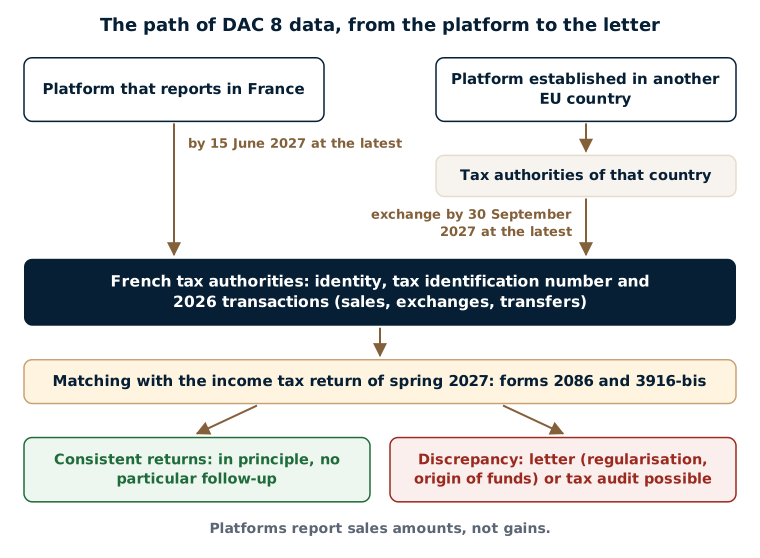
First letters as early as the end of 2027, a probable ramp-up in 2028
For bank accounts, around two years passed, in my cases, between the first exchanges and the first letters. This time, the tax authorities are not starting from scratch: they have been using data from the automatic exchange of bank information since 2017, they already automatically display the foreign accounts annex in the online return, and part of the data will reach them as early as June 2027, directly from the platforms that report in France. Letters could therefore begin to arrive as early as the end of 2027, multiply in 2028, then recur every year as new data comes in.
What forms could they take?
Their content could resemble that of the letters received for bank accounts, since the law now gives the tax authorities the same tools for crypto accounts (see below). The forms could be those experienced by holders of foreign bank accounts:
- an annex 3916-3916-bis automatically displayed in the online return, for crypto accounts, as the bank accounts annex was from the return for 2019 income;
- a request for information, inviting the taxpayer to regularise the situation (see the article request to regularise an undeclared foreign account: what can be done and what to expect);
- a request for justification of the origin of the assets (article L23 C of the French Tax Procedure Code), possible since 2025 for undeclared crypto accounts, which in principle allows sixty days to reply;
- or, directly, a tax audit, for example an in-depth review of personal tax situation (ESFP; see the forms of tax audit): this has already happened in my cases.
These letters could concern 2026 transactions, but also earlier years: as with bank accounts, an account revealed by a single year’s data may lead to questions covering ten years.
These stages are a projection based on the precedent of bank accounts and on the state of the law as of 11 October 2026; neither their form nor their timing has been announced by the tax authorities.
What the law says: an arsenal very close to that for foreign bank accounts
What is taxable
For an individual who manages their crypto-assets without a professional activity, the French rules are, in principle, as follows (article 150 VH bis of the French General Tax Code):
- selling crypto-assets for euros or another currency, or using them to pay for goods or a service, including with a payment card backed by a crypto account, is taxable;
- exchanging one crypto-asset for another is in principle not taxed at the time;
- gains are exempt where total disposals in the year, for the whole tax household, do not exceed €305;
- the gain is in principle taxed under the flat tax: 31.4% for disposals made since 2025 (12.8% income tax and 18.6% social security contributions), 30% previously, unless the progressive scale is opted for;
- it is calculated using a formula specific to crypto-assets, based on the total acquisition price of the whole portfolio, and is declared on form 2086.
These rules are set out in detail on the page cryptocurrency taxation and in the article how to declare your cryptocurrencies.
What must be declared: form 3916-bis
Irrespective of any sale, a French tax resident must in principle declare every year, with their income tax return, crypto-asset accounts opened, held, used or closed with a platform established abroad (article 1649 bis C of the French General Tax Code; form 3916-3916-bis). Since the Law of 25 June 2026 on combating social and tax fraud, the obligation expressly covers crypto-asset wallets and non-fungible tokens (NFTs).
A personal wallet, whose keys are kept by the person themselves, is not an account opened with an institution: it is in principle not covered by this declaration. A proposal to require it to be declared above a certain amount was rejected when that law was examined, in spring 2026. See the article on declaring foreign cryptocurrency accounts.
The risks of an undeclared account
Before the Finance Act for 2025, an undeclared crypto account abroad mainly exposed its holder to a fine. That Act extended to crypto-asset accounts the audit and penalty tools that already existed for bank accounts and life insurance policies abroad. The Law of 25 June 2026 completed the framework.
| In principle | Bank account abroad | Crypto account abroad |
|---|---|---|
| Annual declaration | Form 3916 (article 1649 A) | Form 3916-bis (article 1649 bis C) |
| Fine for failure to declare | €1,500 per account (€10,000 if the account is located in a State that has not concluded an agreement on the exchange of information with France) | €750 per account, or €125 per omission or inaccuracy up to a limit of €10,000 per return; €1,500 and €250 if the value of the accounts exceeds €50,000 at any time during the year |
| Period during which the tax can be claimed | Up to ten years | Up to ten years, since 2025 |
| Surcharge on tax reassessed in connection with the account | 80% | 80%, since 2025 |
| Origin of the assets not justified after a request from the tax authorities | 60% taxation | 60% taxation, since 2025 |
| Inheritance or gift tax and IFI (real estate wealth tax) relating to the assets | Audit possible over ten years | Audit possible over ten years, since the Law of 25 June 2026 |
The ten-year period does not revive years already time-barred when the Finance Act for 2025 came into force, in February 2025, and the 80% surcharge in principle applies only to failures committed since then; for earlier years, the surcharges under the ordinary rules apply, depending on the case (see the limitation periods for an undeclared foreign account). The amounts of the fines are those set by article 1736 of the French General Tax Code (see the fines for failing to declare). Since the Law of 25 June 2026, the tax authorities may also seize, in order to recover a tax debt, crypto-assets held on the taxpayer’s behalf by a digital asset service provider.
What I see in my cases
With foreign bank accounts, the first letters linked to the automatic exchange arrived in my cases as early as 2019, and they have been much the same ever since. The tax authorities ask for regularisation covering ten years and supporting documents on the origin of the funds. In fact, it is almost always such a letter that reveals the account: the tax authorities learned of it through the automatic exchange.
With crypto-assets, the tax authorities have not waited for DAC 8. In some of the cases I handle, information on the use of payment cards linked to accounts opened on a large exchange platform established abroad has already reached the tax authorities. In these cases, they did not send simple invitations to regularise: they opened genuine tax audits, in-depth reviews of personal tax situation. By its nature, such a review looks at the consistency between the income declared and the person’s overall situation: accounts, wealth, lifestyle. In these cases, the tax authorities examined everything in detail, well beyond the crypto-assets alone.
For those who have failed to declare gains on crypto-assets, my first piece of advice is to discuss the matter with a lawyer, in order to see which steps are the most appropriate to their situation. In many cases, it may be useful to retrieve right now all the supporting documents on the origin of the funds invested and the complete history of transactions on each platform. Depending on the case, the question of voluntary regularisation may also arise. In my experience with bank accounts, the tax authorities may be slightly more lenient towards a voluntary approach, although generally without a great difference in treatment: it is one factor among others, to be weighed case by case.
Lastly, when faced with a letter or an audit, the temptation to explain everything at once is strong. In my practice, the reply remains truthful and precise on what is asked, without going further: replies that are too long or too detailed often open up new questions. The whole art of these cases lies in saying enough, but not too much, without ever departing from a truthful presentation of the facts.
Worked example: 2026 sales, declared or discovered
A French tax resident has held, for several years, an account on a platform established in another EU country, which he has never declared. In 2026, he sells all his crypto-assets for €1,000,000, paid into his bank account. He had bought them for a total of €300,000: his gain is €700,000.
In 2027, the platform reports his identity, his tax identification number and his 2026 sales. The tax authorities see €1,000,000 of sales; they see neither the purchase price nor the gain.
| Item | Transaction declared in spring 2027 | Transaction discovered by the tax authorities, for example in mid-2028 |
|---|---|---|
| Tax: 700,000 × 31.4% | €219,800 | €219,800 |
| Late-payment interest: around 12 months × 0.20% | – | €5,275 |
| 80% surcharge on the tax, if applied | – | €175,840 |
| Total | €219,800 | up to €400,915 |
These amounts do not include the contributions on high incomes, which may be added depending on the household, nor, in the second case, any fine for the unfiled form 3916-bis. In the first case, the gain and the account are declared with the 2026 income: the gain is simply taxed, like any other gain of the year. In the second, the cost may almost double, not counting questions about the account’s earlier years, which may go back up to ten years. Transactions carried out in 2026 are declared in spring 2027, at the very moment when the tax authorities start receiving the data: this return therefore deserves, depending on the case, particular attention, ideally with the help of a lawyer. Undeclared earlier years call for a separate analysis.
Worked example: past gains and a lost history
A French tax resident opened an account in 2018 on a platform established abroad, which she has never declared. She paid €200,000 into it from her French bank account, in 2018 and 2019. In 2024 and 2025, she sold some of her crypto-assets, with a gain of €300,000 each year, which she did not declare. In 2026, she still carries out a few transactions on this account, which at the end of 2026 holds crypto-assets worth €800,000.
The 2026 data flags the account to the tax authorities, which write to her, for example in the first half of 2028, asking for regularisation covering ten years and supporting documents on the origin of the funds. Without the ten-year rule, the tax for 2024 could no longer be claimed after the end of 2027; with it, the tax authorities may in principle claim it until the end of 2034.
| Item | Calculation | Amount |
|---|---|---|
| Tax on the 2024 gain | 300,000 × 30% | €90,000 |
| Tax on the 2025 gain | 300,000 × 31.4% | €94,200 |
| Late-payment interest, calculated up to mid-2028 | 90,000 × 0.20% × 36 months + 94,200 × 0.20% × 24 months | €11,002 |
| 80% surcharge on the tax, if applied | 184,200 × 80% | €147,360 |
| Total, excluding fines | up to €342,562 |
Depending on the case, these amounts are increased by the fines for the unfiled forms 3916-bis, in principle €1,500 per year concerned, as the value of the account exceeds €50,000, and by the contributions on high incomes.
The origin of the funds: the difference the history makes
The biggest issue lies elsewhere: the origin of the €800,000 of assets. If it is not justified following the tax authorities’ request, these assets may be taxed as wealth received free of charge, at the rate of 60%.
- If nothing were justified: 800,000 × 60% = €480,000.
- If only the payments of €200,000 were proved, by her French bank statements, the platform history having been lost: (800,000 − 200,000) × 60% = 600,000 × 60% = €360,000.
- With the payments and the complete history of purchases, sales and exchanges: in principle, no 60% taxation.
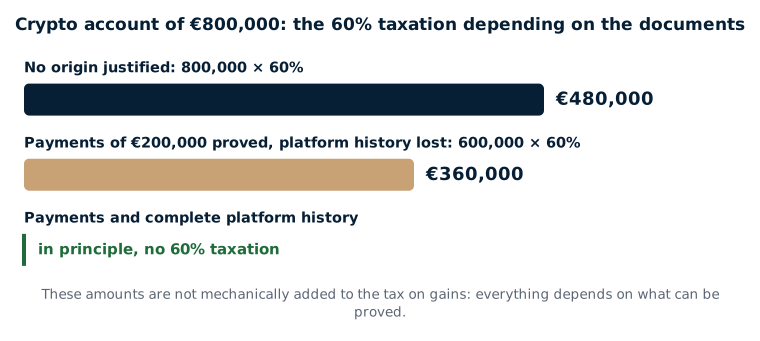
These amounts are not mechanically added to the tax on the gains: depending on what can be proved, the tax authorities may reassess the gains or tax at 60% the assets whose origin is not justified, and how the two fit together depends on each case. The same account may therefore cost several hundred thousand euros more or less, depending on the documents available. Hence the importance of platform histories, which sometimes disappear when an account or a platform closes.
What can be prepared right now
The first step is to have one’s situation analysed by a lawyer, before any approach to the tax authorities: each case is different, and some choices are difficult to correct afterwards. Depending on the case, several tasks may be useful right away:
- Exporting the complete history from each platform: purchases, sales, exchanges, deposits, withdrawals and card payments, since the account was opened, including for closed or little-used accounts.
- Gathering the supporting documents on the origin of the funds: bank statements showing the transfers to the platforms, and documents on the origin of these sums (savings, sale of an asset, gift, inheritance…).
- Reconstructing the total acquisition price of the portfolio, without which the gain cannot be calculated correctly.
- Reviewing past returns: forms 3916-bis and 2086 filed or not, years that can still be audited.
- Taking stock with one’s lawyer: transactions carried out in 2026 are in principle to be declared in spring 2027; for undeclared earlier years, several routes may, depending on the case, be compared: voluntary regularisation under the current conditions, or waiting for the regularisation scheme announced for 2027, although it is not yet known whether it will cover crypto-assets (see should you wait for 2027 to regularise? and the page following the scheme).
In principle, this work does not require any approach to the tax authorities. It makes it possible, when the time comes, to reply quickly and precisely, or to decide with full knowledge of the facts.
A few mistakes to avoid
- Thinking that crypto-assets remain invisible: since 2026, platforms have been collecting their customers’ data for the tax authorities.
- Believing that only sales for euros leave a trace: exchanges between crypto-assets and transfers are also reported by platforms, even when they are not taxable.
- Forgetting form 3916-bis because no sale has taken place: the obligation concerns the account, not the gains.
- Paying with a card backed by a crypto account without knowing that, in principle, each payment funded by crypto-assets is a taxable disposal.
- Letting histories disappear: a closed account, a platform that ceases operating or lost access can make it very difficult to prove the purchase price and the origin of the funds.
- Replying alone, too quickly and at too great length to a letter from the tax authorities: an imprecise or overly detailed reply often opens up new questions.
FAQ
Will the tax authorities receive the data from my crypto platform?
In principle, yes. Platforms authorised in the EU, as well as those established outside the EU that have customers resident in the EU, in principle report in an EU country: the 2026 data then reaches the French tax authorities in 2027. A platform established in a country that applies the OECD standard, with an exchange agreement in force, may report in that country: first exchanges in 2027 for some countries, such as the United Kingdom, in 2028 for others, such as Switzerland or Singapore, and in 2029 for the United States, according to announcements.
When could the first letters arrive?
No timetable has been announced. For bank accounts, the first exchanges date from 2017 and, in my cases, the first letters from 2019. This time, the tax authorities already have the experience and the channels of the automatic exchange: first letters could arrive as early as the end of 2027, with a probable ramp-up in 2028. Audits have, moreover, already taken place in some of the cases I handle, without waiting for this data.
Are my transactions from before 2026 concerned?
Under DAC 8, platforms report only transactions carried out since 1 January 2026. But an account reported for 2026 may lead the tax authorities to ask questions about earlier years: for an undeclared account abroad, they may in principle go back up to ten years, without reviving years already time-barred in February 2025.
Is a personal wallet, whose keys I keep, concerned?
In principle, it is not covered by form 3916-bis, which concerns accounts opened with institutions established abroad. But transfers from a platform to such a wallet are reported by the platform, and gains remain taxable, wherever the crypto-assets are kept.
Is paying with a crypto card taxable?
In principle, yes: using crypto-assets to pay for goods or a service is a taxable disposal, in the same way as a sale for euros, provided that total disposals in the year exceed €305 for the household. In some of the cases I handle, information on the use of such cards has already led to in-depth reviews of personal tax situation.
What are the risks of not having declared a crypto account abroad?
In principle, a fine of €750 per account (€1,500 if the value of the accounts exceeds €50,000 during the year) and, if gains have not been declared, the tax, late-payment interest and, depending on the case, an 80% surcharge, over a period of up to ten years. If the origin of the assets is not justified after a request from the tax authorities, they may be taxed at 60%. Each situation needs to be analysed with a lawyer.
Will the regularisation scheme announced for 2027 cover crypto-assets?
This is not known. As of 11 October 2026, the scheme has only been announced, and no legal text sets its scope. Its progress is followed on the page tax regularisation 2027: where does the scheme stand?, updated at each stage.
Reference texts
- Council Directive (EU) 2023/2226 of 17 October 2023 amending Directive 2011/16/EU on administrative cooperation in the field of taxation (“DAC 8”); OECD, Crypto-Asset Reporting Framework (2022).
- Law no. 2025-127 of 14 February 2025 (Finance Act for 2025): article 54 (transposition of DAC 8) and article 59 (audit of and penalties for crypto-asset accounts held abroad).
- Decree no. 2025-1276 of 19 December 2025 on the reporting and due diligence obligations of crypto-asset service providers.
- Law no. 2026-534 of 25 June 2026 on combating social and tax fraud.
- French General Tax Code (CGI): articles 150 VH bis (gains on crypto-assets), 755 (60% taxation of assets of unjustified origin), 1649 AC bis to 1649 AC sexies (obligations of providers), 1649 bis C (declaration of crypto-asset accounts abroad), 1727 (late-payment interest), 1729-0 A (80% surcharge), 1736 (fines).
- French Tax Procedure Code (LPF): articles L12 (in-depth review of personal tax situation), L23 C (justification of the origin of assets), L169 and L181-0 A (ten-year reassessment periods), L262 (administrative garnishment from third-party holders).
- Ministerial replies to written questions no. 30729 (Journal officiel de l’Assemblée nationale of 6 April 2021: automatic display of annex 3916) and no. 36621 (Journal officiel de l’Assemblée nationale of 3 August 2021: revenue from the fine for undeclared foreign accounts).
DAC 8 does not change the tax rules: it changes what the tax authorities know. Declaring 2026 transactions, reviewing past years, replying to a letter or defending oneself in an audit: these steps often involve large amounts and benefit from being prepared after the situation has been analysed. Maître Uzan, a tax lawyer and member of the Paris Bar since 2008, has regularised more than 250 foreign accounts and assists his clients in their tax audits. See also the page regularising an undeclared foreign account, the article on what DAC8 and the Travel Rule change, or book an appointment.