“Tax regularisation 2027” (régularisation fiscale 2027), “regularisation desk” or “regularisation unit” (guichet or cellule de régularisation), “new STDR” (nouveau STDR), “repentant taxpayers” (repentis fiscaux): since mid-September 2026, these expressions have kept coming up in the French press. The French Government has announced that people who hold undeclared assets, particularly abroad, would be able to put their affairs in order with the tax authorities during 2027, within a specific framework.
Status as of 10 October 2026: the scheme has been announced, but no legal text yet sets out its conditions. Neither the penalty scale, nor the assets covered, nor the opening date is known. This page takes stock of what is settled and what is not, recalls how the previous scheme worked, from 2013 to 2017, and will be updated at each stage. It deals only with French taxation.
In brief
- On 17 September 2026, the French Prime Minister announced that a scheme for the regularisation of undeclared assets would be opened during 2027. The press kit for the 2027 budget refers to an “exceptional tax compliance mechanism” (mécanisme exceptionnel de mise en conformité fiscale).
- To date, this mechanism does not appear in the Finance Bill (projet de loi de finances) introduced on 1 October 2026: the scale, scope, timetable and department responsible remain to be determined.
- The previous scheme (the “STDR”, from 2013 to the end of 2017) was not an amnesty: the tax and late-payment interest remained due; only the penalties were reduced, according to a scale known in advance.
- There is no guarantee that the conditions in 2027 will be those of 2013.
- In the meantime, regularisation remains possible under the ordinary conditions (the “ordinary rules”, or droit commun), with no scale set in advance.
- Waiting for 2027 or acting before then: the answer depends on each situation. Before taking any step, it is advisable to consult a lawyer to determine the most appropriate route.
Contents
- Where does the regularisation scheme stand?
- What is known, and what is not
- Being notified when the conditions are published
- The 2013 to 2017 precedent: how did the “STDR” work?
- And today? Regularisation under the “ordinary rules”
- The origin of the funds: the point that decides everything
- Wait for the scheme or act before?
- Which assets could be covered?
- What I see in my cases
- Three common misconceptions
- FAQ
- Update log
- Texts and sources
Where does the regularisation scheme stand?
Today there is an announcement and one line in a press kit, but no legal text. The table sets out the stages already completed and the planned timetable for the examination of the budget, which may still change.
| Date | Stage | Status |
|---|---|---|
| 17 September 2026 | The Prime Minister announces, in an interview with Le Figaro, that taxpayers who hold undeclared assets will be able to put their affairs in order during 2027, and refers to the 2013 scheme | Done |
| 1 October 2026 | Presentation of the 2027 budget: the press kit announces “the creation of an exceptional tax compliance mechanism” | Done |
| 1 October 2026 | Finance Bill for 2027 introduced in the National Assembly (Assemblée nationale): the mechanism does not appear in it | Done |
| 13 to 19 October 2026 | Examination of the revenue side of the budget (the tax measures) in the National Assembly | Scheduled |
| 17 November 2026 | Vote on the Finance Bill as a whole in the National Assembly | Scheduled |
| Mid-December 2026 | Final adoption of the budget | Scheduled |
| 2027 | Opening of the scheme | Announced, no date |
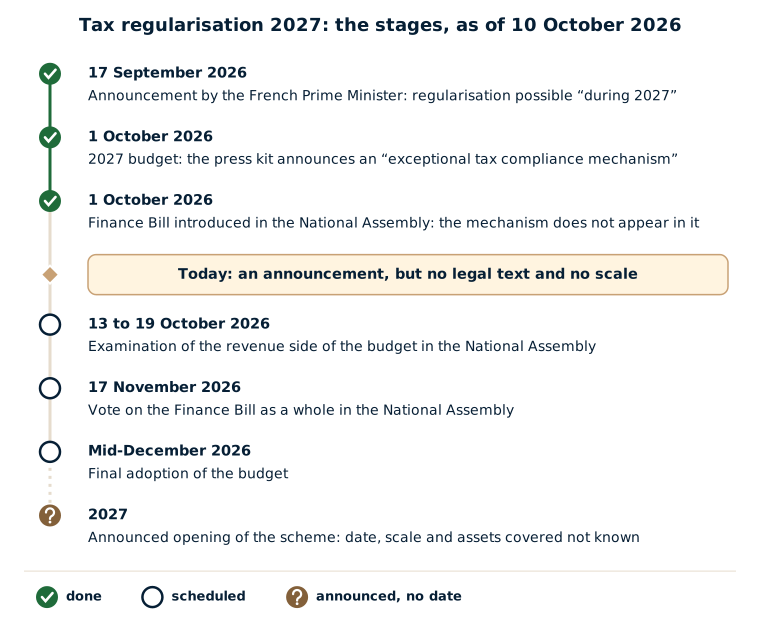
Two clarifications make this timetable easier to read. First, the 2013 scheme had been created by a simple circular from the Budget Minister, without any specific law: it is not known, to date, whether the 2027 scheme will take the form of a provision added to the budget or of a circular, which could then be published at a different time. Second, the budget timetable itself is uncertain: the budgets for 2025 and 2026 were not published until February, and a presidential election is scheduled for spring 2027.
What is known, and what is not
| Question | Status as of 10 October 2026 |
|---|---|
| Is the scheme in force? | No. It has been announced for 2027. |
| Who is covered? | According to the announcement, taxpayers who hold undeclared assets, particularly abroad. The exact scope has not been defined. |
| What penalty scale? | Not published. |
| What opening date, and for how long? | “During 2027”, with no further details. |
| Which department will handle the files? | Not specified. |
| Will the tax itself be reduced? | Nothing indicates that it will. In 2013, the tax and late-payment interest remained due in full. |
| What guarantees on the criminal side? | Not specified. |
| What revenue does the Government expect from it? | The press kit sets a target of €1 billion in additional revenue for the fight against fraud, improved collection and this mechanism taken together. |
Being notified when the conditions are published
To receive an email on the day the conditions of the scheme are published (scale, assets covered, opening date), all it takes is to leave an address below.
The 2013 to 2017 precedent: how did the “STDR” work?
The STDR (service de traitement des déclarations rectificatives), the unit that handled amended returns, was set up in 2013 within the tax authorities, following a circular of 21 June 2013 from the Budget Minister, Bernard Cazeneuve. It received the files of people who held undeclared assets abroad and wished to put their affairs in order.
The principle was as follows. The person came forward of their own accord, without anonymity. They filed amended returns (returns that correct those of past years) and a file explaining the origin of the assets. They paid the tax due for the years the tax authorities could still audit, with late-payment interest. In return, the penalties were reduced according to a public scale, the same for everyone.
| Situation | Surcharge on the tax reassessed (instead of 40%) | Fine for an undeclared account, capped per year at |
|---|---|---|
| So-called “passive” taxpayer: assets received by inheritance or gift, or built up when the person was not resident in France | 15% | 1.5% of the value of the assets |
| So-called “active” taxpayer: all other cases | 30% | 3% of the value of the assets |
Scale laid down by the 2013 circulars. It was changed along the way: for requests filed from 15 September 2016, the surcharge rates rose to 25% and 35%, after a decision of the Constitutional Council (Conseil constitutionnel) of 22 July 2016 on the proportional fine.
This scheme was therefore not an amnesty. It applied neither to people already subject to a procedure by the tax authorities, nor to assets derived from a hidden or unlawful activity. A few reference points, taken from the review carried out by the French Court of Audit (Cour des comptes) in October 2017 and from the legal press of the time:
- more than 50,000 requests filed, for more than €32 billion of assets;
- around €8 billion in revenue for the State between 2014 and 2017;
- nearly nine files out of ten concerned Switzerland;
- nearly two-thirds of the files involved less than €400,000 of assets, and the majority of the assets came from an inheritance or a gift;
- files of more than €1 million were generally processed in less than a year, whereas some “small” files waited more than two years.
The unit stopped accepting new files on 31 December 2017. This precedent provides useful reference points; it says nothing about the conditions that will be adopted for 2027.
Example: the difference a scale makes
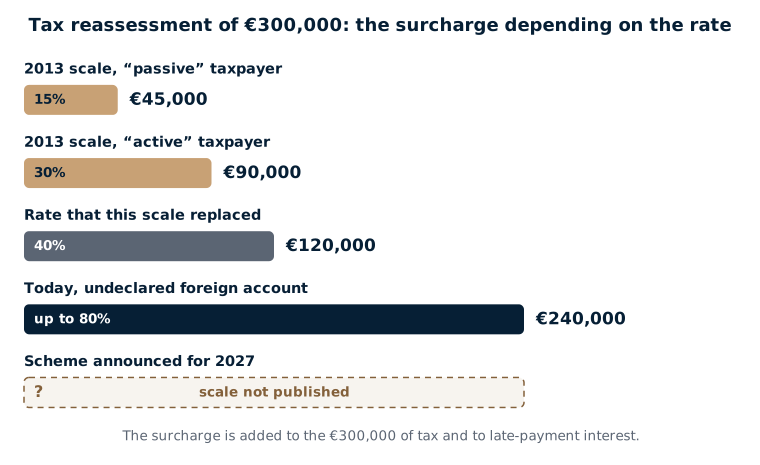
A tax reassessment of €300,000, excluding late-payment interest, is linked to an undeclared foreign account. The surcharge, that is to say the penalty added on top of the tax, would have been as follows:
- under the 2013 scale, for a “passive” taxpayer: 300,000 × 15% = €45,000;
- under the 2013 scale, for an “active” taxpayer: 300,000 × 30% = €90,000;
- at the 40% rate that this scale replaced: 300,000 × 40% = €120,000.
Today, for tax reassessments linked to an undeclared foreign account, the law provides for a surcharge that can reach 80%, i.e. up to €240,000 in this example. Depending on the rates, the gap is therefore well over €100,000: this is what explains the attention paid to the future scale, about which nothing is yet known.
And today? Regularisation under the “ordinary rules”
Since 2018, there has no longer been a scale for assets held abroad by individuals. Regularisation remains possible, but it follows the ordinary rules, known to lawyers as the “droit commun”: filing of amended returns for the years the tax authorities can still audit (in principle up to ten years for income linked to an undeclared account), payment of the tax and late-payment interest, then discussion of the penalties on a case-by-case basis. The voluntary nature of the step and the quality of the file may be taken into account, and a settlement with the tax authorities may, in some cases, make it possible to reduce the penalties.
In addition, since 2019 businesses and their managers have had a permanent desk, the tax compliance service (service de mise en conformité fiscale, SMEC), which has its own rules: see how to submit a tax compliance request. This service does not, in principle, deal with the foreign accounts of individuals, and nothing indicates at this stage which department will receive the files in 2027.
These rules are set out in detail in several articles on this site: forgetting to declare a foreign account, the fines for failing to declare, the limitation periods, and the page on the tax audit of foreign accounts. Where a letter from the tax authorities has already been received, the situation is different: see the article on the request to regularise an undeclared foreign account.
The origin of the funds: the point that decides everything
Regularising is not only a matter of paying tax on the account’s interest, dividends or capital gains. It also means explaining where the money comes from, with supporting documents: an inheritance, a gift, income earned while living abroad, the sale of an asset. The older the facts, the harder these supporting documents are to gather.
The stakes are high. Where the origin of the assets in an undeclared account is not justified, the law allows the tax authorities to tax them as if they had been received as a gift, at the rate of 60%. This taxation in principle applies to the portion whose origin is not established.
Example: an origin that is only partly justified
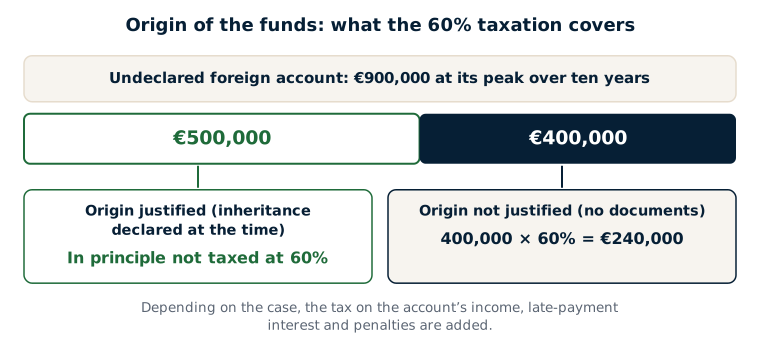
An undeclared foreign account reached a peak of €900,000 during the last ten years. Its holder can prove that €500,000 comes from an inheritance, declared at the time. For the remaining €400,000, the holder has no documents.
- Portion whose origin is justified: €500,000, in principle outside this taxation.
- Portion whose origin is not justified: 400,000 × 60% = €240,000.
Depending on the case, the tax on the account’s income, late-payment interest and penalties come on top of this sum. A file in which the missing documents have been traced, or which convincingly explains the origin of the €400,000, therefore changes the outcome entirely. It is not known whether the 2027 scheme will provide for specific rules on this point.
Wait for the scheme or act before?
This is the question I have been asked ever since the announcement. Every case is different; generally speaking, if the plan is confirmed, waiting for the 2027 framework may be preferable in many cases, because it should in principle offer clear ground rules, known before any commitment is made. But the scheme does not yet exist, late-payment interest keeps running, and where a letter from the tax authorities has already been received, its deadlines are not suspended by the announcement. These factors are set out, with worked examples, in the article should you wait for 2027 to regularise a foreign account?. The decision is made after a lawyer has analysed the case.
Which assets could be covered?
The scope of the future scheme is not known. The 2013 scheme covered assets held abroad. As a point of reference, here is what the current reporting obligations in principle cover for a French tax resident:
- bank accounts and securities accounts opened abroad, including those used under a power of attorney: see the page declaring a foreign account;
- life insurance policies taken out abroad and trusts: see declaring foreign accounts, life insurance policies and trusts;
- digital asset (cryptocurrency) accounts opened with a platform established abroad: see declaring foreign cryptocurrency accounts;
- income from a property located abroad.
At this stage, there is nothing to say that each of these situations will come within the scheme.
What I see in my cases
I handled many regularisation cases at the time of the STDR. The accounts were then mainly in Switzerland, Israel, Portugal and Spain. Today, the situations I come across more often involve Asia, the United States and the United Kingdom.
The main difficulty in those cases lay in justifying the origin of the funds. That origin often goes back several decades, while the tax authorities ask for many supporting documents and are demanding on this point. Yet this is the heart of a regularisation: if the origin of the funds is judged insufficiently justified, the 60% taxation may apply, and the person who wanted to put their affairs in order ends up with a very heavy tax bill.
Among the people concerned, I meet many French tax residents of foreign nationality who have kept assets in their country of origin. No nationality predominates: anyone who has settled in France may have kept an account where they used to live. In my experience, the tax authorities generally start to take an interest in an account when its balance or its movements reach around €100,000. This is only an observation drawn from my cases, and not a threshold laid down by law: the obligation to declare in principle exists whatever the amount.
These clients are generally very worried. Lacking experience of such cases, in the grip of emotion and after what they have read on the internet, they often form an inaccurate picture of their situation, which generally seems more serious to them than it actually is.
The whole art of these cases lies in saying enough, but not too much, while always keeping to a truthful presentation of the facts: never a lie, which I very strongly advise against and will not accept. A precise knowledge of the tax authorities’ practices and customs does, on the other hand, make it possible to present the file in the most favourable light. Every case is unique, and experience plays an important part in it.
What I expect from the future scheme
What I expect from it, first of all, is simplicity and clarity: an easy-to-read scale of surcharges, with no surprises, which gives a clear view of the penalties and makes it possible to know where one is heading before committing. What I fear, conversely, is a build-up of exceptions, and of exceptions to the exceptions. Lastly, I hope for greater flexibility on proof of the origin of the funds, without being certain of it: in my view, that is what will determine the real value of the scheme.
Three common misconceptions
- “It is a tax amnesty.” The 2013 scheme cancelled neither the tax nor the late-payment interest, and nothing indicates that it will be any different in 2027.
- “The desk is already open.” To date there is only an announcement, with no legal text and no scale.
- “The conditions will be those of 2013.” There is no guarantee of this; they were in fact tightened in 2016, while the scheme was running.
FAQ
Is the 2027 tax regularisation desk already open?
No. As of 10 October 2026, the scheme has only been announced for 2027. No legal text sets out its conditions, and it does not appear in the Finance Bill introduced on 1 October 2026.
What will the penalty scale be in 2027?
It has not been published. As a point of reference only, the 2013 scale reduced the surcharge from 40% to 15% or 30% depending on the situation, then to 25% or 35% from September 2016. There is no guarantee that the 2027 scale will be modelled on it.
Will the 2027 regularisation be a tax amnesty?
Nothing indicates that it will. From 2013 to 2017, the tax due and late-payment interest were still paid in full; only the penalties were reduced.
Accounts, life insurance, trusts, real estate, cryptocurrencies: which assets will be covered?
The scope has not been defined. The announcement refers to undeclared assets, particularly abroad; the 2013 scheme concerned assets held abroad. It will be necessary to wait for the legal text to know which assets come within the scheme. For crypto-assets, the French tax authorities should receive the first information transmitted by platforms in 2027, under the European DAC 8 directive: what could follow is set out in the article crypto-assets and DAC 8: letters from the tax authorities as early as the end of 2027?
I have already received a letter from the tax authorities: will I be able to benefit from the scheme?
It is not known. The 2013 scheme was reserved for voluntary steps, taken before any procedure. In any event, a letter from the tax authorities in principle calls for a reply within short time limits: it is advisable to consult a lawyer as soon as it is received.
How can I be notified when the conditions are published?
This page is updated at each stage, and the date of its last update appears at the top. It is also possible to leave an email address in the form provided above to receive a message on that day.
Update log
- 10 October 2026: page published. Scheme announced, absent from the Finance Bill introduced on 1 October; examination of the budget in the National Assembly from 13 October.
Texts and sources
- French Government, “Budget 2027” press kit, 1 October 2026 (summary: “exceptional tax compliance mechanism”).
- Projet de loi de finances pour 2027 (Finance Bill for 2027), no. 3210, introduced in the National Assembly on 1 October 2026.
- Budget Minister’s circulars of 21 June 2013, 12 December 2013, 10 December 2014 and 14 September 2016 (processing of amended returns from taxpayers holding assets abroad); ministerial reply to question no. 29045, Journal officiel de l’Assemblée nationale, 4 March 2014.
- French Court of Audit, “Les régularisations d’avoirs à l’étranger gérées par le service de traitement des déclarations rectificatives (STDR)”, October 2017.
- Constitutional Council, decision no. 2016-554 QPC of 22 July 2016 (proportional fine for an undeclared account).
- French General Tax Code (CGI): Articles 1649 A, 1649 AA and 1649 AB (declaration of foreign accounts, life insurance policies and trusts), 1729-0 A (80% surcharge), 1736 (fines), 755 (60% taxation); French Tax Procedure Code (LPF): Articles L23 C (request for justification of the origin of the assets) and L169 (ten-year reassessment period).
The 2027 announcement, the STDR precedent, the current rules, the origin of the funds: a regularisation often involves large amounts and is decided only after the situation has been analysed. Maître Uzan, a tax lawyer and member of the Paris Bar since 2008, has handled many foreign account regularisation cases, both at the time of the STDR and since. He examines the available documents, the origin of the funds and the possible options before any step is taken. See also the page regularising an undeclared foreign account and the article can the French tax authorities see your foreign bank accounts?, or book an appointment.