You received RSUs or stock options from the foreign parent company of your employer. During the years between the grant and the definitive vesting, you changed country: you came to France following a mobility within the group, you were seconded for a few months to a subsidiary, or you spent part of your time travelling or teleworking outside France. When the gain becomes taxable, a question arises, often for very large amounts: does France tax the whole gain, or only part of it?
This article explains, for a reader who is new to the subject, how the share of the gain that falls to France (the “pro rata”) is calculated in principle, which period counts, how the days are counted, and above all how the days worked in France are proved, with two worked examples. It only deals with taxation in France; the rules of other countries are a matter for professionals in those countries.
In brief
- The acquisition gain on an RSU or the exercise gain on a stock option is, in principle, the reward for work performed during a reference period, which generally runs from the grant to the definitive vesting of the right (the vesting).
- When this work was carried out in several countries, French administrative guidelines in principle provide for the gain to be split in proportion to the days of activity carried out in France during this period, subject to the applicable tax treaty.
- For a French resident, the share linked to work performed abroad could, in certain cases, not be taxed in France, or be taxed with a mechanism avoiding double taxation: only an analysis of the situation by a lawyer can determine whether or not the treaty allows this.
- The stakes are often considerable: in the first example of this article, the split brings the tax base in France down from €1.6 million to about €800,000.
- Everything rests on the proof of the days worked in France and elsewhere: employer certificates, train and plane tickets, schedules, e-mails… The more complete the file, the better it holds up in a tax audit.
- The impatriate regime may apply to the salary of a newcomer, but the exemption of the impatriation bonus does not, in principle, cover RSUs and stock options.
Contents
- Why the question arises: a gain that rewards several years of work
- Key terms
- The rule: a split in proportion to working days
- Example 1: Mr A, who arrived in France halfway through
- Example 2: Mrs B, business trips, secondment and telework
- Proving the days worked in France: the heart of the file
- What about the impatriate regime?
- What I see in my cases
- The most common mistakes
- FAQ
- Reference texts
Why the question arises: a gain that rewards several years of work
An RSU (restricted stock unit) is a promise to receive shares free of charge after a waiting period, often three or four years, provided the person is still an employee of the group. A stock option is the right to buy shares later at a price fixed in advance. In both cases, the employee obtains a benefit because they have worked for the group for several years: the value received at the end of the waiting period is, in principle, regarded as the remuneration for that work.
If all this work was done in France by a French resident, the question hardly arises. But when the employee worked part of the period in another country, it seems logical that each country can only tax the share of the gain that corresponds to the work done there. This is the idea adopted by French administrative guidelines, relying on the OECD commentaries: the gain is divided between the countries in proportion to the working time spent in each of them during the reference period.
The general taxation rules (qualified or non-qualified plan, acquisition gain, capital gain on sale, social levies) are set out in the complete guide to the taxation of RSUs and in the article on stock options and free shares. This article focuses on a single question: what share of the gain can France tax when the employee has been internationally mobile?
Key terms
| Term | What it means, simply |
|---|---|
| Grant (grant) | The day the company promises the shares (RSUs) or grants the right to buy them (stock options). The employee does not yet own anything. |
| Definitive vesting (vesting) | The day the conditions of the plan are met (generally, still being with the group): the shares are delivered, or the option can be exercised. |
| Reference period | The period of work that the gain is deemed to reward; generally, from the grant to the definitive vesting. The pro rata is calculated on this period. |
| Acquisition gain (RSUs) or exercise gain (options) | The value obtained thanks to the plan: value of the shares delivered (RSUs), or difference between the value of the share and the price paid on exercise (options). |
| Qualified / non-qualified plan | A qualified plan meets the conditions of the French Commercial Code and benefits from a specific tax regime; otherwise, the gain is in principle taxed as salary. |
| Pro rata | The share of the gain that corresponds to the days of activity carried out in France during the reference period. |
The rule: a split in proportion to working days
Which period counts?
For stock options, administrative guidelines in principle use the period running from the grant of the options to the date on which the employee definitively acquires the right to exercise them, even if they only exercise them later. The period following the definitive vesting, up to the exercise, is therefore in principle not taken into account.
For free shares and RSUs, the reference period in principle runs from the grant to the date on which the employee becomes the definitive owner of the right, that is to say, most often, until the presence condition or the targets set by the plan are met. When the plan sets no condition of this kind, the period may be reduced to the day of the grant alone. This is why reading the plan rules is the first step in any file: they are what say which work the gain rewards.
How are the days counted?
The principle is simple: the French share is equal to the gain multiplied by the number of days of activity carried out in France during the reference period, divided by the total number of days in the period. The way days are counted (calendar days, working days, days actually worked) is specified by administrative guidelines according to the situation; an employee who has worked in several countries during the same period may in principle use the days on which they actually worked in each of them. The choice of method and the count itself deserve a precise analysis, as a few dozen days can represent significant sums.
Resident or non-resident of France at the time of taxation
The treatment also depends on the employee’s situation at the time the gain becomes taxable. According to administrative guidelines, this time is in principle the date of sale of the shares for a qualified plan, and the date of definitive vesting for a non-qualified plan.
- Resident of France at that time: France in principle taxes its residents on all their income. Administrative guidelines nevertheless provide that, where the activity was carried out partly in a State linked to France by a tax treaty, the gain is in principle only taxable in France in proportion to the activity carried out in France, subject to the provisions of the treaty. Finding out whether the treaty actually leads to excluding the foreign share or not, and by which mechanism double taxation is avoided (exemption with effective rate or tax credit), requires an analysis of the situation by a lawyer. Without a treaty, the whole gain would in principle be taxable in France.
- Non-resident of France at that time: only the French-source share of the gain, calculated using the same pro rata, is in principle taxable in France, in the form of a withholding tax (Article 182 A ter of the French General Tax Code (CGI)). This case is presented in the guide on RSUs.
The capital gain on sale, that is to say the rise in the share price between vesting and the sale of the shares, in principle follows its own rules (those for capital gains on securities) and not this split of the acquisition gain.
Example 1: Mr A, who arrived in France halfway through
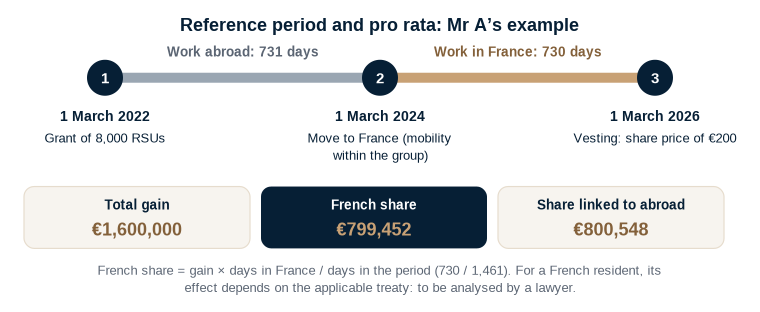
Mr A works for a group whose parent company is listed abroad. On 1 March 2022, while working for a subsidiary outside France, he receives 8,000 RSUs under a non-qualified plan, with a four-year presence condition. On 1 March 2024, he joins the French subsidiary as part of a mobility within the group and becomes a resident of France. On 1 March 2026, the 8,000 shares are delivered to him; the share price is then €200. Fictitious example, for teaching purposes.
| Step | Calculation | Amount |
|---|---|---|
| Total acquisition gain | 8,000 shares × €200 | €1,600,000 |
| Reference period | from 1 March 2022 to 1 March 2026 | 1,461 days |
| Days in France | from 1 March 2024 to 1 March 2026 | 730 days |
| French share of the gain | €1,600,000 × 730 / 1,461 | €799,452 |
| Share linked to work abroad | €1,600,000 − €799,452 | €800,548 |
As the plan is not qualified, the gain is in principle taxed as salary in the year of definitive vesting, 2026, when Mr A is a resident of France. To give an order of magnitude, at the top marginal income tax rate of 45% (not counting social contributions, the exceptional contribution on high incomes or the 10% standard deduction, which his salary already uses up):
- if the whole gain were taxed in France: €1,600,000 × 45% = €720,000 of income tax;
- if only the French share were: €799,452 × 45% = €359,754.
The difference, of about €360,000, shows what is at stake with the pro rata. It remains to be seen whether the treaty concluded with the State where Mr A worked before his arrival allows, in his case, this share to be removed from the French tax base, and by which mechanism: only an analysis of the situation by a lawyer can determine this. The pro rata also assumes that Mr A can prove his dates of work in each country (see below).
Example 2: Mrs B, business trips, secondment and telework
Mrs B is a resident of France throughout the period. She receives 10,000 RSUs under a non-qualified plan of her employer’s foreign parent company, definitively vested after three years, at a share price of €150. During these three years, she was seconded for five months to a subsidiary abroad, made many business trips outside France and sometimes worked remotely from abroad. Fictitious example, for teaching purposes.
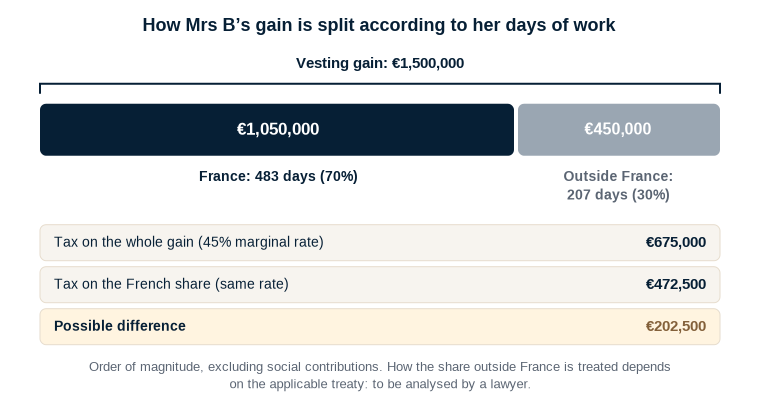
As she worked in several countries during the same period, the count here uses the days she actually worked: of 690 days worked during the reference period, 483 were worked in France and 207 outside France.
| Step | Calculation | Amount |
|---|---|---|
| Total acquisition gain | 10,000 shares × €150 | €1,500,000 |
| French share | €1,500,000 × 483 / 690 (70%) | €1,050,000 |
| Share linked to work outside France | €1,500,000 × 207 / 690 (30%) | €450,000 |
| Tax on the whole gain, at the 45% marginal rate | €1,500,000 × 45% | €675,000 |
| Tax on the French share, at the same rate | €1,050,000 × 45% | €472,500 |
The possible difference reaches €202,500 of income tax. Here, the difficulty is not the calculation but the reconstruction of the days: five months of secondment are fairly easy to prove; dozens of business trips lasting a few days and days of telework abroad, much less so. The share linked to work outside France could also, depending on the applicable treaty, be taken into account to calculate the rate of French tax or give rise to a tax credit: here again, an analysis of the situation by a lawyer is necessary to find out what the treaty allows, or not. On how the tax credit works in the return, see the article on boxes 8TK and 8VL.
Proving the days worked in France: the heart of the file
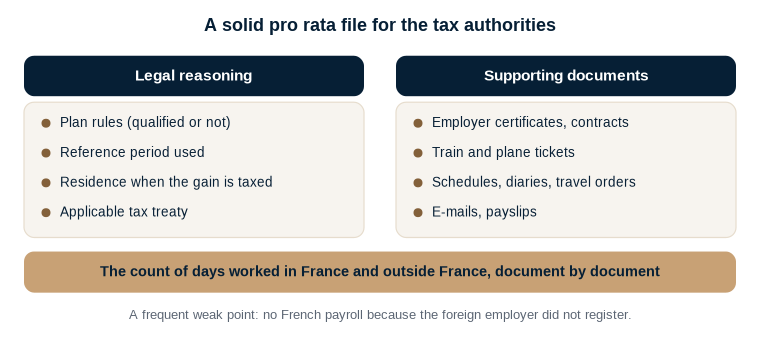
The pro rata is only as good as the evidence. In the event of a tax audit, the tax authorities may ask for proof, day by day if necessary, of where the employee worked during the reference period. All documents can be used, and the more numerous and consistent they are, the more solid the count:
- employer certificates: dates of taking up the post, of secondment, of return, country of work;
- contracts and amendments: employment contract, secondment or mobility letter, successive amendments;
- payslips and social security returns in each country;
- train and plane tickets, boarding passes, expense reports, bank card statements;
- schedules, work diaries, travel orders;
- e-mails and other exchanges showing where the employee was;
- for telework, any evidence showing the place from which the work was done (telework agreement, log-ins, proof of stay).
The most frequent weak point: payroll in France
When an employee works in France for a company established abroad that has no establishment in France, and is covered by French social security, this company must in principle register with the Urssaf centre for foreign companies (Urssaf Alsace) and declare salaries every month (nominative social security return, DSN). When this step has not been taken, there is no trace of payroll in France for the period concerned. The employee then loses one of the most reliable means of proving the split between work in France and work abroad, and has to reconstruct this split with other documents.
What about the impatriate regime?
An employee who comes to France as part of a mobility within the group may, if they meet the conditions of Article 155 B of the CGI (in particular not having been tax resident in France during the five calendar years preceding their taking up the post), benefit from the impatriate regime until 31 December of the eighth year following that in which they took up the post. This regime in principle exempts the impatriation bonus and, subject to conditions, the part of the remuneration linked to activity carried out abroad.
On the other hand, the exemption of the impatriation bonus does not, in principle, cover gains on RSUs or stock options: it concerns salary. Administrative guidelines specify in particular that option exercise gains and benefits from free shares are not taken into account in the remuneration used to calculate the 30% flat-rate bonus. The impatriate regime and the pro rata can therefore be combined, but they are not the same thing: the first concerns the newcomer’s salary, the second the split of the plan gain between countries. The calculation of the exemption is detailed, with examples, in the article French impatriate regime: how is the exemption calculated?
What I see in my cases
The employees concerned most often work for large tech companies, American or British, or for groups from other European Union countries. The amounts are almost always very large, and mobility during the vesting period is frequent. A large part of my work consists of removing from the French tax base the portions of the gain that, depending on the applicable treaty and the situation, may not be taxable in France. The split is in principle made according to the vesting period worked in France, often with complex judgement calls when telework or travel in several countries is added.
To reconstruct the days, all types of documents are useful, and the more the better: employer certificates, train and plane tickets, schedules, e-mails… Each additional document strengthens the count.
The first mistake I come across is often upstream, at the employer: the foreign company has not been registered in France for payroll purposes. There is then no trace of payroll in France, and therefore no perfectly reliable means of proving the split between work in France and work abroad. In many cases, it is still possible to build a file with the other documents, but it takes more work and leaves more room for discussion.
In a tax audit, the reaction of the tax authorities depends on how solid the file is, and therefore on how it was prepared. In my experience, a good file is both well argued legally (plan rules, reference period, applicable treaty) and well supported by documents. The tax authorities mainly ask for the bank documents on the sales, sometimes the plans themselves; they are often uncomfortable with these mechanisms, particularly in international mobility, and explanatory work is frequently necessary.
Combination with the impatriate regime does exist, but it is fairly rare: it requires both a non-qualified RSU or stock option plan and an arrival in France following a mobility within the group. In that case, impatriation remains possible, but the exemption of the impatriation bonus cannot, in principle, cover RSUs and stock options, only salary.
Finally, I see employees who come to me after a reassessment, for lack of advice from the outset; putting the situation right is sometimes possible, but not always. Nothing is guaranteed in all this: this is my experience to date, and each file calls for its own analysis.
The most common mistakes
- Declaring everything in France by default, without examining whether part of the gain relates to work performed abroad.
- Conversely, declaring nothing, in the belief that the gain “belongs” to the country of the parent company or of the broker: the share linked to work in France in principle remains taxable in France.
- Using the wrong period: taking the period up to the exercise of the options, or up to the sale of the shares, instead of the reference period set by the plan.
- Applying the qualified plan regime to a plan that is not qualified, which changes both the tax regime and the date on which residence is assessed.
- Not keeping the evidence: tickets, schedules and e-mails disappear quickly; finding them several years later is difficult.
- Missing or incomplete French payroll at the foreign employer, which deprives the employee of the simplest proof.
- Forgetting the foreign broker account, which is in principle declared every year (see form 3916 step by step).
FAQ
I arrived in France during the vesting period of my RSUs: is the whole gain taxable in France?
Not necessarily. According to administrative guidelines, where the activity was carried out partly in a State linked to France by a treaty, the gain is in principle only taxable in France in proportion to the days of activity carried out in France during the reference period, subject to the treaty. Only an analysis of the situation by a lawyer can determine whether or not the treaty allows the foreign share to be removed from the French tax base.
Which period is used to calculate the pro rata?
In principle the reference period, which runs from the grant to the definitive vesting of the right (the vesting). For stock options, the period following the vesting of the right to exercise, up to the exercise, is in principle not taken into account. The plan rules are decisive.
Do days of telework abroad count as days outside France?
In principle, what counts is the place where the work was actually carried out. Days of telework done from abroad may therefore, depending on the case, be counted as days outside France, provided this can be proved. These situations call for a precise analysis.
Which documents should I keep to prove my working days?
All of them can be useful: employer certificates, contracts and mobility letters, payslips, train and plane tickets, boarding passes, expense reports, schedules, diaries, e-mails. In Me Uzan’s practice, the more numerous and consistent the documents, the more solid the file in the event of a tax audit.
My foreign employer never ran payroll in France: is this serious?
It may raise several difficulties, in particular for proving the split between work in France and work abroad, since there is then no trace of payroll in France. It is often possible to reconstruct this split with other documents; the situation of the employer and that of the employee deserve to be analysed by a lawyer before taking any step.
I benefit from the impatriate regime: are my RSUs exempt?
In principle no: the exemption of the impatriation bonus concerns salary, not gains on RSUs or stock options, which are not taken into account to calculate the flat-rate bonus. The pro rata between France and abroad may, on the other hand, depending on the case, reduce the share taxable in France.
Is the capital gain made on selling the shares also split?
In principle no: the capital gain on sale, which corresponds to the rise in the share price after vesting, follows the rules for capital gains on securities, and not the pro rata of the acquisition gain. For a French resident, it is in principle taxable in France.
Reference texts
- French General Tax Code: Articles 4 A and 4 B (tax domicile), Article 80 bis (stock options), Article 80 quaterdecies (free shares), Article 155 B (impatriates), Article 164 B (French-source income), Article 182 A ter (withholding tax for non-residents).
- French Commercial Code: Articles L225-177 et seq. (options) and L225-197-1 et seq. (free shares).
- BOFiP: BOI-RSA-ES-20-10-20-60 (options and international mobility), BOI-RSA-ES-20-20-20 (free shares, international mobility and non-qualified plans), BOI-IR-DOMIC-10-20-20-30 (withholding tax on French-source gains), BOI-INT-DG-20-20-100 (elimination of double taxation), BOI-RSA-GEO-40-10-20 (impatriate regime).
- Commentaries on the OECD Model Tax Convention on employee stock options, to which the administrative guidelines refer.
- Tax treaty concluded between France and the other State concerned, cited by its name and date.
Reading the plan rules, determining the reference period, counting the days, the applicable treaty, the interplay with the impatriate regime: every mobility situation is different, and the sums at stake justify an analysis before any return is filed or any reply is sent to the tax authorities. Me Uzan, a tax lawyer and member of the Paris Bar since 2008, analyses your plan and your career path, builds the file of evidence and assists you in the event of a tax audit. See also the page on the taxation of foreign RSUs and stock options, the page dedicated to impatriates, or book an appointment.