

You have come from abroad to work in France, and you have been told about the impatriate regime: part of your remuneration could escape income tax for several years. But in practice, how much? The impatriation bonus, the “30% flat rate”, days worked abroad, the 50% and 20% ceilings: these notions combine in a precise order, which often puzzles newcomers.
This guide sets out the calculation step by step, starting from scratch, with three worked examples and diagrams. For the general conditions of the regime, see also our practical guide to the impatriate regime (Article 155 B).
In brief
- The impatriate regime (Article 155 B of the French General Tax Code, CGI) in principle concerns employees and certain executives who come from abroad to work in France and who did not have their tax domicile in France during the 5 calendar years preceding their arrival. It lasts until 31 December of the 8th year following the taking up of the post.
- The following may be exempt: the impatriation bonus (actual amount set in the contract or, on election, a 30% flat rate of remuneration) and the share of remuneration corresponding to days worked abroad.
- The remuneration that remains taxable must in principle be at least equal to the reference remuneration for a comparable post in France; otherwise, the exemption of the bonus is reduced.
- The total exempt amount is capped: either 50% of total remuneration, or 20% of taxable remuneration for the share relating to days abroad alone.
- In addition, there is a 50% income tax exemption on certain investment income and capital gains from foreign sources.
- Every contract and every career path is different: it is advisable to have the calculation and the supporting documents checked by a lawyer before filing your return.
Contents
- 1. The impatriate regime in a few words
- 2. The calculation in four steps
- 3. Example 1: Paul, a bonus set in the contract
- 4. Example 2: Sofia, the 30% flat rate and a few days abroad
- 5. Example 3: Marc, a lot of travel and a ceiling that applies
- 6. What about foreign investment income?
- 7. How to declare?
- The most common mistakes
- FAQ
- Reference texts
1. The impatriate regime in a few words
The regime aims to attract to France employees and executives coming from abroad, whether they are recruited directly abroad by a company established in France or sent by a foreign group to its French subsidiary. Three main conditions apply in principle:
- not having had one’s tax domicile in France during the five calendar years preceding that of taking up the post;
- having, for the duration of the regime, one’s tax domicile in France (home or main place of stay and main professional activity in France);
- carrying on a salaried activity (or that of an executive treated as an employee) in a company established in France.
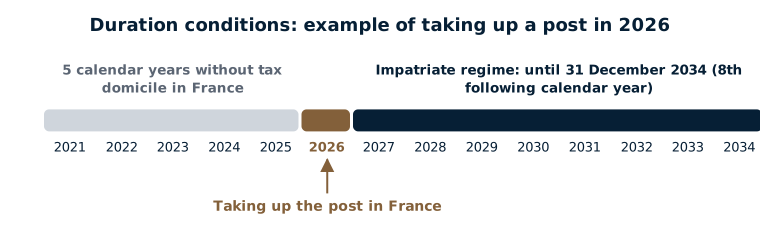
For a post taken up in 2026, one must therefore in principle not have been tax domiciled in France from 2021 to 2025; the regime may then apply until 31 December 2034. A change of position within the company or the group does not extend this period.
2. The calculation in four steps
The calculation always follows the same order, summarised in the diagram below. The amounts used are net remuneration: after social security contributions and deductible CSG, but before the 10% standard deduction for professional expenses.
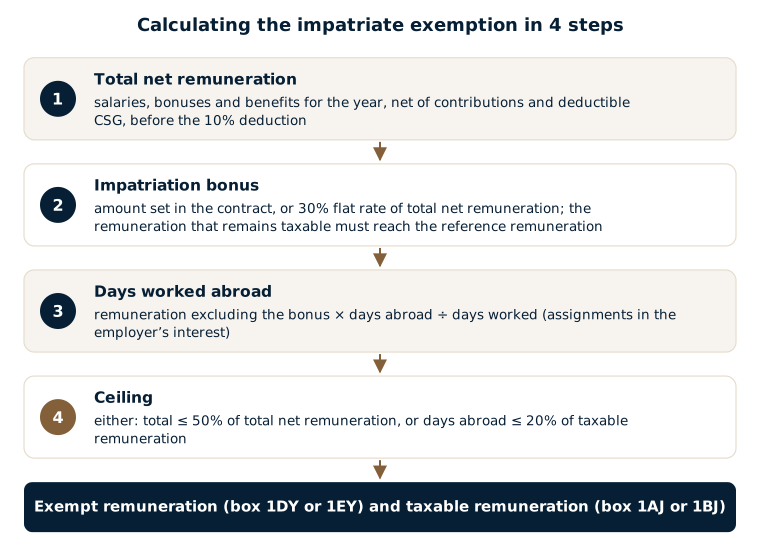
Step 1: total net remuneration
This is all the salaries, bonuses and benefits of the year, impatriation bonus included, net of social security contributions and deductible CSG. Gains from employee savings schemes and those relating to stock options or free shares are not taken into account in this calculation.
Step 2: the impatriation bonus
- Actual bonus: the amount set by the employment contract (or an amendment) drawn up before taking up the post, or determined according to objective criteria that it lays down (for example a percentage of salary, housing provided).
- 30% flat rate: on election, the bonus is deemed equal to 30% of total net remuneration. According to the administrative guidelines, this election has been open to all impatriates since 16 November 2018. Several administrative courts have nevertheless ruled that it requires an additional remuneration linked to the impatriation provided for in the contract: the wording of the contract deserves to be checked.
The reference remuneration test: after deducting the bonus, the remuneration that remains taxable must in principle be at least equal to that paid for similar functions in the company or in similar companies established in France. If it is lower, the difference is added back: the exemption of the bonus is reduced accordingly. The employer often issues a certificate on this point.
Step 3: the share for days worked abroad
The remuneration corresponding to assignments carried out abroad, in the direct and exclusive interest of the employer, may also be exempt. Unless the contract provides a rule, the tax authorities accept a pro rata calculation: remuneration (excluding the impatriation bonus) × days worked abroad ÷ days worked in the year. Evidence of the trips (tickets, hotel invoices, expense reports, assignment orders) is worth keeping.
Step 4: the ceilings
The taxpayer can in principle choose the most favourable ceiling:
- overall ceiling: bonus + share for days abroad ≤ 50% of total net remuneration;
- days-abroad ceiling: the share for days abroad alone ≤ 20% of taxable remuneration (excluding the bonus), the bonus remaining fully exempt.
3. Example 1: Paul, a bonus set in the contract
Paul is recruited abroad by a Paris company. His contract, signed before his arrival, provides for an impatriation bonus of €30,000 a year. His total net remuneration is €150,000, bonus included. The reference remuneration for a comparable post is €110,000. He does not work abroad.
| Step | Calculation | Amount |
|---|---|---|
| Total net remuneration | — | €150,000 |
| Impatriation bonus (contract) | — | €30,000 |
| Reference test | €150,000 − €30,000 = €120,000 ≥ €110,000 | met |
| 50% ceiling | €150,000 × 50% = €75,000 | not reached |
| Exempt remuneration | — | €30,000 |
| Taxable remuneration (before the 10% deduction) | — | €120,000 |
Variant: if the reference remuneration were €125,000, the remuneration remaining taxable (€120,000) would be €5,000 lower: this €5,000 would be added back, and the exemption of the bonus reduced to €25,000.
4. Example 2: Sofia, the 30% flat rate and a few days abroad
Sofia is sent by her group’s foreign parent company to the French subsidiary. Her contract provides for an additional remuneration linked to her move to France, without setting its amount; she elects for the 30% flat rate. Her total net remuneration is €140,000; the reference remuneration is €90,000. She worked 220 days in the year, including 22 days on assignment abroad for her employer.
| Step | Calculation | Amount |
|---|---|---|
| Flat-rate bonus | €140,000 × 30% | €42,000 |
| Reference test | €140,000 − €42,000 = €98,000 ≥ €90,000 | met |
| Share for days abroad | €98,000 × 22 ÷ 220 | €9,800 |
| Overall 50% ceiling | €42,000 + €9,800 = €51,800 ≤ €70,000 | met |
| Exempt remuneration | — | €51,800 |
| Taxable remuneration (before the 10% deduction) | €140,000 − €51,800 | €88,200 |
As no ceiling is reached, the choice between the two ceilings makes no difference for Sofia this year.
5. Example 3: Marc, a lot of travel and a ceiling that applies
Marc has total net remuneration of €200,000, including a contractual impatriation bonus of €60,000. The reference remuneration is €120,000. He worked 220 days, including 80 days abroad for his employer.
| Step | Calculation | Amount |
|---|---|---|
| Impatriation bonus | €200,000 − €60,000 = €140,000 ≥ €120,000 | €60,000 |
| Share for days abroad | €140,000 × 80 ÷ 220 | €50,909 |
| Total before the ceiling | €60,000 + €50,909 | €110,909 |
| Option 1: overall 50% ceiling | €200,000 × 50% | €100,000 |
| Option 2: days abroad limited to 20% | €60,000 + (€140,000 × 20% = €28,000) | €88,000 |
| Exempt remuneration (most favourable option) | option 1 | €100,000 |
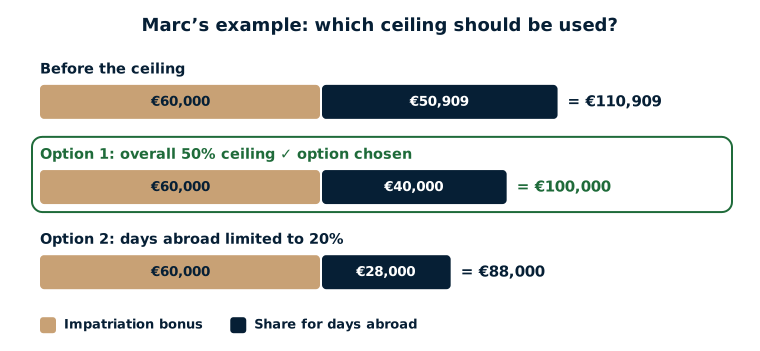
This year, Marc is better off using the overall ceiling: €100,000 exempt, €100,000 taxable. The result may be reversed in another year, for example if travel decreases; the calculation is therefore redone every year.
6. What about foreign investment income?
During the same period, the impatriate may also benefit from a 50% income tax exemption on certain foreign-source income: dividends and interest paid by a person established outside France, certain copyright or patent income, and capital gains on the sale of securities, when the payer or the issuer is established in a State that has concluded an administrative assistance agreement with France. This exemption only applies to income tax: social levies are in principle charged on the full amount.
For example, if Sofia receives €1,000 of dividends from a foreign company that meet these conditions, €500 is in principle exempt from income tax, the remaining €500 being taxed under the usual rules, and social levies being calculated on €1,000. In addition, for the real estate wealth tax (IFI), new residents in principle benefit from favourable rules for five years (Article 964 of the CGI), presented in our guide to the impatriate regime.
7. How to declare?
- The taxable remuneration in principle appears in the pre-filled amount in box 1AJ (declarant 1) or 1BJ (declarant 2), to be checked.
- Exempt salaries and bonuses are entered, for information, in box 1DY (declarant 1) or 1EY (declarant 2) of supplementary return no. 2042-C: they are not taxed, but they are included in the reference tax income.
- Foreign investment income exempt at 50% is declared via form 2047, with boxes 2DM (income) and 3VQ (capital gains) of return 2042-C.
- Accounts opened abroad are declared every year: see our guide form 3916: how to declare a foreign account, step by step.
Our article how to declare the impatriation bonus details these items. If an error is discovered afterwards, it is advisable to consult a lawyer before taking any step: depending on the case, an amended return or a claim may be an appropriate solution.
The most common mistakes
- Calculating the 30% flat rate on gross salary or on salary after the 10% deduction, instead of total net remuneration.
- Forgetting the reference remuneration test, or not having supporting evidence on this point.
- Calculating the share for days abroad on a remuneration that includes the impatriation bonus.
- Counting holidays or travel days as days abroad, or not keeping evidence of the assignments.
- Not comparing the two ceilings every year.
- Forgetting to declare the exempt amounts in box 1DY or 1EY, or foreign accounts on form 3916.
- Thinking that the regime continues beyond the 8th year, or that a change of position extends it.
FAQ
Is the 30% flat rate always more advantageous than the actual bonus?
Not necessarily: everything depends on the amount of the bonus set in the contract, the reference remuneration and the days worked abroad. The comparison is made with figures in hand, ideally with your lawyer, taking the following years into account.
My contract does not mention any impatriation bonus: can I benefit from the regime?
The election for the 30% flat rate may, depending on the case, be considered. Several administrative court decisions have nevertheless required additional remuneration linked to the impatriation: the wording of the contract and the circumstances of your recruitment deserve an analysis before any decision.
How can I prove my days worked abroad?
By any means: assignment orders, tickets, boarding passes, hotel invoices, expense reports, professional diary. These documents do not have to be attached to the return, but it is prudent to keep them so that they can be produced if the tax authorities ask for them.
I arrived in France during the year: is the calculation different?
The calculation covers the remuneration for the period of activity in France. The year of arrival also raises other questions (tax residence, income received before arrival): see our article on changing tax residence during the year.
Do the exempt amounts count anywhere?
They are not taxed, but they are taken into account in the reference tax income, which is used in particular for certain benefits and for the contribution on high incomes. This is why they are declared in box 1DY or 1EY.
What happens if I change employer during the eight years?
According to the administrative guidelines, the regime can in principle continue in the event of a change of position within the same company or of mobility within the group, within the limit of the initial period. A change of employer outside the group raises other questions, which deserve a case-by-case analysis.
Reference texts
- French General Tax Code: Article 155 B (impatriate regime), Article 4 B (tax domicile), Article 1417 (reference tax income), Article 964 (real estate wealth tax of new residents).
- BOFiP: BOI-RSA-GEO-40-10-10 (scope and duration), BOI-RSA-GEO-40-10-20 (exempt remuneration, ceilings and examples), BOI-RSA-GEO-40-10-30 (passive foreign-source income).
- Supplementary return no. 2042-C: boxes 1DY, 1EY, 2DM and 3VQ; form no. 2047.
Wording of the contract, reference remuneration, counting of days abroad, choice of ceiling, interaction with investment income: the impatriate regime is advantageous but demanding. Maître Uzan, a tax lawyer in Paris, analyses your contract, checks the calculation year by year and prepares your returns. See also our page French impatriate tax regime (Article 155 B), or book an appointment.