

You are tax resident in France and you receive income from abroad: rent from a flat abroad, dividends from foreign shares, a salary for work carried out outside France… This income has often already been taxed in the country it comes from. Must you pay a second time in France? In principle no, thanks to tax treaties. But France does not always use the same method, and the income tax return contains boxes with mysterious names for this purpose: 8TK, 8VL, 8TI…
This guide explains simply, for readers who know nothing about it, how France avoids double taxation, what these boxes mean and what difference they make in practice, with worked examples. It only deals with taxation in France.
In brief
- A French tax resident is in principle taxable in France on their worldwide income; tax treaties prevent the same income from being taxed twice.
- Depending on the treaty and the nature of the income, France in principle uses one of three methods: exemption with effective rate, a tax credit equal to French tax (box 8TK) or a capped tax credit equal to foreign tax (box 8VL for dividends and interest).
- With the first two, France does not collect any tax on the income concerned, but it may increase the rate applied to your other income.
- With the third, France calculates its tax, then deducts the tax paid abroad within the limit set by the treaty: if the French tax is higher, the difference remains payable.
- This income is in principle declared on form 2047, then on the income tax return; it is useful to keep evidence of the foreign tax.
- The correct treatment depends on each treaty and each situation: before taking any step, in particular an amended return, it is advisable to consult a lawyer.
Contents
- 1. Why is there a risk of being taxed twice?
- 2. The three methods used by France
- 3. Box 8TK step by step: Claire’s example
- 4. Box 8VL step by step: foreign dividends
- 5. How do you know which method applies to your income?
- 6. Where to declare: form 2047, then the income tax return
- What I see in my cases
- The most common mistakes
- FAQ
- Reference texts
1. Why is there a risk of being taxed twice?
France taxes its tax residents on all their income, whether it comes from France or from abroad (Article 4 A of the French General Tax Code). For its part, the country the income comes from (the “source country”) may also tax it: tax on rent from a property located there, withholding on dividends paid by its companies, tax on a salary earned on its territory.
To prevent the same income from being taxed twice, France has signed more than 120 tax treaties. Each one allocates the right to tax between the two countries and specifies, in an article on the “elimination of double taxation”, how France takes the foreign tax into account. The article international tax treaties: what are they and what are they for? presents these texts, and the table of tax treaties shows whether your country has one.
Where there is no treaty, there is in principle no tax credit: the foreign tax can only, in certain cases, reduce taxable income. These situations deserve a specific analysis.
2. The three methods used by France
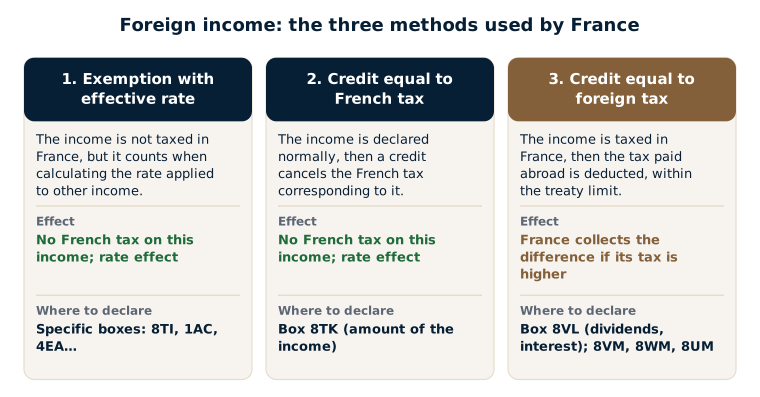
Method 1: exemption with effective rate
The foreign income is exempt from tax in France, but it is taken into account to calculate the rate applicable to your other income: this is the “effective rate” rule. It is declared in specific boxes (for example 1AC for certain salaries, 4EA or 4EB for certain rents, and 8TI, via form 2047, for other income).
Method 2: tax credit equal to French tax (box 8TK)
The foreign income is declared as ordinary income, in the usual boxes, and its amount is also entered in box 8TK. The tax authorities calculate the tax on all the income, then grant a tax credit equal to the share of that tax corresponding to the foreign income. Result: as with method 1, France does not collect any tax on this income, but it increases the rate applied to other income. Note: what goes in box 8TK is the amount of the income, not the tax paid abroad.
Method 3: tax credit equal to foreign tax (box 8VL)
The foreign income is taxable in France. The tax credit is equal to the tax actually paid abroad, but subject to a double limit: the rate provided for by the treaty (for example 15% for US-source dividends) and the amount of French tax on that same income. For dividends and interest, this credit is declared in box 8VL; for other income covered by this method, in box 8VM, 8WM or 8UM depending on the member of the household.
Which method for which income? It depends on each treaty. By way of illustration, dividends and interest often fall under method 3; rent from a property located abroad and certain salaries fall, depending on the treaty, under method 1 or method 2. The notice to form 2047 summarises the main situations.
3. Box 8TK step by step: Claire’s example
Claire is single and tax resident in France. In 2025, her taxable income comprises €600,000 of French salaries and €300,000 of net rent from a building located in a country whose treaty provides, for this rent, a tax credit equal to French tax. The amounts are calculated with the scale applicable to 2025 income (one part, with no reduction or tax credit, excluding the exceptional contribution on high incomes).
| Step | Calculation | Amount |
|---|---|---|
| Total taxable income | €600,000 + €300,000 | €900,000 |
| Tax calculated on €900,000 | 11% from €11,600 to €29,579 + 30% from €29,579 to €84,577 + 41% from €84,577 to €181,917 + 45% from €181,917 to €900,000 | €381,524 |
| Tax credit 8TK | €381,524 × 300,000 ÷ 900,000 | −€127,175 |
| Tax due in France | €381,524 − €127,175 | €254,349 |
| For comparison: tax on salaries alone | on €600,000 | €246,524 |
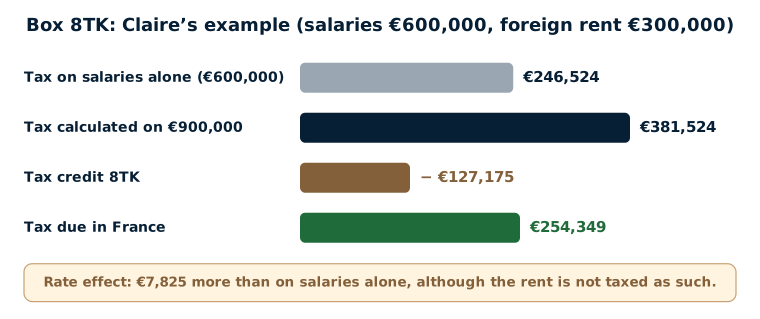
The foreign rent is therefore not taxed in France as such, but Claire pays €7,825 more than if she had only her salaries: this is the rate effect. With method 1 (exemption with effective rate), the result would in practice be the same: only the way of declaring changes.
Social levies follow their own rules, which may depend on your situation (affiliation to a social security scheme, applicable treaty): this point deserves to be checked.
4. Box 8VL step by step: foreign dividends
Claire also owns shares in an American company. She received €800,000 of gross dividends, on which 15% was withheld in the United States: €120,000 withheld, €680,000 received.
| Step | Calculation | Amount |
|---|---|---|
| Dividend to be declared in France (box 2DC) | €680,000 received + €120,000 credit | €800,000 |
| Tax credit (box 8VL) | tax withheld in the United States, up to 15% of the gross amount | €120,000 |
| French income tax at the flat rate | €800,000 × 12.8% | €102,400 |
| Credit actually set off | limited to the French tax | −€102,400 |
| Income tax remaining due | — | €0 |
| Social levies | in principle due in addition, on €800,000 | at the applicable rate |
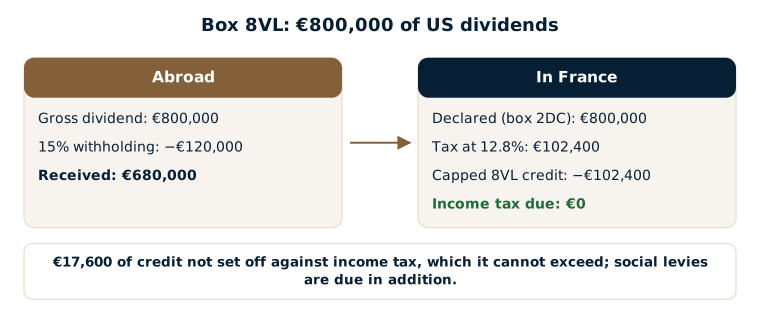
Here, the credit (€120,000) exceeds the French income tax (€102,400): the €17,600 difference is not refunded; depending on the applicable treaty, it may in some cases be set off against certain social levies, which deserves to be checked. Conversely, if Claire elected for the progressive scale, the French tax on these dividends could be higher and absorb the whole credit. If the foreign withholding exceeds the rate provided for by the treaty, the excess does not give rise to a credit in France.
When the dividends are paid by an institution established outside France, an advance tax payment (the non-final flat-rate levy) must in principle also be declared and paid by the taxpayer, using form no. 2778-DIV, within fifteen days of the month following the payment, unless the household is exempt because of modest income. See the page declaring foreign dividends in France.
5. How do you know which method applies to your income?
- The starting point: the source country and the nature of the income (salary, pension, rent, dividend, interest, capital gain…).
- The treaty: the article that allocates the right to tax this income, then the article on the elimination of double taxation, which indicates the method applied by France.
- The notice to form 2047 for the year, which summarises the most common cases.
- Evidence of the foreign tax (withholding certificate, tax assessment notice) and the conversion of the amounts into euros, in principle at the exchange rate on the date of receipt.
If in doubt, or if several countries and several types of income combine, a lawyer’s analysis helps avoid a costly mistake in either direction. The pages declaring foreign rental income (box 8TK) and foreign salary in France cover these two common cases in detail.
6. Where to declare: form 2047, then the income tax return
- Form 2047 lists foreign-source income, by category, for its amount in euros.
- The amounts are then carried over to the income tax return: in the usual boxes (salaries, rent, dividends in 2DC, interest in 2TR…), and in the boxes specific to the applicable method (8TI, 8TK, 8VL…).
- The accounts opened abroad into which this income is paid must also be declared: see the guide form 3916: how to declare a foreign account, step by step.
The article foreign income: which returns to file in France? reviews these forms. If an error is discovered for a past year, it is advisable to consult a lawyer before taking any step: depending on the case, an amended return or a claim may be an appropriate solution.
What I see in my cases
In my cases, the foreign income reported in boxes 8TK and 8VL often involves large amounts: dividends, interest, rents, salaries not taxable in France. Tax treaties almost always offer optimisations, sometimes significant ones, provided they are applied correctly.
The tax authorities know these mechanisms poorly and tend to refuse a poorly presented tax credit or exemption. I therefore prepare returns so that they are solid from the outset, with supporting documents ready in case of questions.
The most common mistakes
- Not declaring income in France on the grounds that it has already been taxed abroad.
- Entering in box 8TK the tax paid abroad instead of the amount of the income.
- Declaring a dividend for its net amount, without adding the tax credit, or claiming a credit higher than the rate provided for by the treaty.
- Applying the same method to all one’s foreign income, when it varies according to the country and the nature of the income.
- Forgetting the advance payment on dividends paid by a foreign institution (form 2778-DIV).
- Not keeping evidence of the foreign tax, which is needed in the event of an audit.
- Converting amounts into euros at a year-end rate instead of the rate on the date of receipt.
FAQ
My income has already been taxed abroad: must I still declare it in France?
In principle yes. Declaring it is precisely what allows the treaty to be applied: exemption with effective rate, credit equal to French tax or credit equal to foreign tax. Not declaring it may, on the contrary, lead to a tax reassessment.
What exactly goes in box 8TK?
The amount of the foreign income concerned (for example rent or a salary), as declared elsewhere in the usual boxes, and not the tax paid abroad. The tax authorities calculate the tax credit themselves.
What goes in box 8VL?
The amount of the tax credit on foreign investment income: in principle the tax withheld abroad, up to the rate provided for by the treaty. The corresponding dividend or interest is declared for the amount received plus this credit.
Can the tax credit be refunded to me if it exceeds the French tax?
In principle no: the credit is limited to the French tax corresponding to the income concerned, and the excess is not refunded. Depending on the treaty, it may in some cases be set off against certain social levies.
Why does my tax increase when my foreign income is “exempt”?
Because of the rate effect: with exemption with effective rate or the credit equal to French tax, the foreign income is not taxed in France, but it is taken into account to determine the rate applied to your French income.
What if there is no treaty with the country concerned?
In principle, no tax credit is then available; the foreign tax can only, in certain cases, reduce taxable income. An analysis of your situation is useful before filing.
Reference texts
- French General Tax Code: Article 4 A (taxation of residents’ worldwide income), Article 4 B (tax domicile), Articles 117 quater and 125 A (non-final flat-rate levy), Article 200 A (flat tax).
- Bilateral tax treaties: articles on the elimination of double taxation.
- Form no. 2047 and its notice (foreign-source income); return no. 2042 and supplementary return no. 2042-C: boxes 8TI, 8TK, 8VL, 8VM, 8WM, 8UM, 2DC, 2TR; form no. 2778-DIV.
- BOFiP: BOI-INT-DG-20-20-100 (elimination of double taxation).
Several countries, several types of income, treaties worded differently, amounts to convert: double taxation can generally be avoided when the method provided for by the treaty is correctly applied. Maître Uzan, a tax lawyer in Paris, analyses your foreign income, identifies the method provided for by each treaty and prepares your returns. See also the page declaring foreign income in France (form 2047), or book an appointment.