“If I exchange my bitcoins for stablecoins, do I pay tax?” Today, the answer is in principle no: in France, exchanging one crypto-asset for another is not taxed at the time. On 16 October 2026, French MPs adopted, in the draft budget for 2027, an amendment that would change this rule for stablecoins backed by a currency, such as the euro or the dollar, and that would also change the way all gains on crypto-assets are calculated.
This article explains in simple terms what a stablecoin is, the current rule, what the amendment as voted provides for, with two worked examples, where it stands in its passage through Parliament, and what it could change for French tax residents who hold crypto-assets, particularly on platforms established abroad. It deals only with French taxation. Status as of 17 October 2026: the amendment was adopted by the National Assembly (Assemblée nationale), in public sitting, on 16 October 2026, by a single vote, during the first reading of the budget; it is not final. It must still get through the Assembly’s vote on the whole first part of the budget, scheduled for 20 October, then examination by the Senate and the rest of the procedure. This article will be updated at each stage.
In brief
- Today, exchanging a crypto-asset for a stablecoin is in principle not taxed: tax arises only on a sale for euros or another currency, or on payment for goods or a service in crypto-assets.
- On 16 October 2026, the National Assembly adopted, by 38 votes to 37, an amendment to the 2027 budget: from 1 January 2027, exchanging a crypto-asset for a stablecoin backed by a single official currency (an “e-money token”, within the meaning of the European MiCA regulation) would become a taxable disposal, even if not a single euro is received.
- The same text would replace the current formula, which is based on the whole portfolio, with an asset-by-asset calculation, at the weighted average acquisition price. For crypto-assets acquired before 2027, an irrevocable choice would have to be made between their actual price, if it can be justified, and an allocation of the total acquisition price of the portfolio.
- In principle, the following would remain untaxed in the year of the exchange: exchanges between ordinary crypto-assets, the exchange of a currency-backed stablecoin for a crypto-asset that is not itself a stablecoin of this type (bitcoins, for example), and exchanges for stablecoins backed by gold or by a basket of assets. Exchanges made in 2026 would not be taxed, but their unrealised gain would remain attached to the crypto-assets received.
- Nothing is final: the text may still be amended or removed (vote on the first part on 20 October, vote on the whole bill on 17 November, Senate, joint committee, final reading, Constitutional Council).
- Each situation deserves to be analysed with a lawyer before any decision, particularly for a large portfolio or one held on a platform established abroad.
Contents
- Stablecoin, e-money token: what do these terms mean?
- The current rule: in principle, no tax until you convert back into euros
- What the amendment adopted on 16 October 2026 provides for
- Worked example: an exchange taxed without a single euro being received
- Worked example: a portfolio bought before 2027, two ways of setting the acquisition price
- Where does the text stand? The timetable
- Platforms established abroad, DAC 8: what the tax authorities will see
- What I see in my cases
- Mistakes to avoid
- FAQ
- Update log
- Reference texts
Stablecoin, e-money token: what do these terms mean?
A stablecoin is a crypto-asset designed to keep a stable value, generally by tracking the price of an official currency: a dollar-backed stablecoin aims always to be worth one dollar, a euro-backed stablecoin one euro. Investors often use them as a waiting room: after a rise, they exchange their bitcoins or ethers for stablecoins to lock in their gain, without going back through their bank account.
The European regulation on markets in crypto-assets, known as “MiCA” (Regulation (EU) 2023/1114 of 31 May 2023), distinguishes two families of stablecoins:
- e-money tokens: crypto-assets that aim to maintain a stable value by referencing the value of a single official currency, the euro, the dollar or another; this is the case, for example, of USDC or EURC;
- asset-referenced tokens: crypto-assets that aim for a stable value by referencing something other than a single official currency, for example gold, a basket of currencies or other assets.
The amendment as voted covers only the first family, e-money tokens. Exchanges for stablecoins backed by gold or by a basket of assets would remain under tax deferral.
And stablecoins that are not authorised in the European Union?
According to some commentary, dollar-backed stablecoins that are not authorised in the European Union, such as USDT, would escape the measure. Yet the regulation’s definition is based on what the token aims for, a stable value by reference to a single official currency, and not on its authorisation in the Union. If the text were adopted, this point would deserve clarification; until then, it would be prudent not to take it for granted that a currency-backed stablecoin escapes the measure.
The current rule: in principle, no tax until you convert back into euros
For an individual who manages their crypto-assets as part of their private wealth, without a professional activity, gains fall under article 150 VH bis of the French General Tax Code. In principle:
- selling crypto-assets for euros or another currency, and using them to pay for goods or a service, are taxable;
- exchanging one crypto-asset for another, without any additional sum of money being paid (without a balancing payment, or “soulte”), is not taxed at the time: it benefits from a tax deferral. This is the case, today, for the exchange of bitcoins for a stablecoin;
- gains are exempt where the total of the year’s disposal prices, for the whole tax household and excluding exchanges under tax deferral, does not exceed €305;
- the gain is in principle taxed under the flat tax, 31.4% for disposals made since 2025 (12.8% income tax and 18.6% social security contributions), unless the progressive scale is opted for; it is declared on form 2086;
- it is calculated using a formula specific to crypto-assets, which is based on the whole portfolio: disposal price − (total acquisition price of the portfolio × disposal price ÷ overall value of the portfolio at the time of the disposal).
The deferral is not an exemption: it postpones the tax. The accumulated gain remains unrealised, and it is in principle taxed on the day the person sells their crypto-assets for euros or pays with them. These rules are set out in detail on the page cryptocurrency taxation and in the article how to declare your cryptocurrencies. These rules, and therefore the amendment, are aimed at occasional investors whose tax domicile is in France; an activity carried out in conditions similar to those of a professional falls under other rules, which the amendment does not change (see individual or professional: where is the line?). A non-resident is in principle not taxed in France on these gains, subject to an analysis of their situation, particularly in the year of an arrival in France or of a departure.
What the amendment adopted on 16 October 2026 provides for
Amendment no. I-3898, tabled by MP Nicolas Sansu and sixteen other MPs, takes up an amendment adopted on 7 October 2026 by the finance committee of the National Assembly. It amends article 150 VH bis of the French General Tax Code for disposals and exchanges made from 1 January 2027. It has three parts.
1. Exchanges for a currency-backed stablecoin would become taxable
The tax deferral would no longer apply to “exchange transactions at the end of which the transferor receives e-money tokens”. In practical terms, exchanging bitcoins, ethers or any other crypto-asset for a euro-backed or dollar-backed stablecoin would be treated as a sale: the gain would be calculated and taxed for the year of the exchange, even if no euros have been received.
The stablecoins received would take as their acquisition price their value on the day of the exchange. Their later sale for euros would therefore, in principle, show only a limited gain or loss, linked for example to movements in the dollar against the euro for a dollar-backed stablecoin. This limited gain assumes, however, that the person does not hold other units of the same stablecoin acquired at a lower price, for example received in 2026 in an exchange under tax deferral: with the weighted average value, part of the unrealised gain on those units would then appear on the sale.
2. A new calculation of the gain: asset by asset, at the weighted average price
The text also rewrites the way the gain is calculated, for all taxable disposals from 2027, and not only for exchanges for stablecoins. The current formula, which is based on the whole portfolio, would disappear. The gain would be equal to the difference between the disposal price, less disposal fees, and the acquisition price of only the crypto-assets disposed of, plus acquisition fees, these fees being taken into account on the basis of supporting documents.
Where crypto-assets “of the same nature” have been acquired at different prices, their acquisition price would be their “weighted average acquisition value”, often called the weighted average price. As a hypothetical example, a person who buys 20 bitcoins at €60,000 and then 20 bitcoins at €90,000 would have an average price of €75,000 per bitcoin; if they sell 20 of them at €100,000 each, i.e. €2,000,000, their gain would be 2,000,000 − 20 × 75,000 = €500,000, i.e. €157,000 of tax at the rate of 31.4%.
A crypto-asset received in an exchange that remains under tax deferral, for example ethers received for bitcoins, would take over the acquisition price of the crypto-asset given up: the unrealised gain would pass from one asset to the other, without being taxed.
3. Crypto-assets acquired before 2027: a choice to be made once and for all
For crypto-assets acquired before 1 January 2027, the current formula does not give a purchase price asset by asset. The text therefore provides for two possibilities:
- using the actual acquisition price of each crypto-asset, provided that it can be justified by any means, this price being determined under the new rules: for a crypto-asset received in an exchange under tax deferral, it would be the acquisition price of the crypto-asset given up, and not its value on the day of the exchange, which could make it necessary to go back, exchange after exchange, to the original purchase in euros;
- or allocating the total acquisition price of the portfolio, calculated at 31 December 2026 under the current rules, among the crypto-assets held at that date, in proportion to their value at that same date.
This choice would be irrevocable, would apply to the whole portfolio and would be made when filing the first return reporting a taxable disposal made after 1 January 2027. The text does not specify how to value the portfolio at 31 December 2026, which could raise practical questions; nor does it specify what would apply if no choice were expressed.
What would change, and what would not
| Transaction by an individual | Current rule | From 2027, if the text is finally adopted |
|---|---|---|
| Bitcoins sold for euros | In principle taxable | In principle taxable, with the new calculation |
| Bitcoins exchanged for a currency-backed stablecoin (e-money token) | Tax deferral: in principle, no tax at the time | In principle taxable |
| Bitcoins exchanged for ethers, or another ordinary crypto-asset | Tax deferral | Tax deferral |
| Currency-backed stablecoin exchanged for bitcoins | Tax deferral | Tax deferral |
| Currency-backed stablecoin exchanged for another currency-backed stablecoin (for example, from the dollar to the euro) | Tax deferral | In principle taxable |
| Bitcoins exchanged for a stablecoin backed by gold or by a basket of assets | Tax deferral | Tax deferral |
| Payment for goods or a service in crypto-assets | In principle taxable | In principle taxable, with the new calculation |
| Currency-backed stablecoin sold for euros | In principle taxable | Taxable as a general rule; gain in principle limited if the stablecoin was received in an exchange already taxed |
The text does not directly change the tax rate, the exemption where the total of the year’s disposal prices does not exceed €305, or the obligation to declare accounts opened abroad.
Worked example: an exchange taxed without a single euro being received
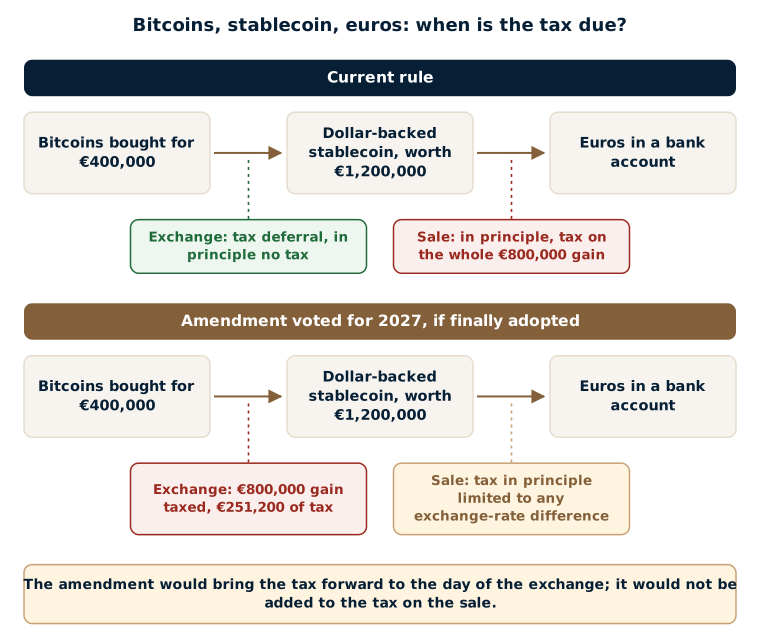
A French tax resident bought bitcoins in 2020 for €400,000. They are his only crypto-assets. In March 2027, when they are worth €1,200,000, he exchanges them all for a dollar-backed stablecoin, on a platform established abroad, to protect himself against a fall in prices. He sells nothing for euros.
| Item | Current rule (exchange made in 2026) | Amendment as voted, if it were adopted (exchange made in 2027) |
|---|---|---|
| Taxable gain in the year of the exchange | None: tax deferral | 1,200,000 − 400,000 = €800,000 |
| Income tax (12.8%) | – | €102,400 |
| Social security contributions (18.6%) | – | €148,800 |
| Tax due on the exchange | €0; the €800,000 gain in principle remains taxable on the future sale for euros | €251,200; gain in principle to be declared in spring 2028, with 2027 income |
Under the amendment as voted, he would have to pay €251,200 of tax even though he has not received a single euro: to pay it, he might have to sell some of his stablecoins. That sale would be a new disposal, but in principle without any significant gain, since his stablecoins would have as their acquisition price their value on the day of the exchange; a gain or a loss could, however, arise if the dollar has moved against the euro in the meantime. Depending on the household’s income, the exceptional contribution on high incomes and, where applicable, the differential contribution on high incomes could also be added.
Under the current rule, the tax is not cancelled: it is postponed. The €800,000 gain would remain taxable on the day he sold his stablecoins for euros. The amendment as voted would therefore bring forward the date of the tax and require it to be paid without the gain having been received; it would not, in itself, create a second tax on the same gain.
Worked example: a portfolio bought before 2027, two ways of setting the acquisition price
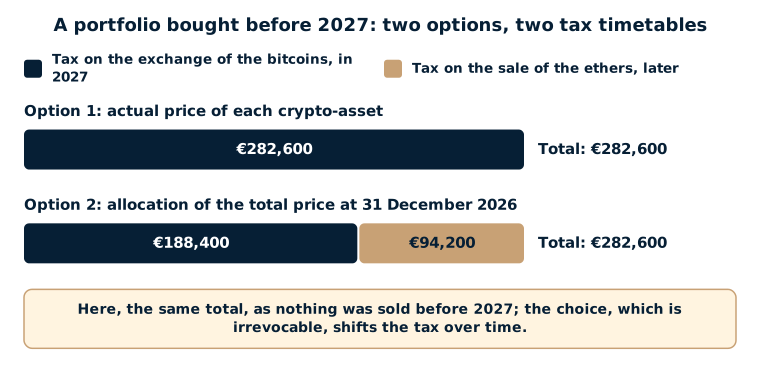
A French tax resident has never sold anything. At 31 December 2026, her portfolio comprises bitcoins bought for €300,000, then worth €1,200,000, and ethers bought for €600,000, then worth €600,000. The total acquisition price of her portfolio is €900,000, for a value of €1,800,000. In 2027, she exchanges all her bitcoins for a euro-backed stablecoin, for €1,200,000; for simplicity, prices have not moved since 31 December 2026. Later, she sells her ethers for €600,000.
| Item | Option 1: actual price of each crypto-asset | Option 2: allocation of the total price at 31 December 2026 |
|---|---|---|
| Acquisition price of the bitcoins | €300,000 | 900,000 × 1,200,000 ÷ 1,800,000 = €600,000 |
| Gain on the exchange of the bitcoins, in 2027 | €900,000 | €600,000 |
| Tax on this exchange (31.4%) | €282,600 | €188,400 |
| Acquisition price of the ethers | €600,000 | 900,000 × 600,000 ÷ 1,800,000 = €300,000 |
| Gain on the sale of the ethers | €0 | €300,000 |
| Tax on this sale (31.4%) | €0 | €94,200 |
| Total | €282,600 | €282,600 |
In this example, where nothing was sold before 2027, the total is identical if everything is sold at the same values: the choice then shifts the tax over time and from one asset to another. This would not always be the case: after taxable disposals made before 2027, the total acquisition price remaining at 31 December 2026 may be very different from the sum of the actual prices of the crypto-assets still held, and the two options may then lead to significantly different amounts of tax; the same applies where a loss cannot be set off, for lack of a gain in the same year. The choice would, moreover, be irrevocable for the whole portfolio. One option or the other may, depending on the case, be more suitable, according to the crypto-assets the person intends to keep or dispose of, price movements, or the supporting documents available to prove the actual price of each asset. This is typically a choice to be prepared with a lawyer, before the first return concerned.
Under the current formula, a sale of the bitcoins for €1,200,000 would give a gain of 1,200,000 − 900,000 × 1,200,000 ÷ 1,800,000 = €600,000: option 2 extends the logic of this formula as at 31 December 2026. These amounts do not include the contributions on high incomes, which may be added depending on the household.
Where does the text stand? The timetable
As of 17 October 2026, the amendment has only been adopted by the National Assembly, in public sitting, during the first reading, by a single vote: 38 votes for, 37 against and 25 abstentions (public vote no. 8836 of 16 October 2026). It may still be amended or removed at several stages.
| Date | Stage | Status as of 17 October 2026 |
|---|---|---|
| 1 October 2026 | Tabling of the Finance Bill for 2027, which does not contain this measure | Done |
| 7 October 2026 | Finance committee of the National Assembly: amendment adopted; as the committee then rejected the whole first part, on 9 October, the debate in public sitting started again from the Government’s text | Done |
| 16 October 2026 | Public sitting of the National Assembly: amendment no. I-3898 adopted, by 38 votes to 37 | Done |
| 20 October 2026 | Assembly vote on the whole first part of the budget (the revenue side) | To come |
| 17 November 2026 | Assembly vote on the whole bill | To come |
| Late November – early December 2026 | Examination by the Senate | To come |
| December 2026 | Joint committee (commission mixte paritaire), bringing together MPs and senators, then, failing agreement, new reading and final reading | To come |
| Late 2026 or early 2027 | Decision of the Constitutional Council, then publication of the Finance Act in the Official Journal | To come |
| 1 January 2027 | Date of application provided for by the text, for disposals and exchanges | Planned |
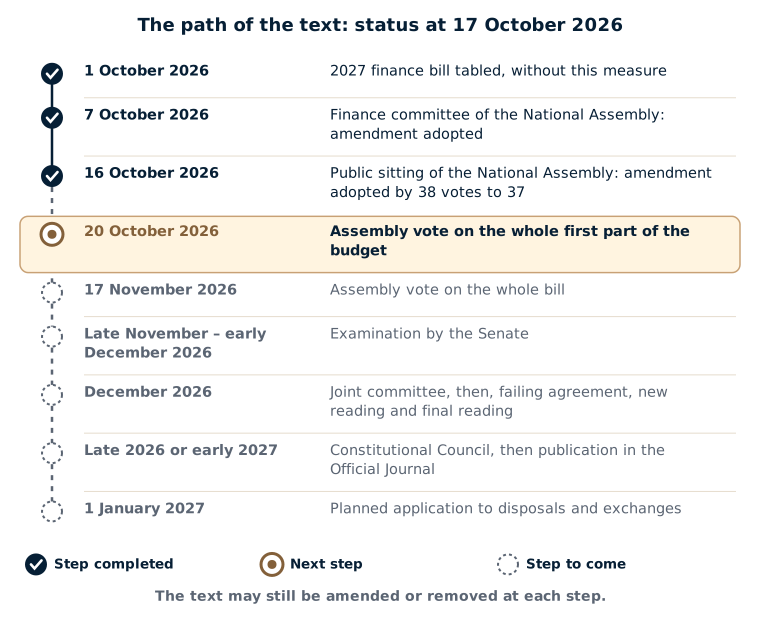
If the Assembly rejected the first part of the budget on 20 October, as it did for the 2026 budget in November 2025, the amendments adopted by MPs would fall, and the Senate would start again from the Government’s original text. The Senate, the joint committee and the Government may also, at each stage, amend the measure or propose its removal. If the Government made the passing of the text an issue of a vote of confidence (article 49, paragraph 3, of the Constitution), it would itself choose which amendments to keep: the measure could then be kept or dropped.
Lastly, the date of 1 January 2027 assumes a law published in time. In 2025 and in 2026, the Finance Act was not published until February. If this happened again, the text, if it were kept in its current wording, could cover exchanges made from 1 January 2027, even before its publication.
Platforms established abroad, DAC 8: what the tax authorities will see
Many investors hold their crypto-assets and stablecoins on platforms established abroad. Two rules, independent of this text, are worth recalling:
- declaring accounts: a French tax resident must in principle declare every year, with their income tax return, crypto-asset accounts opened, held, used or closed with a platform established abroad (form 3916-bis), including, in principle, those that contain only stablecoins (see declaring foreign cryptocurrency accounts);
- DAC 8: since 1 January 2026, platforms subject to DAC 8 have been collecting the identity of their customers and the details of their transactions, including exchanges of one crypto-asset for another, in order to pass them on to the tax authorities; the first data reaches the French tax authorities in 2027 (see crypto-assets and DAC 8: letters from the tax authorities as early as the end of 2027? and what DAC8 and the Travel Rule change).
If the text were adopted, exchanges for stablecoins would therefore appear both among taxable transactions and among the transactions reported by platforms. The tax authorities would see amounts exchanged, not gains: only the taxpayer can establish their acquisition price. With an asset-by-asset calculation, and above all with the actual price option for crypto-assets bought before 2027, the transaction histories from each platform and the proof of purchase would become even more important.
What I see in my cases
In a new case, the first thing I check is the documents. For crypto-assets, this is all the more important as the tax authorities are already taking a close interest in them, without waiting for DAC 8. In some of the cases I handle, information on the use of payment cards linked to accounts opened on a large exchange platform established abroad has reached the tax authorities, and they did not stop at simple invitations to regularise: they opened genuine tax audits, in-depth reviews of personal tax situation, in the course of which they looked at everything in detail, well beyond the crypto-assets alone.
What my clients most often regret is not having filed correct returns, often after doing everything on their own, based on what they had read on the internet. When the stakes are high, saving on advice often proves costly. To those who have failed to declare gains on crypto-assets, I advise first of all discussing the matter with a lawyer, to see which steps are most suitable for their situation. In many cases, it may be useful to gather right now the supporting documents on the origin of the funds invested and the complete history of transactions on each platform; depending on the case, the question of voluntary regularisation may also arise.
Lastly, when faced with a letter or an audit, the reply I prepare remains truthful and precise on what is asked, without going further: this is what I call not being more royalist than the king. Replies that are too long or too detailed often open up new questions.
Mistakes to avoid
- Taking the measure for granted, or on the contrary ignoring it: as of 17 October 2026, it has only been adopted by the National Assembly, during the first reading, but it could apply from 1 January 2027.
- Believing that an exchange without euros can never be taxed: under the amendment as voted, an exchange for a currency-backed stablecoin would be, without any money being received.
- Confusing deferral and exemption: an exchange made in 2026 remains under tax deferral, but the unrealised gain in principle remains taxable on a later sale for euros or, if the text is adopted, on an exchange made from 2027 for a currency-backed stablecoin.
- Forgetting about cash flow: the tax due on a taxable exchange would have to be paid in euros, whereas the gain has remained in stablecoins.
- Letting histories disappear: with an asset-by-asset calculation, it should be possible to justify the actual price of each crypto-asset, transaction by transaction.
- Forgetting form 3916-bis for an account opened on a platform established abroad, even if it contains only stablecoins.
- Deciding in a rush, before 31 December 2026, on transactions based on a text that may still change: each situation deserves to be analysed with a lawyer.
FAQ
Is exchanging bitcoins for stablecoins taxable today?
In principle, no. The exchange of one crypto-asset for another, without any additional sum of money being paid, benefits from a tax deferral (article 150 VH bis of the French General Tax Code). The gain remains unrealised and will in principle be taxed on the sale for euros or on a payment in crypto-assets. It is this rule that the amendment voted on 16 October 2026 would change for currency-backed stablecoins, from 2027.
Is the taxation of exchanges for stablecoins final?
No. As of 17 October 2026, the amendment has only been adopted by the National Assembly, by 38 votes to 37, during the first reading. It still depends on the vote on the first part of the budget, scheduled for 20 October, the vote on the whole bill, scheduled for 17 November, then on examination by the Senate, the joint committee, the final reading and the Constitutional Council. It may be amended or removed at each of these stages. This article is updated as the text progresses.
Which stablecoins would be affected?
E-money tokens within the meaning of the European MiCA regulation, that is to say stablecoins that aim for a stable value by reference to a single official currency, such as USDC or EURC. Stablecoins backed by gold or by a basket of assets would not be covered. For dollar-backed stablecoins that are not authorised in the European Union, the question is debated and would deserve clarification.
Would exchanging a stablecoin for bitcoins be taxable?
In principle, no: the text removes the deferral only from exchanges at the end of which the person receives a currency-backed stablecoin. Receiving bitcoins in exchange for a stablecoin would remain under tax deferral, and the bitcoins received would take over the acquisition price of the stablecoin given up. From a reading of the text, however, exchanging such a stablecoin for another currency-backed stablecoin would be taxable.
Would converting my crypto into stablecoins before 31 December 2026 make it possible to avoid the tax?
In principle, no. An exchange made in 2026 would remain under tax deferral, but the deferral postpones the tax: the stablecoins received would keep, depending on the option chosen for crypto-assets acquired before 2027, the acquisition price of the crypto-assets given up or a share of the total price of the portfolio, and the unrealised gain would remain attached to these stablecoins. It would in principle be taxed when they were sold for euros, used to make a payment or, from 2027, exchanged for another currency-backed stablecoin, for example from a dollar-backed stablecoin to a euro-backed stablecoin. Any decision on the timing of one’s transactions deserves to be taken after one’s situation has been analysed with a lawyer.
How would the gain be calculated from 2027?
Asset by asset: the gain would be the difference between the disposal price and the acquisition price of only the crypto-assets disposed of, at the weighted average price for crypto-assets of the same nature acquired at different prices. For crypto-assets acquired before 2027, an irrevocable choice would have to be made, for the whole portfolio, between their justified actual price and an allocation of the total acquisition price of the portfolio at 31 December 2026, in proportion to the values at that date.
My stablecoins are on a foreign platform: what difference does that make?
The measure would apply in the same way, whatever the platform’s country, to any French tax resident who falls under article 150 VH bis. An account opened on a platform established abroad must in principle be declared every year (form 3916-bis), and, since 2026, the platform in principle collects the details of its customers’ transactions, in order to pass them on to the tax authorities under DAC 8.
Update log
- 17 October 2026: article published. Amendment no. I-3898 adopted by the National Assembly, in public sitting, on 16 October 2026; vote on the whole first part of the budget scheduled for 20 October.
Reference texts
- Projet de loi de finances pour 2027 (Finance Bill for 2027), no. 3210, tabled in the National Assembly on 1 October 2026: amendment no. I-3898 (Mr Sansu and others, after article 4), taking up amendment no. I-CF1826 adopted in the finance committee on 7 October 2026; public vote no. 8836 of 16 October 2026.
- French General Tax Code (CGI): article 150 VH bis (gains on disposals of crypto-assets by individuals), article 200 C (tax rate), article 1649 bis C (declaration of crypto-asset accounts opened abroad).
- Regulation (EU) 2023/1114 of the European Parliament and of the Council of 31 May 2023 on markets in crypto-assets (MiCA), article 3, paragraph 1, points 6 (asset-referenced token) and 7 (e-money token).
- Council Directive (EU) 2023/2226 of 17 October 2023 (“DAC 8”), transposed by article 54 of the Finance Act for 2025.
The amendment voted on 16 October 2026 does not yet change anything: it may be amended or removed before the Finance Act for 2027 is published. If it were adopted, it would bring forward the tax payable by many investors and require each holder of crypto-assets acquired before 2027 to make an irrevocable choice on the acquisition price of those crypto-assets. These questions often involve large amounts and benefit from being prepared after the situation has been analysed. Maître Uzan, a tax lawyer and member of the Paris Bar since 2008, assists his clients with their tax returns and in their tax audits, particularly for assets held abroad. See also the page cryptocurrency taxation, the article on crypto-assets and DAC 8, or book an appointment.