
Your mother lived in London, your uncle in Edinburgh, and you live in France. The estate is opened in the United Kingdom: what has to be paid in France, on which assets, and what steps must be taken? The answer lies in the France–UK tax treaty of 21 June 1963. This old treaty follows rules that differ from more recent treaties: UK assets are disregarded in France, even for calculating the rate, and a bank account follows the domicile of the deceased, not the bank. This guide follows the logic of the treaty, illustrated by a worked example, then sets out your obligations in France once the inheritance has been received.
In brief
- The treaty of 21 June 1963 covers inheritances only: not gifts, nor the Channel Islands (Jersey, Guernsey), nor the Isle of Man.
- If the deceased was domiciled in the United Kingdom, France taxes only the assets located in France within the meaning of the treaty: real estate, movable property located there, shares in companies incorporated in France… Bank accounts and other receivables follow the domicile of the deceased: in principle, they are not taxable in France, even if they were opened in Paris.
- The French rule on heirs domiciled in France for at least 6 years out of 10 is set aside, and UK assets do not even count for the rate.
- Each heir, even one resident in the United Kingdom, is entitled to the French allowances (€100,000 per child).
- If the deceased was domiciled in France, France taxes everything, with a credit for the UK tax paid on the assets located in the United Kingdom.
- Return 2705 within 12 months of a death that occurred in the United Kingdom.
Contents
- An old treaty with particular rules
- 1. Where was the deceased domiciled?
- 2. Where is an asset “located”? The Article 4 grid
- 3. Deceased domiciled in the United Kingdom: what France taxes
- 4. Deceased domiciled in France: everything is taxable, with a tax credit
- 5. Filing the return in France
- 6. Gifts: the treaty does not apply
- 7. After the inheritance: your obligations in France
- United Kingdom or United States: two treaties, two approaches
- What I see in my cases
- FAQ
- Reference texts
An old treaty with particular rules
On the French side, the France–UK treaty applies to inheritance tax. It covers, on the one hand, metropolitan France and the overseas departments and, on the other, Great Britain and Northern Ireland.
It does not apply:
- to gifts, even between parents and children;
- to the Channel Islands and the Isle of Man, which are not part of the United Kingdom within the meaning of the treaty.
In these cases, only French law applies: Article 750 ter of the French General Tax Code (CGI) sets the scope of French inheritance and gift tax, and Article 784 A allows, subject to conditions, the tax paid abroad on assets located outside France to be credited (see below).
1. Where was the deceased domiciled?
Each country first applies its own definition of domicile; in France, that of Article 4 B of the CGI. If both countries claim the deceased, Article 2 of the treaty attaches them successively:
- to the country of their permanent home;
- if they had one in each country, to the one with which their personal and economic ties were closest;
- failing that, to the country of their habitual abode;
- failing that, to the country of their nationality;
- as a last resort, to an agreement between the two tax administrations.
Unlike the France–US treaty, there is no protective rule based on length of stay: a British national who has lived in the Dordogne for three years, all year round, may be domiciled in France within the meaning of the treaty, even if they have kept a house in Kent. For the domicile criteria, see can you be tax resident in two countries?
2. Where is an asset “located”? The Article 4 grid
The treaty sets its own location rule for each category of assets. It is this rule, and not the address of the bank or the notary, that determines whether an asset is located in France.
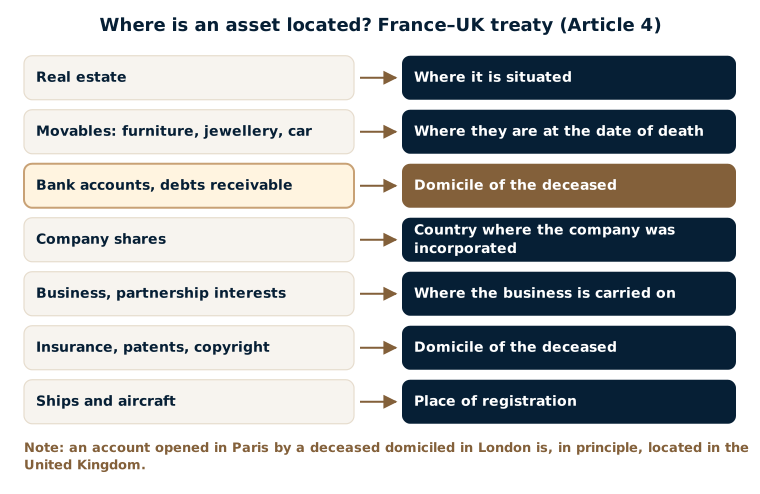
| Asset | Where the treaty locates it | Deceased domiciled in the UK: taxable in France? |
|---|---|---|
| Real estate, rights in real estate | Where it is situated | Yes, if it is in France |
| Tangible movable property (furniture, jewellery, works of art, car) | Where it is on the day of death | Yes, if it is in France |
| Bank accounts and other receivables | Domicile of the deceased | No, in principle, even for an account opened in France |
| Government securities | Domicile of the deceased | No |
| Shares and interests in companies | Country where the company was incorporated | Yes, if the company is French (SCI, listed French company…) |
| Business assets, interests in partnerships | Where the business is carried on | Yes, if the business is carried on in France |
| Insurance proceeds | Domicile of the deceased | No, subject to the specific rules on life insurance |
| Patents, trademarks, copyright | Domicile of the deceased | No |
| Ships and aircraft | Place of registration | Yes, if they are registered in France |
The case of bank accounts often comes as a surprise: the treaty locates receivables at the domicile of the deceased. This is the reading generally adopted for bank balances, to be confirmed case by case before the return is filed. Life insurance policies are, moreover, subject to specific French regimes (Articles 757 B and 990 I of the CGI) that require a separate analysis.
3. Deceased domiciled in the United Kingdom: what France taxes
Article 5 of the treaty is very protective of heirs living in France:
- France levies no tax on assets that are not located in France, whatever the domicile of the heir: the French rule on heirs domiciled in France for at least 6 years out of 10 (Article 750 ter, 3° of the CGI) is set aside;
- these assets are disregarded for calculating both the amount and the rate of French tax: no “effective rate”, unlike the France–US treaty;
- the heirs are entitled to the same exemptions and allowances as if the deceased had been domiciled in France: spouse exemption, €100,000 per child, etc.
Worked example: Margaret’s estate
Margaret, a British national, lived in London. She leaves to her two children, Julien (living in Paris for 10 years) and Emily (who stayed in London), a flat in London, a portfolio of UK shares, a savings account in London, a flat in Nice (€1,500,000), a bank account in Paris (€300,000) and shares in a listed French company (€500,000).
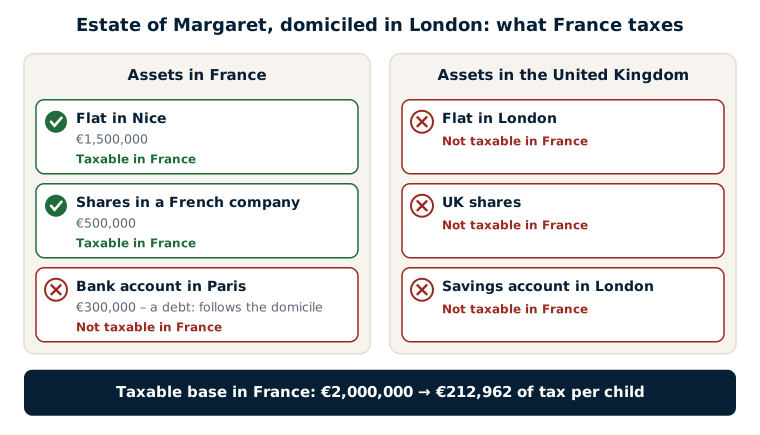
- Taxable in France: the flat in Nice (real estate located in France) and the French shares (company incorporated in France), i.e. €2,000,000.
- Not taxable in France: the Paris account (a receivable located at Margaret’s domicile, and therefore in the United Kingdom) and all the UK assets, even for calculating the rate, and even though Julien has lived in France for 10 years.
- Calculation: each child receives €1,000,000 of taxable assets; after the €100,000 allowance, €900,000 remains, i.e. €212,962 of tax each, €425,924 in total. Emily, although resident in the United Kingdom, is entitled to the same allowance.
4. Deceased domiciled in France: everything is taxable, with a tax credit
If the deceased was domiciled in France, France taxes the whole estate, including the assets located in the United Kingdom. To avoid double taxation, Article 6 of the treaty provides for a credit equal to the UK tax paid on an asset located in the United Kingdom, set against the portion of French tax relating to that same asset and limited to it.
- The credit is calculated asset by asset, then allocated among the heirs.
- It is claimed with the inheritance tax return, using form 2740, together with proof of final payment of the UK tax.
- If the UK tax is paid after the French tax, a refund may be claimed within 5 years of the death (Article 7). The refund is made without interest.
Example: Peter, a British national retired near Bordeaux for 12 years, leaves a house in Kent. France taxes the house along with the rest of the estate; the UK tax relating to that house is credited against the French tax relating to the house, without being able to exceed it.
5. Filing the return in France
The inheritance tax return, step by step
- A prior analysis of the situation, ideally by a lawyer: the domicile of the deceased, the location of each asset and the treaty determine what is due in France, and every estate has its own features.
- Identification of the assets taxable in France, using the Article 4 grid. If the deceased was domiciled in the United Kingdom and owned no asset located in France within the meaning of the treaty, no return is in principle due in France.
- The documents: death certificate, will, proof of the deceased’s domicile, inventory and value of the assets on the day of death, converted into euros at that day’s exchange rate.
- Each heir’s share, according to the will or the applicable law; a French notary will be involved if the estate includes real estate in France.
- Form 2705 and its schedules (2705-S for the heirs and their shares, 2706 for assets and liabilities), plus form 2740 if the deceased was domiciled in France and the Article 6 tax credit is claimed.
- Filing of the return, in principle within 12 months of a death that occurred in the United Kingdom: with the non-residents’ tax collection office (10 rue du Centre, TSA 50014, 93465 Noisy-le-Grand Cedex) if the deceased was domiciled outside France; otherwise with the registration office for their place of domicile. The deadline is 6 months if the death occurred in metropolitan France.
- Payment of the tax, in principle on filing; depending on the case, payment in instalments or deferred payment may be requested with the return.
If you are late, late-payment interest of 0.20% per month applies, and a 10% surcharge applies from the first day of the seventh month after the deadline (Article 1728 of the CGI).
6. Gifts: the treaty does not apply
A gift made by a parent domiciled in the United Kingdom to a child living in France falls outside the treaty. French law applies on its own:
- gifted assets located in France are taxable in France;
- assets located outside France are taxable if the child is domiciled in France on the day of the gift and has been for at least 6 of the last 10 years (Article 750 ter, 3° of the CGI);
- the allowance of €100,000 per parent and per child, renewable every 15 years, applies;
- the tax paid in the United Kingdom on assets located outside France can be credited against French gift tax, up to the amount of that tax (Article 784 A of the CGI).
The gift is in principle declared in France; a gift by hand, for example a bank transfer, is declared on form 2735. To go further, see the page on international gifts.
7. After the inheritance: your obligations in France
- UK accounts in your name or that you can use: in principle to be reported every year on form 3916, including in the year they are closed; see declaring a foreign bank account.
- Income: UK dividends and interest on form 2047, with, where applicable, a tax credit in box 8VL (foreign dividends and interest); rent from a property in the United Kingdom with a credit equal to the French tax in box 8TK (foreign rental income).
- IFI: a UK property in principle falls within the assets subject to the real estate wealth tax (IFI), due when net taxable real estate assets exceed €1,300,000.
- Sale of a UK property: the capital gain is calculated in France on the basis of the value of the property on the day of death; depending on the method provided for by the France–UK tax treaty, it is declared on form 2048-IMM within one month of the sale or mentioned on return no. 2047 (how to use form 2048-IMM).
United Kingdom or United States: two treaties, two approaches
| France–UK treaty (1963) | France–US treaty (1978) | |
|---|---|---|
| Taxes covered | Inheritances only | Inheritances and gifts |
| Domicile | Standard criteria, with no length-of-stay rule | Standard criteria and a 5-out-of-7-years rule for people with a single nationality |
| Bank accounts of a deceased domiciled abroad | Located at the domicile of the deceased: not taxable in France | In principle not taxable in France, even if the deceased held French nationality (Article 8) |
| Foreign assets and the rate of French tax | Disregarded, even for the rate | Taken into account for the rate (effective rate) if French law would tax them |
| Time limit for the tax credit | 5 years from the death | The longest of several periods (French claim period, 5 years, 1 year after the US tax) |
The US case is covered in the guide inheriting from a parent who lived in the United States while living in France.
What I see in my cases
In Franco-British estates, as in the other international estates I handle, two points come up. First, timing: the procedure abroad is often long, and the French deadline is in principle twelve months when the death occurred abroad; depending on the case, a provisional return, supplemented later, makes it possible to meet it.
Second, the application of the 1963 treaty: it is unfamiliar to many departments of the tax authorities, which are moreover very demanding about crediting British tax. A file that explains the treaty clearly, asset by asset, and documents the tax paid, most often avoids long and uncertain discussions.
The assets that raise the most questions are shares and real estate. In an estate that was both British and American, I coordinated with the British and American lawyers and optimised its handling in France: under the tax treaties, it was entirely exempt in France, with returns accepted by the French tax authorities, a result specific to the facts of that case. When a provisional return is filed, it is generally well received.
FAQ
My mother lived in London and I live in Paris: will I pay inheritance tax in France?
Only on the assets located in France within the meaning of the treaty: a flat in France, movable property located there, shares in French companies. Her UK assets are not taxable in France and do not count for the rate, even if you have lived in France for a long time. You are entitled to the €100,000 allowance on the share taxable in France.
Is my father’s bank account in Paris taxable in France if he lived in England?
In principle, no. The treaty locates receivables, including bank balances according to the reading generally adopted, at the domicile of the deceased: an account opened in Paris by a person domiciled in the United Kingdom is therefore not taxable in France. This point should be confirmed before the return is filed.
My parents live in the United Kingdom and are making me a gift: does the treaty apply?
No, the treaty only covers inheritances. The gift is taxable in France if it concerns assets located in France, or if you have been domiciled in France for at least 6 of the last 10 years. Any UK tax on assets located outside France can be credited against French gift tax (Article 784 A of the CGI).
My father lived in Jersey: does the treaty apply?
No. The Channel Islands and the Isle of Man are not covered by the 1963 treaty. Only French law applies: France taxes the assets located in France and, if you have been domiciled in France for at least 6 years out of 10, the assets located outside France that you receive, with a possible credit for the local tax paid on those assets.
My parent lived in France and had a house in England: is the UK tax deductible?
In principle, yes. France taxes the house along with the rest of the estate, then credits an amount equal to the UK tax paid on that asset, up to the French tax relating to it. Form 2740 and proof of payment are in principle attached to the return; if the UK tax is paid later, the refund may be claimed within 5 years of the death. A lawyer can check the calculation and the documents before filing.
By when must the return be filed for a parent who died in the United Kingdom?
Within 12 months of the death, with the non-residents’ tax collection office if your parent was domiciled outside France. After that, late-payment interest of 0.20% per month applies, then a 10% surcharge from the first day of the seventh month after the deadline.
Reference texts
- Treaty between France and the United Kingdom of 21 June 1963 on estate duties: Articles 1 (taxes covered), 2 (domicile), 4 (location of assets), 5 (taxation by the State where assets are located), 6 (tax credit) and 7 (time limit for claims).
- French General Tax Code (CGI): Articles 750 ter (scope of inheritance and gift tax), 777 (scale), 779 (allowances), 784 A (credit for foreign tax), 1728 (surcharges).
- BOFiP: BOI-ENR-DMTG-10-50-60 (credit for duties paid outside France).
Disputed domicile, wrongly located bank account, assets in Jersey, gifts: every Franco-British estate requires a precise analysis. Maître Uzan, a tax lawyer in Paris, determines what France can tax, calculates the tax and prepares the return. See also the page France–United Kingdom inheritance and the guide for the beneficiary of a British trust living in France, or book an appointment.