
A parent or a close relative has died. They held a life insurance policy, but not with a French insurer: the contract had been taken out in another European Union country, in Switzerland, in the United Kingdom, in the United States or elsewhere, and you are its beneficiary. You live in France, or the deceased lived there. The first question that arises is almost every time the same: does this foreign contract benefit from the same rules as a French life insurance policy, in particular the €152,500 allowance per beneficiary? Or does it fall completely outside the life insurance regime, to be taxed like any other asset of the estate?
This article explains, for a reader new to the subject, how France taxes the capital of a foreign life insurance policy on the death of the insured: the two regimes specific to life insurance (the levy of Article 990 I and the inheritance tax of Article 757 B of the French General Tax Code), the conditions for a foreign contract to fall within them, what happens when it does not, the 2027 budget bill, and three worked examples. It deals only with taxation in France. The surrender of a foreign life insurance policy during the insured’s lifetime is covered in a separate article.
In brief
- A contract taken out with an insurer established outside France can, in principle, benefit from the same rules as a French contract on death: the texts also cover insurance bodies that are not established in France.
- It must still be life insurance within the meaning of French law: sums due by reason of the death of the insured to a designated beneficiary. A capitalisation contract, an investment account presented as insurance or certain pension products may not be.
- For premiums paid before the insured turned 70, each beneficiary is in principle entitled to an allowance of €152,500, then a levy of 20% up to €700,000 and 31.25% above (Article 990 I). For premiums paid after age 70, inheritance tax applies to the premiums above €30,500, the gains being exempt (Article 757 B).
- When the contract falls outside these regimes, the capital is in principle taxed like the rest of the estate: a scale of 5% to 45% in the direct line, and up to 60% between unrelated persons. The difference can reach several hundred thousand euros.
- The 2027 budget bill, still under discussion, provides for new conditions, which would also apply to foreign contracts, for deaths occurring from 1 July 2027.
- Each contract is different: before declaring or paying anything, it is advisable to have the contract and the situation analysed by a lawyer, to determine the applicable regime and the most appropriate course of action.
Contents
- Policyholder, insured, beneficiary: the words to know
- On death, life insurance in principle escapes the ordinary inheritance regime
- Can a foreign contract follow the same rules as a French contract?
- When the contract “leaves” the life insurance regime: ordinary taxation
- Example 1: two children, beneficiaries of a contract taken out in another European Union country
- Example 2: payments made after age 70
- Example 3: a beneficiary with no family relationship
- The 2027 budget bill: new conditions, foreign contracts included
- The steps in France after the death
- What I see in my cases
- The most common mistakes
- FAQ
- Reference texts
Policyholder, insured, beneficiary: the words to know
A life insurance policy involves three roles, often held by only two people.
- The policyholder is the person who opens the contract and pays in the money. These payments are called premiums.
- The insured is the person whose death triggers the payment. Most often, it is the policyholder themselves.
- The beneficiary is the person who receives the money on the death of the insured. They are designated in the contract’s beneficiary clause (for example: “my children, in equal shares”).
The sum paid to the beneficiary is the death benefit. It includes the premiums paid and the gains accumulated in the contract (interest, dividends, capital gains). A “foreign” life insurance policy means a contract taken out with an insurer established outside France, whatever the language of the contract or the nationality of the policyholder.
Life insurance differs from the capitalisation contract, which closely resembles it but does not depend on the life or death of a person: there is no insured and no designated beneficiary, and the contract passes to the heirs like an ordinary investment. This difference, which seems technical, has considerable tax consequences, as will be seen.
On death, life insurance in principle escapes the ordinary inheritance regime
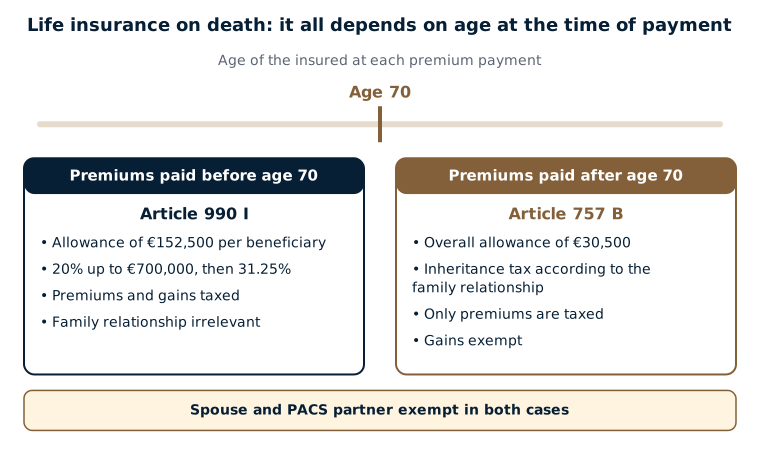
Under French law, the capital paid to a designated beneficiary does not form part of the estate in the civil-law sense: it is paid to them directly by the insurer, outside the division between heirs. Tax law applies two specific regimes to it, depending on the age of the insured at the time of each payment.
Premiums paid before age 70: the Article 990 I levy
The part of the death benefit corresponding to premiums paid before the insured turned 70 (premiums and the related gains) is not subject to inheritance tax, but to a specific levy provided for by Article 990 I of the French General Tax Code:
- each beneficiary is entitled to an allowance of €152,500, valid for all the contracts taken out on the life of the same insured;
- above that, the levy is 20% up to €700,000 of taxable share, then 31.25% above.
This regime has a feature that matters a great deal in blended families: it does not depend on the family relationship. A friend, a nephew or an unmarried partner benefits from the same allowance and the same rates as a child. The surviving spouse and the PACS partner are exempt, as are, under certain conditions, brothers and sisters.
Premiums paid before 13 October 1998, and contracts taken out before 20 November 1991, are subject to transitional rules, often more favourable, which require checking contract by contract.
Premiums paid after age 70: Article 757 B inheritance tax
For contracts taken out since 20 November 1991, the part corresponding to premiums paid after the insured turned 70 falls under Article 757 B: it is subject to inheritance tax, according to the family relationship between the beneficiary and the insured, but only for the amount of premiums exceeding €30,500. This €30,500 threshold is overall: it applies to all the contracts and all the beneficiaries of the same insured. The gains produced by these premiums are not taxed.
These sums are added to what the beneficiary otherwise receives from the estate, with the usual allowances (€100,000 for a child, for example). The surviving spouse and the PACS partner are exempt, as for the rest of the estate.
| Premiums paid before age 70 | Premiums paid after age 70 | |
|---|---|---|
| Text | Article 990 I of the CGI | Article 757 B of the CGI |
| What is taxed | Premiums and corresponding gains | Premiums only, above €30,500 |
| Allowance | €152,500 per beneficiary | €30,500 for all beneficiaries, then inheritance allowances |
| Rate | 20% up to €700,000, 31.25% above | Inheritance tax scale according to the family relationship (5% to 60%) |
| Family relationship | Irrelevant | Decisive |
| Spouse, PACS partner | Exempt | Exempt |
The same contract may fall under both regimes when the insured made payments before and after turning 70: the death benefit is then split between the two, which requires knowing the date and amount of each premium.
Can a foreign contract follow the same rules as a French contract?
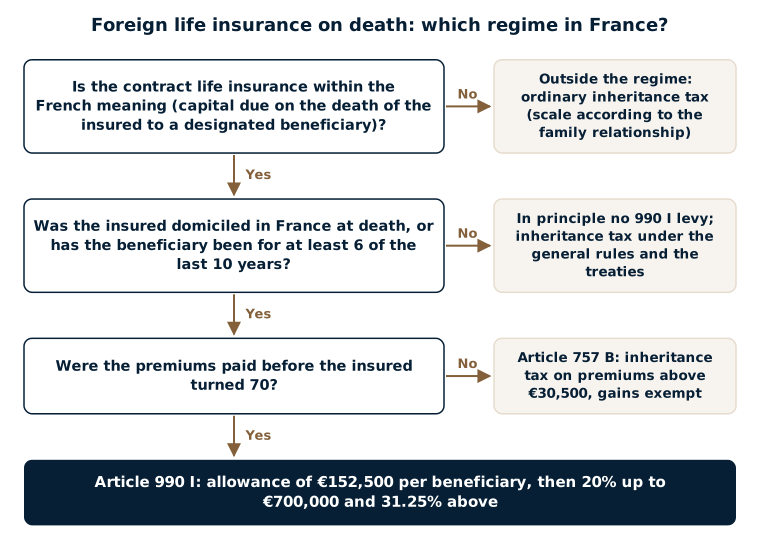
This is the central question. The answer comes down to three successive checks.
1. The insurer’s country is not, in itself, an obstacle
Article 990 I covers sums paid by “insurance bodies and similar bodies”. The tax authorities specify, in their official guidance (the Bulletin officiel des finances publiques, or BOFiP), that this also includes bodies of the same nature that are not established in France. Article 757 B covers sums due “by an insurer”, without distinction as to country. A contract taken out with a foreign insurer is therefore not excluded from these regimes merely because of its location.
2. The contract must be genuine life insurance under French law
This is where most of the difficulties lie. The regimes of Articles 990 I and 757 B apply to sums due by reason of the death of the insured to a beneficiary designated without consideration. Yet some products sold outside France under the name “life insurance” do not quite match this definition:
- a capitalisation contract, with no insured and no beneficiary, does not fall within these regimes: it forms part of the estate at its value on the date of death;
- a product that in reality works as an investment account or a securities portfolio, with a very thin insurance wrapper, may raise the question of its classification;
- some foreign retirement or pension contracts follow their own rules, which are not always those of life insurance;
- a contract taken out for consideration (for example as security for a loan, in favour of the lender) is outside the scope of the levy.
The classification is checked against the contract itself: general and specific terms, beneficiary clause, operation, guarantees provided in the event of death. The documents are often written in another language and according to legal categories different from the French ones, which makes the analysis delicate.
3. The tax domicile of the insured or the beneficiary
The Article 990 I levy applies in principle when, on the date of death:
- the insured had their tax domicile in France; or
- the beneficiary has their tax domicile in France and has had it for at least six years out of the ten years preceding the death.
The policyholder’s place of residence when opening the contract, or the beneficiary’s when receiving the funds, is in principle irrelevant. For premiums paid after age 70, which are subject to inheritance tax, the general territorial rules of inheritance tax apply (domicile of the deceased, domicile of the heir for six of the last ten years, location of the assets), subject to the inheritance tax treaties. These rules are detailed on the page on international inheritance.
Where a tax treaty on inheritance exists between France and another country, whether it applies to the Article 990 I levy, which is not legally an inheritance tax, requires a case-by-case analysis.
When the contract “leaves” the life insurance regime: ordinary taxation
If the foreign contract cannot be treated as life insurance within the French meaning, it loses the €152,500 allowance, the 20% levy and the exemption of the gains attached to premiums paid after age 70. The capital is then in principle included in the deceased’s estate and subject to inheritance tax, on the scale that depends on the family relationship, after the standard allowances.
| Taxable share of each child (after the €100,000 allowance) | Rate |
|---|---|
| Up to €8,072 | 5% |
| From €8,072 to €12,109 | 10% |
| From €12,109 to €15,932 | 15% |
| From €15,932 to €552,324 | 20% |
| From €552,324 to €902,838 | 30% |
| From €902,838 to €1,805,677 | 40% |
| Above €1,805,677 | 45% |
Inheritance tax scale in the direct line (Article 777 of the CGI). Between brothers and sisters, the rates are 35% and 45%; between relatives up to the fourth degree, 55%; between unrelated persons, 60%.
For a child, the difference remains moderate as long as the amounts are modest; it becomes very large on big contracts, where the scale rises to 40% and 45%. For a beneficiary with no family relationship to the deceased, the difference is dramatic: 60% instead of 20% or 31.25%.
Example 1: two children, beneficiaries of a contract taken out in another European Union country
A father, tax resident in France, dies at 78. He had taken out a life insurance policy with an insurer established in another European Union country, into which he had paid €1,800,000 of premiums, all before he turned 70 and after 1998. On death, the contract is worth €2,600,000. The beneficiary clause designates his two children, in equal shares: each receives €1,300,000. Neither of them benefits from another contract on their father’s life.
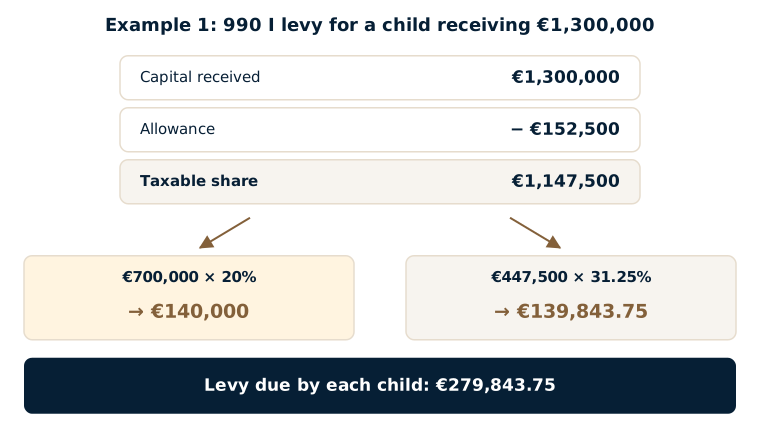
If the contract is recognised as life insurance, each child falls under Article 990 I:
- taxable share: 1,300,000 − 152,500 = €1,147,500;
- levy at 20% on the first €700,000: €140,000;
- levy at 31.25% on the remaining €447,500: €139,843.75;
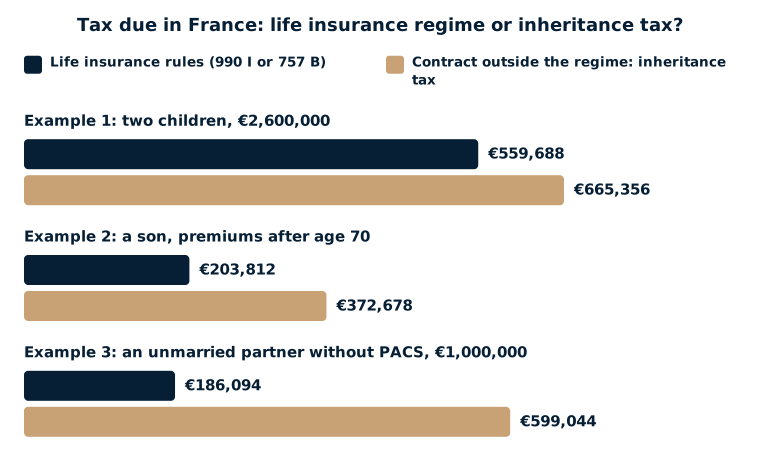
- total per child: €279,843.75, i.e. €559,687.50 for the two.
If the contract falls outside the life insurance regime (for example because it is in reality a capitalisation contract), the €2,600,000 enters the estate. Assuming, for simplicity, that it is the only asset passed on, each child is taxed on 1,300,000 − 100,000 = €1,200,000 on the direct-line scale, i.e. €332,678.15 per child and €665,356.30 for the two. The difference is more than €105,000.
Example 2: payments made after age 70
A mother, tax resident in France, paid €1,000,000 into a contract taken out with an insurer established outside the European Union, between the ages of 72 and 80. She dies at 86; the contract is then worth €1,400,000. Her only son is the sole beneficiary. For simplicity, it is assumed that this contract is the only asset she passes on to him, so that the €100,000 allowance has not been used elsewhere.
| Calculation | Contract recognised as life insurance (Article 757 B) | Contract outside the life insurance regime |
|---|---|---|
| Amount subject to tax | Premiums: €1,000,000 | Total value: €1,400,000 |
| Gains of €400,000 | Exempt | Taxed |
| Article 757 B allowance | − €30,500 | — |
| Direct-line allowance | − €100,000 | − €100,000 |
| Taxable share | €869,500 | €1,300,000 |
| Inheritance tax | €203,811.95 | €372,678.15 |
Even without the €152,500 allowance (which only concerns premiums paid before age 70), the life insurance regime remains more favourable here by almost €169,000, essentially because the contract’s gains are not taxed. By way of comparison, if the same premiums had been paid before age 70, the Article 990 I levy on €1,400,000 would have been €311,093.75: the most favourable regime therefore depends on each situation.
Example 3: a beneficiary with no family relationship
A tax resident of France designates as beneficiary of his foreign contract his partner, to whom he is neither married nor bound by a PACS. On death, she is to receive €1,000,000, corresponding to premiums paid before the insured turned 70.
- Contract recognised as life insurance (Article 990 I): (1,000,000 − 152,500) = €847,500 taxable; 700,000 × 20% + 147,500 × 31.25% = €186,093.75.
- Contract outside the regime: inheritance tax between unrelated persons, at 60% after an allowance of €1,594: (1,000,000 − 1,594) × 60% = €599,043.60.
The difference exceeds €412,000. It is in this type of situation that the classification of the foreign contract has the heaviest consequences.
The 2027 budget bill: new conditions, foreign contracts included
The 2027 finance bill, tabled at the National Assembly on 1 October 2026, contains an Article 6 entitled “Protection of the life insurance model”. In its tabled version, and as it has been presented, it would make the life insurance tax regime subject to several cumulative conditions: premiums paid in cash (and not by contributing securities) from 1 October 2026, unit-linked funds with characteristics similar to those permitted by the French Insurance Code, and the absence, in a dedicated fund, of assets linked to the policyholder, the insured, the beneficiaries, their close family or the companies they control. According to the explanatory memorandum, foreign contracts would have to present similar characteristics.
On death, a contract that did not meet these conditions would see its capital subject to inheritance tax, according to the family relationship, instead of the Article 990 I levy, for deaths occurring from 1 July 2027. This text is only a bill: it may be amended, or even deleted, during the parliamentary debates. For holders of foreign contracts invested in dedicated funds or funded by contributions of securities, it may nevertheless be useful to have the contract examined now, to measure the possible consequences.
The steps in France after the death
The Article 990 I levy
The levy is owed by the beneficiary, but it is in principle withheld and paid to the Treasury by the insurer, on the basis of a sworn statement by the beneficiary (which states in particular the allowance already used on other contracts). Some foreign insurers used to clients resident in France take care of this; others do not, or are simply unaware of the French rule. In that case, the arrangements for declaring and paying in France deserve careful examination, as the levy remains due.
Premiums paid after age 70 and the inheritance tax return
The sums falling under Article 757 B, like contracts that fall outside the life insurance regime, are entered on the inheritance tax return (form no. 2705-SD and its schedule no. 2705-A-SD dedicated to life insurance contracts). It is in principle filed within six months of the death if it occurred in metropolitan France, and within twelve months if it occurred abroad. The guide to the international inheritance tax return details these steps, including the possibility of a provisional return when information from abroad is slow to arrive.
The documents to obtain from the foreign insurer
To determine the regime and calculate the tax, the useful items to obtain from the insurer are in practice: the general and specific terms of the contract, the beneficiary clause in force at death, the history of premiums (dates and amounts, which makes it possible to distinguish payments before and after age 70), the value of the contract on the date of death and the amount due to each beneficiary. When the deceased held the contract during their lifetime while resident in France, they were in principle required to declare it each year (form 3916-3916-bis): the article on the declaration of life insurance policies held abroad explains this obligation.
If a tax was levied in the insurer’s country, whether it is taken into account in France depends on the regime applicable to the contract and, as the case may be, on the tax treaty: this requires analysis, and recovering any overpayment abroad is a matter for a local professional.
What I see in my cases
On death, the first question for the beneficiaries of a foreign life insurance policy is whether this contract falls under the same rules as a French life insurance policy, in particular as regards the €152,500 allowance per beneficiary. Then come the questions about the levy specific to life insurance: can the foreign contract follow the same rules as French contracts, or does it fall completely outside them, to be taxed like the rest of the estate? As the examples above show, the stakes often run into hundreds of thousands of euros.
Answering first requires classifying the contract, and this is rarely immediate. Some foreign contracts are difficult to fit into the categories of French tax law, and the insurer’s detailed documents (history of premiums, payment dates, value at death) often take time to arrive. These delays add to those of the foreign succession procedure, which is often long, whereas the French return is in principle due within twelve months of a death abroad. The whole challenge is then to manage the French procedure without waiting: depending on the case, a provisional return, completed later, can be a solution; in my experience, when it is well presented, it is well received and rarely gives rise to questions afterwards.
These contracts are also often unfamiliar to the tax administration’s departments, given their complexity. Explanatory work is then necessary: a clear file that explains how the contract works, the regime adopted and the calculation, with supporting documents. I also see that the administration is increasingly demanding on foreign assets. In my experience, the quality of the presentation can, depending on the case, significantly influence the outcome, even though every situation is different and no result can be guaranteed.
Finally, when the funds remain blocked abroad while the French tax is due, the situation is delicate: it may be necessary to negotiate a payment schedule with the administration, which is not simple.
The most common mistakes
- Considering that a foreign contract automatically benefits from the €152,500 allowance, without checking that it is genuine life insurance within the meaning of French law.
- Conversely, automatically including the foreign contract in the estate and paying tax on the scale, when it could have fallen under the life insurance regime.
- Confusing life insurance and a capitalisation contract, or applying the same treatment to all the contracts of the same insurer.
- Failing to distinguish premiums paid before and after the insured turned 70, for lack of having requested the payment history.
- Applying the €152,500 allowance several times for the same beneficiary, on several contracts taken out on the life of the same insured.
- Thinking that a foreign insurer that withheld nothing means that no tax is due in France.
- Waiting for the end of the foreign procedure before dealing with the French return, at the risk of missing the deadlines.
FAQ
Does a life insurance policy taken out abroad give entitlement to the €152,500 allowance?
In principle yes, for premiums paid before the insured turned 70, if the contract is genuine life insurance within the meaning of French law and if the insured was domiciled in France at death, or if the beneficiary has been domiciled there for at least six of the last ten years. The place where the insurer is established is not, on its own, an obstacle. The classification of the contract nevertheless requires analysis.
I live in France and my father lived abroad: can France tax the life insurance of which I am the beneficiary?
For premiums paid before age 70, the Article 990 I levy applies in principle if you have your tax domicile in France at the time of death and have had it for at least six years out of the ten preceding years. For premiums paid after age 70, the inheritance tax rules apply, subject to any tax treaty. An analysis of the situation is advisable.
The foreign insurer paid me the capital without withholding anything: do I still owe anything in France?
Not necessarily, but the absence of withholding does not mean that nothing is due. If the contract falls under the Article 990 I levy or inheritance tax, the tax remains due in France, even if the insurer did not levy it. It is useful to check the situation quickly, given the deadlines.
What can make a foreign contract “leave” the life insurance regime?
Mainly its nature: a capitalisation contract, a product that works like a simple investment account, certain pension products, or a contract taken out for consideration. The capital is then, in principle, included in the estate and subject to the inheritance tax scale. The 2027 finance bill also provides for new conditions, which have not yet been adopted.
My spouse designated me as beneficiary of a foreign contract: am I taxed?
In principle no: the surviving spouse and the PACS partner are exempt both from the Article 990 I levy and from inheritance tax. The contract and any other beneficiaries should nevertheless be examined.
The deceased had never declared their foreign contract in France: what are the consequences for me?
The deceased’s failure to declare the contract during their lifetime may have consequences for the estate (fines, tax reassessments on any surrenders), which require a separate analysis. Depending on the case, a regularisation may be considered: the article on forgetting to declare a foreign account presents the possible options.
Reference texts
- French General Tax Code (CGI): Article 990 I (levy on sums paid on the death of the insured, €152,500 allowance, 20% and 31.25% rates, territorial scope); Article 757 B (inheritance tax on premiums paid after age 70, €30,500 allowance); Articles 750 ter (territorial scope of inheritance tax), 777 (scale), 779 (allowances), 796-0 bis and 796-0 ter (exemptions for the spouse, the PACS partner and certain brothers and sisters); Article 1649 AA (declaration of contracts taken out outside France).
- BOFiP: BOI-TCAS-AUT-60 (Article 990 I levy, including bodies not established in France and territorial scope).
- Forms no. 2705-SD and 2705-A-SD (inheritance tax return and life insurance contracts); form no. 3916-3916-bis.
- 2027 finance bill (National Assembly, no. 3210, tabled on 1 October 2026), Article 6 “Protection of the life insurance model” (bill, not adopted at the date of the article).
Classification of the contract, age of the insured at the time of payments, domicile of the deceased and of the beneficiaries, tax treaties, reform announced for 2027: the fate of a foreign life insurance policy on death depends on many factors, often with large amounts. Maître Uzan, a tax lawyer and member of the Paris Bar since 2008, analyses the contract and the foreign insurer’s documents, determines the applicable regime in France and assists beneficiaries with their declarations, working, where necessary, with professionals in the country concerned. See also the page on international inheritance, the articles inheriting from a parent who lived in the United States and inheriting from a relative who lived in the United Kingdom, or book an appointment.