You live in France and hold a life insurance policy with a foreign insurer: taken out before you moved to France, recommended by a private bank, or a habit carried over from saving in another country. One day, you withdraw part of the money, or all of it. This is called a surrender. Does it have to be declared in France? On what amount is tax paid? And why did the foreign insurer withhold nothing for France?
This article explains, step by step and for a reader new to the subject, how France taxes the surrender of a foreign life insurance policy: the part of the withdrawal that is actually taxable, the rates, form 2778 to be filed in the following month, the income tax return, with two worked examples. It only deals with taxation in France; the annual declaration of the policy itself is covered in an article on declaring life insurance policies held abroad.
In brief
- For a French tax resident, the surrender of a life insurance policy taken out abroad is in principle taxable in France, like that of a French policy.
- Only the portion of gains included in the withdrawal is taxable, not the total amount withdrawn: for a partial surrender, it is calculated with a proportional formula.
- The foreign insurer in principle withholds no French tax: it is up to the policyholder to declare and pay a tax advance and the social levies, using form 2778, within the first fifteen days of the month following the surrender, and then to declare the gains the following year.
- The income tax rate is 12.8% or, for a policy held for eight years or more and taken out in the European Union or the European Economic Area, 7.5% on part of the gains, after an allowance; the social levies are in principle 17.2%.
- Any tax withheld abroad may, depending on the tax treaty and after analysis, give entitlement to a tax credit in France, within certain limits.
- Every policy and every situation is different: before declaring a surrender, or correcting a past return, it is advisable to consult a lawyer to determine the most appropriate course of action.
Contents
- Surrender, premiums, surrender value: the words to know
- Only the gains are taxable: how to calculate the taxed portion of a surrender?
- What tax rate applies to the gains?
- The foreign insurer withholds nothing for France: the policyholder’s steps
- Example 1: total surrender of a policy held for more than eight years
- Example 2: two partial surrenders, and the total-amount trap
- Tax withheld abroad: how France treats it
- Policies that are sometimes hard to classify
- What I see in my cases
- A surrender was not declared: what are the risks, what are the options?
- The most common mistakes
- FAQ
- Reference texts
Surrender, premiums, surrender value: the words to know
A life insurance policy works like a savings wrapper. You pay money into it: these are the premiums (also called payments, or invested capital). The insurer invests this money, in a guaranteed fund or in financial assets (shares, bonds, funds) called “unit-linked” investments. Over time, the value of the policy changes: this is the surrender value, that is to say the sum you would get back if you withdrew everything today.
A surrender is a withdrawal. It is total when you take back the whole value of the policy, which then comes to an end; it is partial when you withdraw only part of it and the policy continues. The gain (or “income”, in tax vocabulary) is the difference between what the policy is worth and what you paid into it: interest, dividends and capital gains accumulated inside the policy.
What is a “foreign” life insurance policy?
For the French tax authorities, what matters is where the insurer is established: a policy taken out with a company established outside France is a foreign policy, even if it is written in French, even if it was recommended by a French bank, and even if it was taken out when you were already living in France. The policyholder’s nationality is irrelevant. The insurer’s country does, however, affect the tax rate, as explained below: it is useful to distinguish insurers established in the European Union or the European Economic Area (Iceland, Liechtenstein, Norway) from those established elsewhere.
The policy itself must in principle be declared every year (box 8TT and form 3916-3916-bis), regardless of any surrender: the guide to form 3916 explains how to fill it in.
Only the gains are taxable: how to calculate the taxed portion of a surrender?
This is the point that causes the most difficulty in practice. When you withdraw money, part of the sum corresponds to your own payments, which you are getting back, and another part to the gains. Only the gains are taxable. The capital you paid in is not taxed a second time.
Total surrender
The calculation is simple: taxable gain = sum received − total premiums paid. A policy funded with €1,500,000 of premiums and surrendered for €2,300,000 produces a gain of €800,000.
Partial surrender: the proportional rule
For a partial surrender, each euro withdrawn is considered to contain the same proportion of capital and gains as the policy as a whole on the day of the withdrawal. The taxable portion is calculated as follows:
taxable gain = amount surrendered − (premiums paid × amount surrendered ÷ total surrender value of the policy on the day of the surrender)
“Premiums paid” means the premiums that have not already been repaid in earlier surrenders: each surrender “uses up” part of the capital, which cannot be deducted a second time.
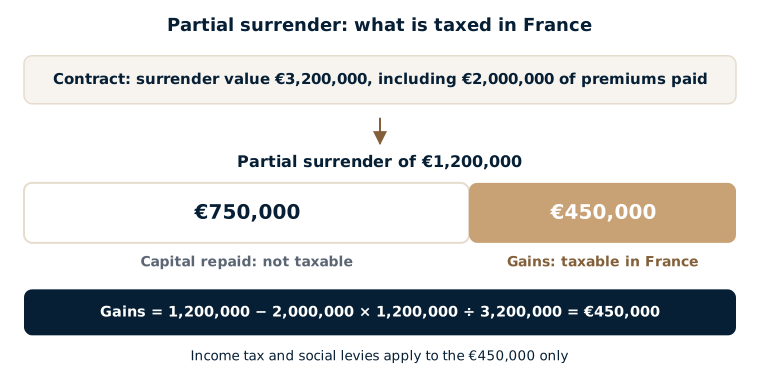
To make this calculation, three figures are needed: the total premiums paid (and the premiums already repaid), the surrender value of the policy on the day of the withdrawal and the amount withdrawn. Foreign insurers do not always present them in this way: their statements often show only the amount paid to the client, without separating capital and gains. Obtaining this breakdown is therefore the first step.
What tax rate applies to the gains?
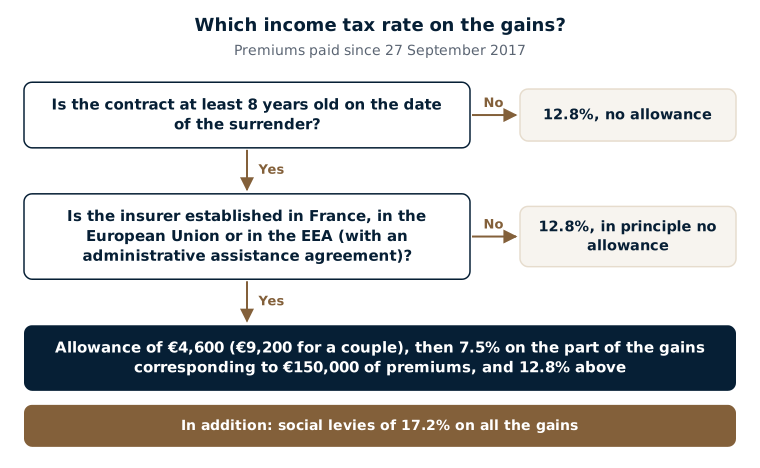
The rules depend on the date of the payments, the length of the policy and the insurer’s country. For premiums paid since 27 September 2017, which concern most policies today, the rules are as follows.
Policy under eight years: 12.8%
The gains are taxed at the flat rate of 12.8%, with no allowance, whatever the insurer’s country.
Policy of eight years or more: allowance and 7.5% rate, subject to conditions
When the insurer is established in France or in a State of the European Union or the European Economic Area that has concluded an administrative assistance agreement with France, two advantages apply:
- an annual allowance of €4,600 for a single person, or €9,200 for a married couple or civil partners (PACS) taxed jointly, shared by all the household’s policies;
- a rate of 7.5% on the portion of the gains corresponding to €150,000 of premiums; above that, the portion corresponding to premiums exceeding €150,000 is taxed at 12.8%.
The €150,000 threshold is assessed per person, by adding up the unrepaid premiums of all their policies (French and foreign) on 31 December of the year before the surrender. When this threshold is exceeded, the portion of the gains taxed at 7.5% is calculated proportionally: gains × 150,000 ÷ premiums paid (for premiums paid since 27 September 2017). The allowance is set off first against the portion taxed at 7.5%, then against the portion taxed at 12.8%.
When the insurer is established outside the European Union and the European Economic Area, these two advantages do not in principle apply: the gains are taxed at 12.8%, even after eight years.
Social levies: 17.2%
The gains are also subject to social levies (CSG, CRDS and solidarity levy), at an overall rate of 17.2% for life insurance income: the CSG increase decided for 2026 on other investment income (18.6%) does not apply to this income. The allowance does not reduce the social levies. On a foreign policy, they are in principle due at the time of the surrender, on the portion of gains included in the withdrawal.
What about older premiums?
Gains attached to premiums paid before 27 September 2017 follow different rules (taxation at the progressive scale or, by option exercised at the time of the surrender, a final withholding at a rate that depends on the length of the policy). The same policy may combine both regimes: splitting the gains between old and new premiums then requires a precise calculation.
| Situation (premiums paid since 27/09/2017) | Income tax | Allowance | Social levies |
|---|---|---|---|
| Policy under 8 years, any insurer | 12.8% | No | 17.2% |
| Policy of 8 years or more, EU or EEA insurer (with assistance agreement) | 7.5% on the portion corresponding to €150,000 of premiums, 12.8% above | €4,600 or €9,200 per year | 17.2% |
| Policy of 8 years or more, insurer outside the EU and EEA | 12.8% | No, in principle | 17.2% |
By an overall option, valid for all the investment income of the year, the gains can be taxed at the progressive income tax scale instead of the flat rates (box 2OP). With large gains, this option is rarely advantageous, but the comparison can be made depending on the case.
The foreign insurer withholds nothing for France: the policyholder’s steps
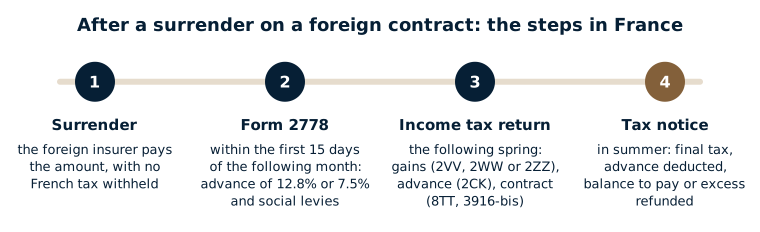
With a French policy, the insurer itself withholds, at the time of the surrender, a tax advance and the social levies, and then sends the information to the tax authorities. A foreign insurer in principle does not. The steps therefore fall to the policyholder, in three stages.
1. Within fifteen days of the following month: form 2778
Form no. 2778 is used to declare and pay, to the tax office of your place of residence, an income tax advance (the “non-final flat-rate withholding”) and the social levies. It is filed, with the payment, within the first fifteen days of the month following the surrender. The advance is 12.8% of the gains, or 7.5% for a policy of eight years or more taken out with an insurer in the European Union or the European Economic Area that has concluded an administrative assistance agreement with France. It is only an advance: it will be deducted from the final tax the following year, and any excess will be refunded.
Households whose reference tax income for the year before last is below €25,000 (single person) or €50,000 (couple) are exempt from the advance, but not from the social levies. An insurer established in the European Economic Area may also, if its client has given it a mandate, handle these formalities: it is useful to check this with the insurer.
2. The following spring: the income tax return
The gains are then declared on the income tax return for the year of the surrender, whether or not they bore the advance. In the return filed in 2026 (2025 income), gains attached to premiums paid since 27 September 2017 were declared in boxes 2VV and 2WW (policies of eight years or more, gains taxed at 7.5% and at 12.8%) or 2ZZ (policies under eight years), and the advance already paid in box 2CK. The policy itself appears, as every year, in box 8TT and on form 3916-3916-bis, including in the year it comes to an end.
3. The summer: the tax notice
The tax authorities calculate the final tax (applying the allowance and the split between 7.5% and 12.8%), deduct the advance and claim the balance or refund the excess.
Example 1: total surrender of a policy held for more than eight years
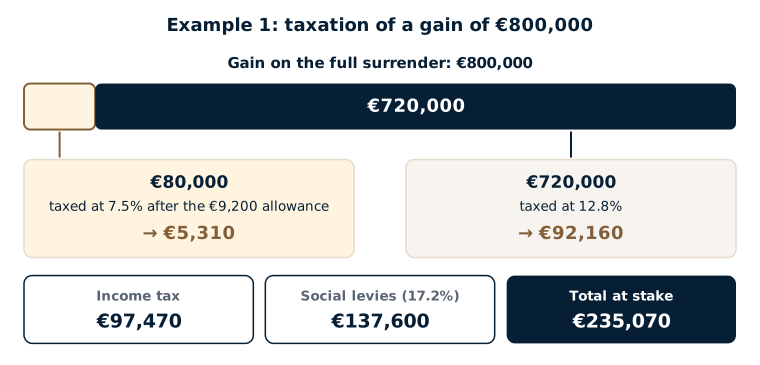
A married couple, tax resident in France, holds a policy taken out in the wife’s name in October 2017 with an insurer established in another European Union country. A single premium of €1,500,000 was paid in when the policy was taken out. The wife has no other policy. In November 2025, more than eight years later, she surrenders the whole policy for €2,300,000.
- Taxable gain: 2,300,000 − 1,500,000 = €800,000.
- Portion taxed at 7.5%: 800,000 × 150,000 ÷ 1,500,000 = €80,000; portion taxed at 12.8%: €720,000.
- Couple’s allowance (€9,200), set off against the 7.5% portion: (80,000 − 9,200) × 7.5% = €5,310.
- 12.8% portion: 720,000 × 12.8% = €92,160.
- Income tax: 5,310 + 92,160 = €97,470.
- Social levies: 800,000 × 17.2% = €137,600.
In total, €235,070 is at stake. In practice, the wife in principle files a form 2778 no later than 15 December 2025, with an advance of €60,000 (7.5% of €800,000) and the €137,600 of social levies. In spring 2026, the income tax return in principle shows €80,000 in box 2VV, €720,000 in box 2WW and the €60,000 advance in box 2CK; the tax notice then claims the balance of €37,470.
If the same policy had been taken out with an insurer established outside the European Union and the European Economic Area, there would in principle have been neither allowance nor 7.5% rate: 800,000 × 12.8% = €102,400 of income tax, plus the same €137,600 of social levies, i.e. €240,000. The advance on form 2778 would then have been 12.8%.
Example 2: two partial surrenders, and the total-amount trap
A French tax resident paid a premium of €2,000,000 in 2020 into a policy taken out with an insurer established in a European Union country. In 2025, the policy is worth €3,200,000 and he withdraws €1,200,000. The policy is less than eight years old.
| Calculation | 2025 surrender | 2026 surrender |
|---|---|---|
| Value of the policy on the day of the surrender | €3,200,000 | €2,100,000 |
| Premiums not yet repaid | €2,000,000 | €1,250,000 |
| Amount withdrawn | €1,200,000 | €1,000,000 |
| Capital repaid (premiums × withdrawal ÷ value) | €750,000 | €595,238 |
| Taxable gain | €450,000 | €404,762 |
| Income tax (12.8%) | €57,600 | €51,810 |
| Social levies (17.2%) | €77,400 | €69,619 |
| Total | €135,000 | €121,429 |
In 2026, the policy is worth €2,100,000 and he withdraws another €1,000,000. The premiums to be taken into account are no longer €2,000,000, but €1,250,000: €750,000 of capital was already repaid in 2025.
Now suppose that, for lack of a breakdown from the insurer, the 2025 surrender is declared for its total amount of €1,200,000. The tax calculated would then be €153,600 and the social levies €206,400, i.e. €360,000: €225,000 too much. Conversely, a surrender that is not declared at all exposes the policyholder to a reassessment of the €135,000, with late-payment interest and, depending on the case, surcharges. Either way, an accurate reconstruction of capital and gains is what makes it possible to pay the right amount.
Tax withheld abroad: how France treats it
The foreign insurer sometimes withholds tax at the time of the surrender, under the rules of its own country. On the French side, the question is whether this tax can be deducted from French tax. The answer depends on the tax treaty between France and that country: depending on the case, and after analysis of the treaty, the tax withheld abroad may give entitlement in France to a tax credit, in principle within the limit of the rate set by the treaty and of the French tax on the same income. Any amount withheld above that is in principle neither credited nor refunded in France. The article on boxes 8TK and 8VL and double taxation explains these mechanisms in detail.
It is therefore useful for the foreign insurer to have accurate information on the policyholder’s French tax residence: a withholding applied as if the policyholder lived in the insurer’s country may exceed what France takes into account. Recovering this excess, where applicable, involves steps in the other country, with the help of a local professional.
Policies that are sometimes hard to classify
The tax regime described here is that of life insurance and capitalisation contracts, and of “investments of the same nature” taken out abroad. Yet some products sold outside France under the name of life insurance do not quite resemble French policies: highly customised policies invested in a dedicated portfolio, products close to a securities account, retirement or protection contracts, structures combining several mechanisms. Depending on their features, the question may arise whether they fall under the life insurance regime or under other tax rules, sometimes less favourable. This classification is checked against the policy itself (general and specific terms, operation, guarantees) before a surrender is declared.
The death of the insured person follows other rules, specific to inheritance, which are not covered here: see the article foreign life insurance and inheritance and the page on international inheritance.
What I see in my cases
Surrenders of foreign life insurance policies are a frequent source of errors in the cases I handle. I often come across surrenders that were not declared in France, or were declared incorrectly. Life insurance policies are, along with securities accounts and retirement accounts, among the foreign accounts most often forgotten: these are generally the ones holding the most money. And when the tax authorities take an interest in them, it is almost always because they have received information through the automatic exchange of information.
The first difficulty is getting the documents. For a surrender, it is often hard to obtain from the insurer the breakdown that matters for French tax: within the sum paid out, which part corresponds to the capital invested and which part to the investment income, which alone is taxable. Detailed documents take time to arrive, and the timescales grow longer accordingly. This is why I start by gathering and checking the documents: history of premiums, surrender values, statements for each transaction.
I also see foreign insurers applying their withholdings as if the policyholder were tax resident in their country, when he or she is resident in France. The withholding is then often heavier than the one that would have been applied to a non-resident, and France only takes it into account within the limits of the treaty. Recovering the overpayment is then complicated: hence the importance, from the outset, of the policyholder being correctly registered as a non-resident with the foreign institution.
Finally, some policies are hard to classify under French tax rules. These products are often unfamiliar to tax officials, given their complexity: real explanatory work is then needed, with a clear file that explains how the policy works and the calculation used, with supporting documents. In my experience, the way the file is presented can, depending on the case, have a significant bearing on the outcome, even though every situation is different and no result can be guaranteed.
A surrender was not declared: what are the risks, what are the options?
An undeclared surrender may lead to a reassessment of income tax and social levies on the gains, with late-payment interest and, depending on the circumstances, surcharges. If the policy itself was not declared, a fine of €1,500 per policy and per year is in principle incurred (€10,000 when the insurer is established in a State that has not concluded an administrative assistance agreement with France), and the period during which the tax authorities can correct the tax is in principle extended to ten years: see the articles on fines and on limitation periods.
Several options may exist, and whether they are appropriate depends on each situation: in some cases, an amended return may be a solution; in others, a broader regularisation of foreign accounts and policies may be considered, as explained in the article on forgetting to declare a foreign account. Before taking any step, a lawyer’s analysis makes it possible to measure what is at stake, check the calculations and the classification of the policy, and choose the most appropriate route.
The most common mistakes
- Not declaring a surrender in France because the insurer is foreign or because tax was withheld abroad.
- Declaring the total amount withdrawn instead of only the portion of gains, and thus paying tax on one’s own capital.
- Forgetting, on a second surrender, to deduct from the premiums the capital already repaid on the first.
- Applying the 7.5% rate and the allowance to a policy taken out with an insurer established outside the European Union and the European Economic Area.
- Forgetting form 2778 and the advance in the month following the surrender, or forgetting the social levies.
- No longer declaring the policy (box 8TT, form 3916-3916-bis) in the year it is fully surrendered.
- Letting the foreign insurer treat the policyholder as a resident of its country, with a withholding that France will not fully take into account.
FAQ
I only withdrew my capital: am I still taxable?
In principle, it is not possible to choose to withdraw “only the capital”: for tax purposes, each partial surrender contains a portion of capital and a portion of gains, calculated in proportion to the value of the policy. Only the portion of gains is taxable.
My foreign insurer has already withheld tax: do I have to declare the surrender in France?
In principle yes. Tax withheld abroad does not remove the need to declare in France; depending on the tax treaty and after analysis, it may give entitlement to a tax credit, within certain limits.
What is form 2778 and when is it filed?
It is the form used to declare and pay the income tax advance and the social levies on the gains from a foreign policy. It is filed, with the payment, with the tax office of your place of residence within the first fifteen days of the month following the surrender, unless the insurer, established in the European Economic Area, handles it under a mandate.
My policy is more than eight years old: am I entitled to the €4,600 or €9,200 allowance?
In principle yes if the insurer is established in France or in a State of the European Union or the European Economic Area that has concluded an administrative assistance agreement with France. For an insurer established elsewhere, the allowance does not in principle apply. It does not reduce the social levies.
I took out the policy before moving to France: can France tax all the gains?
In principle, a French tax resident is taxable in France on the surrenders he or she makes, including on gains accumulated before arriving. Depending on the case, the applicable tax treaty and the personal situation may however change the analysis: a prior review is useful, particularly when the amounts are large.
My insurer only gives me the amount paid out, without the breakdown: what can be done?
The calculation requires knowing the total premiums paid, the earlier surrenders and the surrender value on the day of the withdrawal. This information can be requested from the insurer, or reconstructed from the annual statements and transaction notices. As it sometimes takes a long time to obtain, it may be prudent to request it early.
I surrendered my policy several years ago without declaring anything: is it too late?
Not necessarily. Depending on the case, an amended return or a broader regularisation may be considered. The choice depends on the amounts, the years concerned, whether the policy itself was declared and whether the tax authorities have sent a letter: a prior analysis by a lawyer is advisable.
Reference texts
- French General Tax Code (CGI): Article 125-0 A (taxation of income from life insurance and capitalisation contracts, allowance, 7.5% rate and €150,000 threshold), Article 125 D (non-final flat-rate withholding), Article 200 A (12.8% flat rate and option for the progressive scale), Article 1649 AA (declaration of contracts taken out outside France), Article 1766 (fine for failing to declare a contract).
- French Social Security Code: Article L136-7 (CSG on investment income); Law no. 2025-1403 of 30 December 2025 on social security financing for 2026.
- French Tax Procedure Code (LPF): Article L169 (reassessment period extended to ten years).
- BOFiP: BOI-RPPM-RCM-20-10-20-50 (calculation of income, partial surrender, allowance) and BOI-RPPM-RCM-20-15 (regime for premiums paid since 27 September 2017).
- Form no. 2778 and its notice; return no. 2042: boxes 2VV, 2WW, 2ZZ, 2CK and 2OP; form no. 3916-3916-bis and box 8TT.
Calculating capital and gains, rates depending on the insurer’s country, the form 2778 advance, foreign withholdings, classification of the policy: the surrender of a foreign life insurance policy involves many rules, often with large amounts. Maître Uzan, a tax lawyer and member of the Paris Bar since 2008, analyses the policy and the insurer’s documents, checks the calculation of the taxable portion and assists with the declaration, or with a possible regularisation when past surrenders were not declared. See also the page declaring a foreign account (form 3916) and the article declaring foreign accounts, life insurance policies and trusts, or book an appointment.