
Your father or mother lived in the United States, you live in France, and the estate is being settled. Do you have to pay inheritance tax in France? On which assets? Do you have to file a return, and by when? The answer depends neither on where the death occurred nor on the bank holding the assets. It depends on two questions: the domicile of the deceased and the nature of each asset. The France–US tax treaty of 24 November 1978 answers them, and the deceased’s French nationality in principle makes no difference. This guide takes these questions in order, with worked examples, then sets out your obligations in France once the inheritance has been received.
In brief
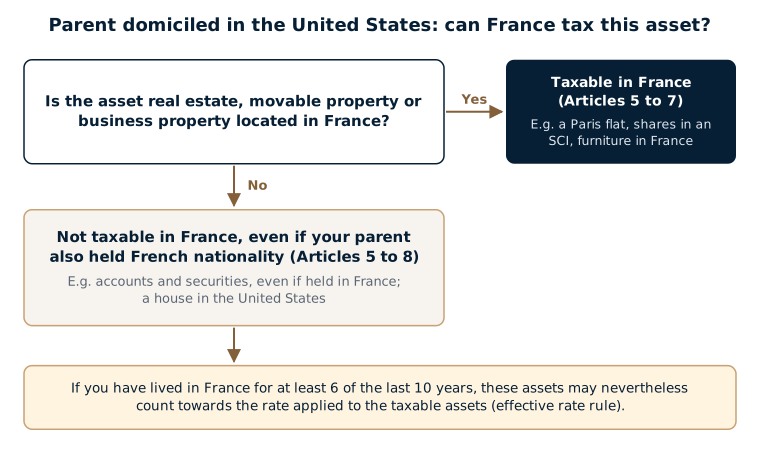
- If your parent was domiciled in the United States, France in principle taxes only their assets located in France within the meaning of the treaty: real estate (and shares in companies whose assets are mainly real estate), assets of a permanent establishment and tangible movable property. Their bank accounts and securities are not taxable in France, even if they are held in France (Article 8).
- The French rule on heirs domiciled in France for at least 6 of the last 10 years (Article 750 ter, 3° of the French General Tax Code, CGI) gives way to the treaty. It can, however, increase the rate applied to the French assets (effective rate rule).
- If your parent also held French nationality, this in principle makes no difference: for France, only their domicile counts (1988 ministerial answer to Mr Valleix).
- The return (form 2705) must be filed within 12 months of a death that occurred abroad, with the non-residents’ tax collection office (recette des non-résidents).
- After the inheritance: US accounts to be reported every year (form 3916), income to be declared in France, IFI and capital gains tax if you sell.
Contents
- Two questions decide everything
- 1. Your parent’s domicile: the treaty decides
- 2. Dual French and US nationality: in principle, nothing changes in France
- 3. Asset by asset: what France can tax
- 4. Calculating the tax: two worked examples
- 5. Filing the inheritance tax return in France: how to do it
- 6. What if your parent lived in France?
- 7. After the inheritance: your obligations in France
- What I see in my cases
- The most common mistakes
- FAQ
- Reference texts
Two questions decide everything
To find out whether France can tax what you receive, two questions arise, in this order:
- Where was your parent domiciled within the meaning of the treaty: in France or in the United States?
- What asset is involved, and where is it located? A flat in Paris, a securities account in New York and a house in Florida do not follow the same rules.
Your parent’s nationality plays a role only in determining their domicile (section 1): their French nationality in principle gives France no additional right to tax (section 2). The diagram below summarises the reasoning where the parent was domiciled in the United States, the most frequent case for an heir living in France.
1. Your parent’s domicile: the treaty decides
Each country first applies its own definition of domicile. In France, this is Article 4 B of the CGI: home or main place of stay, main professional activity, centre of economic interests. If both countries consider that your parent was domiciled with them, Article 4 of the treaty breaks the tie by looking successively at:
- the permanent home;
- failing that, the centre of vital interests, i.e. the country with which personal and economic ties were closest;
- failing that, the place of habitual abode;
- failing that, nationality;
- as a last resort, an agreement between the two tax administrations.
The treaty adds a protective rule (Article 4, paragraph 3): a person who holds the nationality of only one of the two States is deemed to be domiciled only in that State if they had clearly shown their intention to keep their domicile there and had been domiciled in the other State for less than 5 years in the 7 years preceding death. For renewed work assignments, the period can extend to less than 7 years out of 10.
Example: an American who has lived in Paris for 3 years for work, without French nationality, and who intended to return to the United States, remains domiciled in the United States for the purposes of the treaty. Conversely, an American retired in France for 15 years will in principle be domiciled in France: France then taxes all of their assets (see section 6). To go further on these criteria, see can you be tax resident in two countries?
2. Dual French and US nationality: in principle, nothing changes in France
Article 8 of the treaty covers all assets other than real estate, permanent establishment assets and tangible movable property: bank accounts, cash, shares, bonds, receivables and other intangible assets. Its wording allows a State to tax these assets if the deceased was domiciled there or held its citizenship, and if its own law so provides.
This citizenship criterion, however, works only in favour of the United States. The French tax authorities made this clear as early as 1988: for France, only the domicile of the deceased counts, and France does not tax these assets where a deceased person of French nationality was domiciled in the United States (ministerial answer to Mr Valleix, written question No. 626 of 11 July 1988).
- Parent domiciled in the United States, with or without French nationality: France in principle cannot tax their accounts or securities, wherever they are held, including an account opened in Paris or shares in French companies. The rule on heirs domiciled in France for 6 of the last 10 years does not apply. The same is true of their real estate located in the United States.
- What nationality can change: it matters for determining your parent’s domicile (section 1) and, if they were a US citizen domiciled in France, for the deduction of the US tax (section 6). Their French nationality, on the other hand, in principle gives France no additional right to tax.
3. Asset by asset: what France can tax
The following table summarises the position for a parent domiciled in the United States at the time of death, whether or not they held French nationality.
| Inherited asset | Treatment in France |
|---|---|
| Flat or house in France; shares in a company (SCI…) whose assets consist of at least 50% real estate located in France | Taxable in France (Article 5) |
| Furniture, works of art, vehicle located in France | Taxable in France (Article 7)* |
| Bank account or securities account in France, shares in French companies | Not taxable in France (Article 8) |
| Bank account, securities account or shares in the United States | Not taxable in France (Article 8) |
| House or flat in the United States | Not taxable in France |
| Retirement plans (401(k), IRA), life insurance, trust | Special regimes: case-by-case analysis (see the page on US trusts) |
* Exception: personal-use items of a person covered by the protective rule of Article 4, paragraph 3, are taxable only in the State of their domicile (Article 7, paragraph 2).
An asset that is not taxable in France can nevertheless count towards calculating the rate: this is the effective rate rule, explained below.
4. Calculating the tax: two worked examples
The tax is calculated on the net share received by each heir, converted into euros at the exchange rate on the day of death. Each child is entitled to an allowance of €100,000 (reduced by gifts received from the deceased in the previous 15 years), followed by the scale for children and parents:
| Taxable share after allowance | Rate |
|---|---|
| Up to €8,072 | 5% |
| From €8,072 to €12,109 | 10% |
| From €12,109 to €15,932 | 15% |
| From €15,932 to €552,324 | 20% |
| From €552,324 to €902,838 | 30% |
| From €902,838 to €1,805,677 | 40% |
| Above €1,805,677 | 45% |
The spouse and the PACS civil partner are exempt. Between brothers and sisters, the allowance is €15,932 and the rates are 35% then 45%. Nephews and nieces are taxed at 55% after an allowance of €7,967.
Example 1: an American parent, a daughter living in Bordeaux
Emma’s father, a US citizen without French nationality, lived in Chicago. He leaves her a US securities account (€1,200,000), a house in Illinois (€600,000) and a flat in Paris (€700,000). Emma is his sole heir.
- Only the Paris flat is taxable in France: real estate located in France (Article 5). The securities account and the house are not.
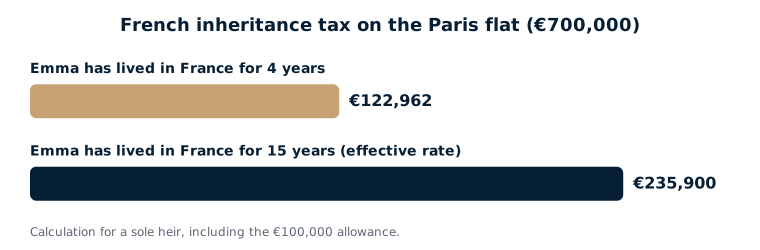
- If Emma has lived in France for 4 years, the US assets are not taxable under French law (she does not meet the 6-out-of-10-years condition): they are disregarded. Tax: €700,000 − €100,000 = €600,000 taxable, i.e. €122,962.
- If Emma has lived in France for 15 years, the US assets would be taxable under French law, but the treaty exempts them. France can then take them into account to set the rate (Article 12, paragraph 7, of the treaty): the tax is calculated as if the €2,500,000 were all taxable (€842,394), which gives an average rate of 33.70%, applied to the flat alone. Tax: €700,000 × 33.70% = €235,900.
Example 2: the same parent, with dual nationality
If Emma’s father also held French nationality, the result would in principle be the same: France could tax only the Paris flat, i.e. €122,962 if Emma has lived in France for 4 years and €235,900 if she has lived there for 15 years. Contrary to a widespread belief, his French nationality does not allow France to tax the securities account or the US house: for France, only the domicile of the deceased counts.
5. Filing the inheritance tax return in France: how to do it
The inheritance tax return, step by step
- A prior analysis of the situation, ideally by a lawyer: the domicile of the deceased, the nature of the assets and the treaty determine what is due in France, and every estate has its own features.
- Verification that at least one asset is taxable in France, using the table above. If none is, no return is in principle required; it may still be useful to keep the evidence of the deceased’s domicile and nationality.
- The documents: death certificate, will or trust deed, proof of domicile and nationality, inventory of assets and debts on the day of death (statements, valuations), exchange rate on that day.
- Each heir’s share: it results from the will or from the law governing the estate. If the estate includes real estate in France, a French notary will be involved for the certificate of ownership (attestation de propriété).
- Form 2705 and its schedules (2705-S for the identification of the heirs and each one’s share, 2706 for the details of assets and liabilities). Where France takes the US assets into account for the rate, they are in principle to be listed. Form 2740 is used to credit tax paid outside France.
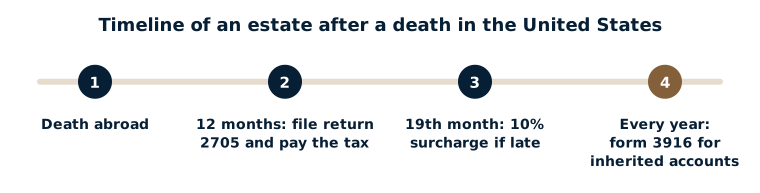
- Filing of the return, in principle within 12 months of the death (death outside France) with the non-residents’ tax collection office: 10 rue du Centre, TSA 50014, 93465 Noisy-le-Grand Cedex.
- Payment of the tax, in principle on filing; depending on the case, payment in instalments (over 1 year, up to 3 years if at least 50% of the estate consists of non-liquid assets) or deferred payment may be requested with the return.
If you are late, late-payment interest of 0.20% per month applies, and a 10% surcharge applies from the first day of the seventh month after the deadline, i.e. from the 19th month after the death (Article 1728 of the CGI).
6. What if your parent lived in France?
If your parent was domiciled in France within the meaning of the treaty, France taxes all of their assets, in France and in the United States. To avoid double taxation (Article 12 of the treaty):
- the tax paid in the United States on the assets that the treaty allows the United States to tax (US real estate, permanent establishment assets, tangible movable property) is deducted from French inheritance tax, up to the portion of the French tax relating to those assets;
- if your parent was a US citizen, the treaty treats the US tax on these assets as equal to that portion of the French tax, provided that it is shown that the US tax obligations arising from the death have been fulfilled: in practice, these assets then bear no inheritance tax in France;
- the claim must be made within the longest of the following periods: the French time limit for claims, 5 years from the death, or 1 year after the final assessment and payment of the US tax, if these occur within 10 years of the death (Article 13).
The return must then be filed within 6 months of the death if it occurred in metropolitan France (12 months if it occurred abroad), with the registration office (service de l’enregistrement) for the deceased’s place of domicile. The page France–United States inheritance covers this case in detail.
7. After the inheritance: your obligations in France
Once the inheritance tax has been paid, the inheritance becomes part of your own assets. As a French tax resident, you are now, in principle, required to:
- Report the US accounts every year that are in your name or that you can use, on form 3916, including in the year they are closed. Failing to do so may cost a €1,500 penalty per account per year: see declaring a foreign bank account.
- Declare the income from these assets on form 2047, then on your income tax return: dividends and interest with, where applicable, a tax credit in box 8VL (foreign dividends and interest), rent from a US property with a credit equal to the French tax in box 8TK (foreign rental income).
- Include the US real estate in your IFI (real estate wealth tax) if your net taxable real estate assets exceed €1,300,000.
- If you sell a US property, declare the capital gain in France according to the method provided for by the France–US tax treaty: on form 2048-IMM within one month of the sale, or by mentioning it on return no. 2047. The acquisition price is in principle the value on the day of death: the value used for inheritance tax or, if the estate was not taxed in France, the market value at that date, which needs to be justified. See form 2048-IMM.
What I see in my cases
As in most of the international estates I handle, the procedure abroad, here in the United States, often takes longer than the twelve-month French deadline. Depending on the case, a provisional return, supplemented later, makes it possible to move forward in France without waiting.
The second sensitive point is the tax paid in the United States: the tax authorities examine its credit very closely, since it reduces French tax. A refused credit then means a long and uncertain procedure. A complete file, with proof of payment and a clear explanation of the treaty, most often avoids this situation.
US living trusts often surprise heirs with their tax consequences in France: complex taxation and returns (forms 2181-TRUST1 and 2181-TRUST2) that are very little known, sometimes even to the tax authorities. When the funds remain blocked in the United States while the duties are payable in France, one solution may be to negotiate a payment schedule with the tax authorities, which is not straightforward. In an estate that was both American and British, I coordinated with the American and British lawyers, and the estate was entirely exempt in France under the tax treaties, a result specific to the facts of that case.
The most common mistakes
- Thinking that an inheritance from the United States never has anything to do with the French tax authorities.
- Forgetting that a flat in France remains taxable even if everything else is in the United States.
- Believing that the deceased’s French nationality allows France to tax their US accounts, securities and assets.
- Calculating the tax on the French asset alone without checking the effective rate rule.
- Missing the 12-month deadline, and then the date of the 10% surcharge.
- Not reporting on form 3916 the US accounts received as an inheritance.
FAQ
I live in France and I am inheriting from my American father who lived in New York: do I have to pay inheritance tax in France?
Only on his assets located in France within the meaning of the treaty: real estate, shares in property companies, movable property located in France. His accounts and securities are in principle not taxable in France, even if he also held French nationality and even if you have lived in France for a long time. If you have lived there for at least 6 years out of 10, France can however take the US assets into account to calculate the rate applied to the French assets.
My parent held dual French and US nationality: what difference does it make?
In principle none, as far as French inheritance tax is concerned, if they were domiciled in the United States. The citizenship criterion of Article 8 of the treaty works only in favour of the United States: France takes only the domicile of the deceased into account (ministerial answer to Mr Valleix, written question No. 626 of 11 July 1988). France therefore taxes the same assets as for a parent who was American only: their real estate and movable property located in France. Nationality can, on the other hand, count in determining where they were domiciled, when both countries consider them to be domiciled in their territory.
Do I have to file a return in France if nothing is taxable there?
In principle, no: the inheritance tax return covers the assets taxable in France. It may nevertheless be useful to keep the evidence of the deceased’s domicile and nationality and the inventory of their assets, so that you can show, if the tax authorities ask, that nothing was due.
By when and where do I file the return for a parent who died in the United States?
Within 12 months of the death, with the non-residents’ tax collection office (10 rue du Centre, TSA 50014, 93465 Noisy-le-Grand Cedex) where the deceased was domiciled outside France. After that deadline, late-payment interest runs, and a 10% surcharge applies from the 19th month.
Does the US account I am inheriting have to be reported in France?
In principle yes, as soon as it is in your name or you can use it: it is listed every year on form 3916 attached to your income tax return, and its income is in principle taxable in France. This obligation applies even if the inheritance bore no inheritance tax in France.
I am selling the house I inherited in Florida: how is the capital gain calculated in France?
The capital gain is in principle the difference between the sale price and the value of the property on the day of death, the holding period being counted from the death. Depending on the method provided for by the France–US income tax treaty to avoid double taxation, it is declared on form 2048-IMM within one month of the sale, with the allowances for length of ownership, or mentioned on return no. 2047; this point deserves to be checked before the sale.
Reference texts
- Treaty between France and the United States of 24 November 1978 on estate and gift taxes, as amended by the protocol of 8 December 2004: Articles 4 (domicile), 5 to 8 (taxable assets), 12 (elimination of double taxation and effective rate) and 13 (time limits).
- French General Tax Code (CGI): Articles 750 ter (scope of inheritance tax), 777 (scale), 779 (allowances), 784 A (credit for foreign tax), 796-0 bis (spouse exemption), 1728 (surcharges).
- BOFiP: BOI-ENR-DMTG-10-50-70 (effective rate rule) and BOI-ENR-DMTG-10-50-60 (credit for duties paid outside France).
- Ministerial answer to Mr Valleix, written question No. 626 of 11 July 1988 (National Assembly): citizenship criterion of Article 8 reserved to the United States, France taking only domicile into account.
Every Franco-American estate has its own features: disputed domicile, dual nationality, trust, retirement plans. Maître Uzan, a tax lawyer in Paris, analyses your situation, calculates the tax due in France and prepares the return. See also the page France–United States inheritance and the guide to the US living trust on the death of the settlor, or book an appointment.