
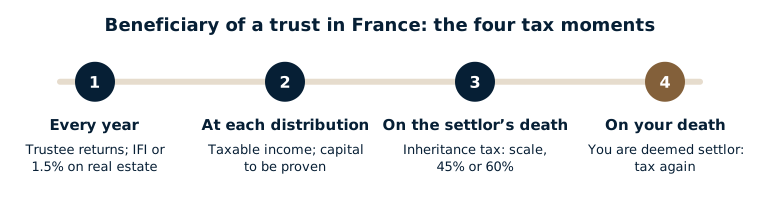
You live in France and you are a beneficiary of a trust set up in the United Kingdom by a parent: discretionary trust, life interest trust, will trust… For the French tax authorities, a trust is neither a company nor a bank account: it is subject to a regime of its own, defined in Article 792-0 bis of the French General Tax Code (CGI). Your move to France is enough on its own to bring the trust within the scope of French obligations, even if nothing changes in London. This guide follows the moments at which French tax comes into play: every year, at each distribution, on the death of the settlor, and then on your own death.
In brief
- As soon as a beneficiary is domiciled in France, the trustee is in principle required to report the trust in France (forms 2181-TRUST1 and 2181-TRUST2), even if it is established outside France; each failure is liable to a €20,000 penalty.
- Income distributions are in principle taxable in France as investment income (Article 120, 9° of the CGI): 31.4% in 2026 under the flat tax, or the progressive scale on option.
- Distributed capital is not income, but the burden of proof in principle lies with the beneficiary. If distributed during the settlor’s lifetime, it may be taxed as a gift from the settlor.
- On the settlor’s death, where France has the right to tax, the trust assets are in principle subject to inheritance tax according to the family relationship if the beneficiary’s share is determined, otherwise at 45% (descendants) or 60%.
- Afterwards, the beneficiary in principle becomes “deemed settlor”: IFI, annual 1.5% levy on undeclared real estate, and inheritance tax on their own death.
Contents
- What the French tax authorities see in a trust
- The four moments when France steps in
- 1. Every year: the trustee’s returns
- 2. At each distribution: income or capital?
- 3. On the settlor’s death: inheritance tax
- 4. After the settlor’s death: you become a “deemed settlor”
- Penalties and regularisation
- What I see in my cases
- FAQ
- Reference texts
What the French tax authorities see in a trust
French law does not recognise the trust, but French tax law defines it: a settlor (constituant) places assets under the control of an administrator (the trustee), in the interest of beneficiaries. The English distinction between legal ownership and beneficial ownership (equitable interest) is disregarded: the tax authorities attach the assets to the settlor during their lifetime and then, after their death, to the beneficiaries, who are then “deemed settlors”.
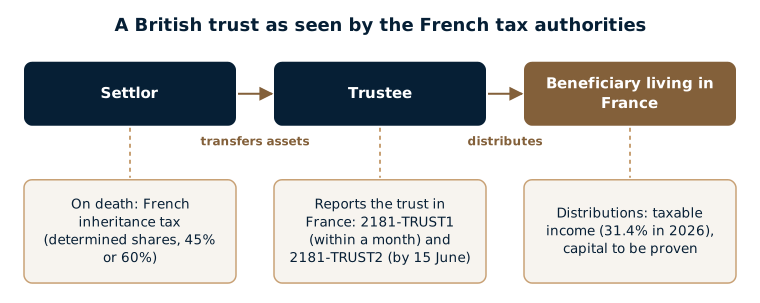
All English trusts are concerned, whatever their form:
| Type of trust | How it works | Point to watch in France |
|---|---|---|
| Discretionary trust | The trustee chooses when and to whom to distribute. | Shares rarely determined on the settlor’s death: risk of a 45% or 60% rate. |
| Interest in possession or life interest trust | A beneficiary, often the spouse, receives the income for life; the capital then goes to the children. | Income taxable in France for the resident beneficiary; transfer of the capital to be considered in advance. |
| Will trust | Created by will, on death. | A trust that continues remains subject to the French reporting obligations. |
| Bare trust | The beneficiary has an absolute right to the assets. | Assets in practice attached to the beneficiary; classification to be checked. |
For an overview, see the page on British trusts.
The four moments when France steps in
1. Every year: the trustee’s returns
The administrator of a trust is in principle required to report it in France (Article 1649 AB of the CGI) as soon as the settlor or at least one beneficiary is domiciled in France, or the trust holds an asset located in France:
- 2181-TRUST1: creation, modification and termination of the trust, within one month of the event;
- 2181-TRUST2: value of the trust assets on 1 January, every year by 15 June;
- since Law no. 2026-534 of 25 June 2026, for transfers made from 27 June 2026: a return at the time of the transfer, identifying the beneficiaries and giving the information needed to calculate the tax.
A British trustee is often unaware of these French formalities: in practice, it may be useful for the beneficiary who has moved to France to inform them on arrival, after reviewing the position with a lawyer.
The annual 1.5% levy (Article 990 J of the CGI) applies only to the trust’s real estate assets, where they are not declared for IFI by the settlor or the beneficiary deemed to be the settlor (or, if the taxable assets do not reach the IFI threshold, in the trustee’s annual return). A trust that holds only financial securities is not subject to it, but it remains, in principle, to be reported. Trusts managing occupational pension plans, including individual ones, are exempt under certain conditions (Conseil d’État, 7 May 2026, no. 511615).
2. At each distribution: income or capital?
Each amount paid by the trustee needs to be classified, because the tax treatment is not the same:
- Income distribution: investment income (Article 120, 9° of the CGI), whatever the nature of the income received by the trust (dividends, interest, capital gains). In 2026, the flat tax is 31.4% (12.8% income tax and 18.6% social security contributions), unless you opt for the progressive scale for all such income. This income is declared on form 2047, then on the income tax return.
- Capital distribution: it is not income, but any sum paid by a trust to a resident beneficiary is presumed taxable unless proven otherwise (Conseil d’État, 13 March 2026, no. 500318). It may therefore be useful to be able to produce the trust deed, the trustee’s decisions and accounts separating capital from accumulated income.
- Capital distributed during the settlor’s lifetime: it may be subject to gift tax, according to the family relationship between the settlor and you, where France has the right to tax, for example if you have been domiciled in France for at least 6 of the last 10 years (Articles 750 ter and 792-0 bis of the CGI). The 1963 treaty does not cover gifts; a child is entitled to the €100,000 allowance, renewable every 15 years.
Example: Sophie, in Bordeaux since 2015
Sophie is a beneficiary of a discretionary trust set up in 2010 by her father, Peter, who lives in London. In 2026, the trustee pays her €1,100,000: €400,000 taken from the trust’s income and €700,000 from its capital, which the trust accounts make it possible to establish.
- The €400,000 of income is taxable under the flat tax: €400,000 × 31.4% = €125,600.
- The €700,000 of capital bears no income tax. As Sophie has lived in France for more than 6 years, it is in principle taxable as a gift from her father: if Peter has given her nothing in the last 15 years, €600,000 remains taxable after the €100,000 allowance, i.e. €122,962 of tax under the direct-line scale.
- Without accounts separating capital and income, the tax authorities can tax the whole €1,100,000 as income.
3. On the settlor’s death: inheritance tax
On the settlor’s death, the trust assets are taxed as if they formed part of their estate, in the cases provided for by Article 750 ter of the CGI: settlor domiciled in France (all the trust assets), assets located in France, or beneficiary domiciled in France for at least 6 of the last 10 years (assets located outside France that they receive).
The France–UK treaty of 21 June 1963 limits these rules where the settlor was domiciled in the United Kingdom: France can then in principle tax only the assets located in France, without taking the others into account, even for the rate. Trusts are not dealt with specifically in the treaty, which calls for a case-by-case analysis. See the guide inheriting from the United Kingdom while living in France.
Where France taxes, the rate depends on how the trust is drafted and administered (Article 792-0 bis of the CGI):
- share of each beneficiary determined on the death: tax according to the family relationship, as in an ordinary inheritance (€100,000 allowance and a scale of up to 45% for a child);
- overall share going to descendants, without allocation among them: 45%, with no allowance;
- other cases (beneficiaries who are not descendants, unallocated assets): 60%.
The tax is in principle payable by the trustee, and the beneficiaries can be held jointly liable for it. If the settlor was domiciled in France, the UK tax paid on the assets located in the United Kingdom gives entitlement to a credit (Article 6 of the treaty), which is claimed on form 2740.
Example: the trust of Peter, retired in Provence
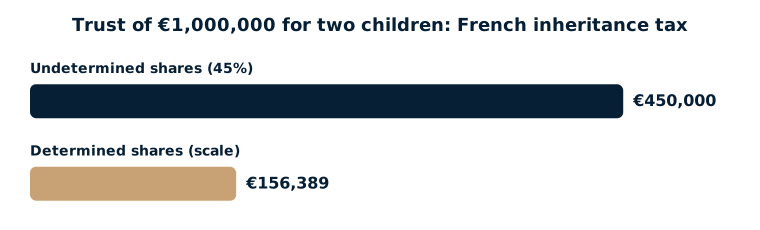
Peter, domiciled in France for 12 years, placed €1,000,000 in a discretionary trust for his two children. On his death, France taxes the whole amount.
- If the shares are not determined: €1,000,000 × 45% = €450,000.
- If the trust deed gives each child a determined share of €500,000: €400,000 taxable after the allowance each, i.e. €78,194 of tax per child, €156,389 in total.
4. After the settlor’s death: you become a “deemed settlor”
After the settlor’s death, each beneficiary is deemed to be the settlor of the trust assets that go to them. As a French resident, you now bear the consequences:
- IFI: the trust’s real estate in principle falls within the beneficiary’s assets subject to the real estate wealth tax (Article 970 of the CGI), due when net taxable real estate assets exceed €1,300,000; failing a declaration, the 1.5% levy applies;
- returns: the trustee continues to report the trust every year;
- on your own death, the trust assets attached to you may again be subject to French inheritance tax, under the same rules.
For a life interest trust, the surviving spouse is exempt from inheritance tax, but the transfer of the capital to the children on the spouse’s own death deserves to be considered in advance, as the 45% or 60% rates could otherwise apply.
Moving to France with a trust: the points to review
- An initial review with a lawyer: every trust and every family situation is different, and the appropriate steps depend on them.
- The trust documents: the trust deed, the letter of wishes and the latest trust accounts.
- Informing the trustee of the domicile in France: they are in principle required to file form 2181-TRUST1, then form 2181-TRUST2 before each 15 June.
- A statement of each distribution distinguishing income from capital.
- The declaration of income distributions, in principle on form 2047 and the income tax return, and the keeping of the evidence for capital.
- Any real estate held by the trust, in France or elsewhere: IFI and the 1.5% levy.
- The settlor’s death: determined shares or rates of 45% and 60%, the 1963 treaty.
- If the trust has not been reported in France, the possible options, to be reviewed with a lawyer: depending on the case, a regularisation may be an appropriate solution.
Penalties and regularisation
An unreported trust exposes you to a penalty of €20,000 per missing return (Article 1736, IV bis of the CGI), to an 80% surcharge on the evaded tax, extended in 2026 to all assets held in trust (Article 1729-0 A of the CGI), and to an extended assessment period of 10 years for the tax authorities. The settlor and the beneficiaries can be held jointly liable. Depending on the case, a voluntary regularisation, prepared with a lawyer, may limit the exposure; whether it is appropriate is assessed case by case. See also the page on reporting foreign accounts, life insurance and trusts.
What I see in my cases
The trusts I come across are set up and managed abroad, and some of their beneficiaries live in France. The French returns that concern them, forms 2181-TRUST1 and 2181-TRUST2, remain very little known, sometimes even to the tax authorities. Yet the tax authorities are paying increasing attention to trusts and to assets held abroad: clear returns and a file capable of explaining the structure of the trust simply then take on their full importance.
FAQ
I am moving to France and I am a beneficiary of an English discretionary trust: what should I do?
The best first step is usually to talk to a lawyer, who can analyse the trust and your situation. In principle, the trustee is required to report the trust in France (forms 2181-TRUST1 and 2181-TRUST2), even if it is established outside France: it may therefore be useful to tell them. A statement distinguishing income from capital for each distribution can also make it easier to declare the income received. On the settlor’s death, French inheritance tax will depend on their domicile, yours and the drafting of the trust.
Are distributions from my English trust taxable in France?
Income distributions, yes: they are investment income, taxed in 2026 at 31.4% under the flat tax, unless you opt for the progressive scale. A repayment of capital is not income, provided you can prove it. During the settlor’s lifetime, however, a capital distribution may be taxed as a gift.
How do I prove that a distribution is capital?
With the trust deed, the trustee’s decisions (trustee resolutions) and accounts that separate the original capital from accumulated income. On 13 March 2026, the Conseil d’État ruled that any sum paid by a trust to a resident beneficiary is presumed taxable unless proven otherwise: these documents are therefore decisive.
My father, who set up the trust, lives in London: will there be inheritance tax in France on his death?
The France–UK treaty of 1963 in principle limits French inheritance tax to assets located in France where the deceased was domiciled in the United Kingdom. If the trust holds no asset in France, French tax should not apply, even if you have lived in France for a long time; as trusts are not specifically covered by the treaty, a precise analysis is still needed.
The trust holds only shares: is the 1.5% levy due?
No: since 2018, this levy applies only to the trust’s real estate assets. The trust nevertheless remains, in principle, to be reported every year in France as soon as a beneficiary is domiciled there, a €20,000 penalty being provided for each missing return.
The trustee has never reported the trust in France: what are the risks?
A €20,000 penalty per missing return, the 80% surcharge on the evaded tax and a 10-year assessment period, with possible joint liability of the settlor and the beneficiaries. Before taking any step, it is advisable to consult a lawyer to analyse the situation: depending on the case, a regularisation (filing the missing returns, checking the income declared by the beneficiaries) may be an appropriate solution.
Reference texts
- French General Tax Code (CGI): Articles 792-0 bis (trust regime), 120, 9° (distributions), 750 ter (scope of the tax), 970 (IFI), 990 J (annual levy), 1649 AB (returns), 1736, IV bis and 1729-0 A (penalties); Book of Tax Procedures (LPF): Article L. 169.
- Law no. 2026-534 of 25 June 2026 on combating social security and tax fraud, Article 84.
- Conseil d’État, 13 March 2026, no. 500318 (proof of capital); Conseil d’État, 7 May 2026, no. 511615 (pension trusts).
- France–UK treaty of 21 June 1963 on estate duties.
- BOFiP: BOI-DJC-TRUST (definitions), BOI-ENR-DMTG-30 (transfer taxes), BOI-PAT-IFI-20-20-30-20 (assets placed in trust and IFI).
Analysis of the trust deed, classification of distributions, returns and regularisation, planning for the settlor’s death: Maître Uzan, a tax lawyer in Paris, assists trust beneficiaries living in France. See also the page on British trusts and the guide to the US living trust, or book an appointment.