
In the United States, the revocable living trust is a very widely used estate planning tool: the settlor places their assets in it during their lifetime, and the trust organises their management and then their transfer on death. But when the settlor lives in France, or one of their children has settled there, this trust also has tax consequences in France, in particular on the settlor’s death. France does not recognise the trust in civil law, but its tax law takes it into account, with a regime of its own that can be very heavy. This guide explains, with worked examples, what France taxes on the settlor’s death, at what rate, and how to prepare for it.
In brief
- A living trust is a trust within the meaning of Article 792-0 bis of the French General Tax Code (CGI), whether revocable or not. For the French tax authorities, its assets remain those of the settlor during their lifetime.
- On death, France taxes the trust assets in the same cases as an ordinary estate (Article 750 ter of the CGI), within the limits of the France–US treaty of 24 November 1978.
- The rate depends on how the trust is drafted: determined shares, scale according to the family relationship; overall share going to descendants, 45%; otherwise, 60%.
- A property in France held by the trust is in principle taxable in France on death, and creates obligations from the settlor’s lifetime onwards.
- After the death, the beneficiaries become deemed settlors: annual returns, IFI, taxable distributions.
Contents
The living trust in a nutshell
The settlor (grantor or settlor) transfers their assets to a trust of which they are often, during their lifetime, both the trustee and the beneficiary. They can amend or revoke it at any time. On their death, the trust becomes irrevocable: the trustee appointed to succeed them (successor trustee) distributes the assets to the beneficiaries or keeps them in separate trusts, for example one for each child.
French tax law disregards this mechanism: Article 792-0 bis of the CGI covers any trust created under a foreign law, revocable or irrevocable, during lifetime or by will. The trust assets are attached to the settlor, then, after their death, to the beneficiaries. In civil law terms, where the estate is governed by French law, it may also be necessary to check that the trust respects the children’s reserved share (réserve héréditaire): a point to be examined with a notary.
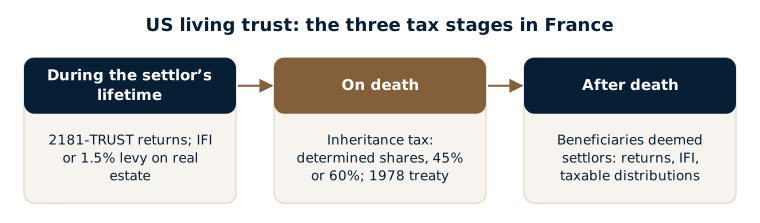
During the settlor’s lifetime: what France already requires
The trustee is in principle required to report the trust in France (Article 1649 AB of the CGI) as soon as the settlor or a beneficiary is domiciled in France, or the trust holds an asset located in France: form 2181-TRUST1 for its creation, modification or termination, within one month; form 2181-TRUST2 for the value of the assets on 1 January, by 15 June each year. Each failure is liable to a €20,000 penalty.
- Settlor domiciled in France (an American living in Paris, for example): the trust’s real estate, in France and abroad, falls within their IFI if they are liable to it.
- Settlor domiciled in the United States, child domiciled in France: the presence of a beneficiary in France is in principle enough to make the returns compulsory.
- Trust holding a property in France: failing a declaration for IFI or, if the taxable real estate assets do not reach the IFI threshold, failing the trustee’s annual return, a levy of 1.5% per year applies to its value (Article 990 J of the CGI).
On the settlor’s death: can France tax?
The trust assets are treated as if they formed part of the settlor’s estate. The same rules as for an estate without a trust therefore apply, asset by asset:
- Domicile of the settlor within the meaning of Article 4 of the treaty: if they were domiciled in France, France taxes all the trust assets, with a deduction for the US tax on the assets that the treaty allows the United States to tax (Article 12).
- Settlor domiciled in the United States: France in principle taxes the real estate located in France. Their accounts and securities (Article 8) and their real estate located in the United States escape French tax, even if they held French nationality: for France, only their domicile counts (1988 ministerial answer to Mr Valleix).
- Heir domiciled in France for at least 6 years out of 10: the French rule that would allow the foreign assets they receive to be taxed gives way to the treaty, but can increase the rate applied to the assets taxable in France (effective rate rule).
This reasoning is explained in detail in the guide inheriting from a parent who lived in the United States while living in France.
What rate? It all depends on how the trust is drafted
Where France taxes, Article 792-0 bis of the CGI distinguishes three situations on the settlor’s death:
| What the trust provides on death | Taxation in France |
|---|---|
| Each beneficiary receives a determined share (for example, distribution in halves to the two children, or a separate trust for each with a quantified share) | Tax according to the family relationship, as in an ordinary estate: €100,000 allowance per child, then the scale from 5% to 45% |
| The assets remain in a trust for the descendants as a whole, without a determined share for each | 45% of the value of the assets, with no allowance |
| Other beneficiaries, or unallocated assets | 60% |
The tax is in principle payable by the trustee; the beneficiaries can be held jointly liable for it. Since Law no. 2026-534 of 25 June 2026, for transfers made from 27 June 2026, the trustee is also required to declare, at the time of the transfer, the identity of the beneficiaries and the information needed to calculate the tax.
Example 1: a mother in Boston, a son in Lyon
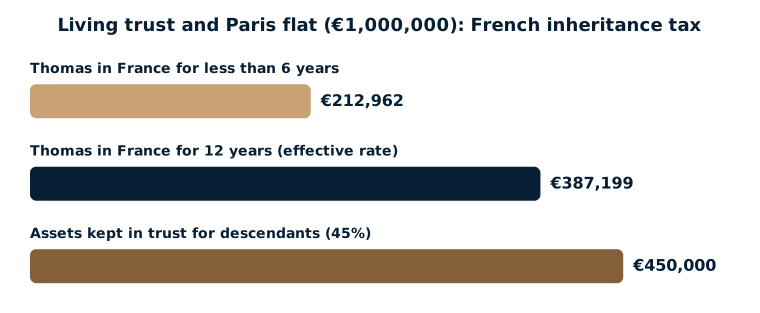
Linda, a US citizen domiciled in Boston, placed in her living trust a securities account in New York (€2,000,000), a house in Massachusetts (€1,500,000) and a flat in Paris (€1,000,000). On her death, the trust provides that everything goes to her son Thomas, who has lived in Lyon for 12 years.
- What France taxes: in principle the Paris flat only (real estate located in France). The securities account and the house escape French tax, as Linda was domiciled in the United States; the same would apply if she had also held French nationality.
- The effective rate: as Thomas has lived in France for more than 6 years, French law would also tax the US assets. France takes them into account for the rate: the notional tax on €4,500,000 (€1,742,394) gives an average rate of 38.72%, applied to the flat, i.e. €387,199. If Thomas had lived in France for less than 6 years, the tax would be €212,962.
- If the trust kept the assets for Thomas and his children as a whole, without a determined share: €1,000,000 × 45% = €450,000.
- During Linda’s lifetime: the flat already required returns in France. As her French real estate was below the IFI threshold, the trustee’s annual return avoided the 1.5% levy, i.e. €15,000 a year.
Example 2: an American living in Paris
Robert, a US citizen, has lived in Paris for 15 years: he is domiciled in France within the meaning of the treaty. His living trust holds a US securities account (€1,200,000) and a house in California (€800,000), shared equally between his two daughters.
- France taxes everything: each daughter receives €1,000,000, i.e. €212,962 of tax each, €425,924 in total.
- For the Californian house, the treaty provides for a deduction of the US tax up to the corresponding French tax (about €170,370). As Robert was a US citizen, that tax is deemed equal to this portion of the French tax, provided that it is shown that the US tax obligations arising from the death have been fulfilled: the French tax then falls to about €255,554, which corresponds to the securities account.
- US tax due solely because of Robert’s citizenship is not deductible in France.
After the death: the beneficiaries become deemed settlors
If the trust continues after the death, for example in the form of separate trusts for each child, the beneficiaries are deemed to be the settlors of the assets that go to them. If they live in France:
- the trustee continues to report the trust every year;
- the trust’s real estate in principle falls within their assets subject to IFI, failing which the 1.5% levy applies;
- income distributions are in principle taxable as investment income (Article 120, 9° of the CGI), the burden of proving capital lying with the beneficiary;
- on their own death, the trust assets attached to them may again be subject to French inheritance tax.
The treatment of distributions is explained in detail in the guide for the beneficiary of a trust living in France, whose French rules also apply to US trusts.
Franco-American families: the points to review
- An initial review with a lawyer: every family, every trust and every estate is different, and the appropriate steps depend on them.
- The trust deed: who succeeds as trustee, what does it provide on death, are the beneficiaries’ shares determined?
- The links with France: domicile of the settlor, beneficiaries living in France, assets located in France.
- The French returns (2181-TRUST1 and 2181-TRUST2): have they been filed? If years are missing, whether a regularisation is appropriate is reviewed with a lawyer.
- Determined shares on death for the beneficiaries connected with France, to be considered with a lawyer: depending on the case, they may avoid the 45% or 60% rates.
- Whether placing a French property in the trust is advisable, to be analysed beforehand: inheritance tax, IFI and the 1.5% levy may depend on it.
- The death: inheritance tax return in France (in principle within 12 months if the death occurs abroad) and a new trustee return at the time of the transfer.
- Coordination with the US lawyer and the trustee, who are often unaware of the French rules.
What I see in my cases
With US living trusts, what most surprises the heirs I advise are the tax consequences in France: complex taxation and returns, forms 2181-TRUST1 and 2181-TRUST2, that are very little known, sometimes even to the tax authorities. The trusts I come across are set up and managed abroad, with some of the beneficiaries living in France, and the tax authorities, in the current budgetary context, are paying increasing attention to them. When the funds remain blocked in the United States while duties are payable in France, one solution may be to negotiate a payment schedule, which is not straightforward.
FAQ
Is my living trust recognised in France?
Not in civil law, but in tax law, yes: it is a trust within the meaning of Article 792-0 bis of the CGI. If it has a link with France, it must in principle be reported, and its assets are taxed on the settlor’s death as if they still belonged to them. In civil law terms, compliance with the reserved share may also need to be checked where French law governs the estate.
My American parents have a living trust and I live in France: does it have to be reported?
In principle yes, if you are a beneficiary: the presence of a beneficiary domiciled in France is in principle enough to require the trustee to file the 2181-TRUST1 and 2181-TRUST2 returns. The trustee files them; in practice, they are often informed by the beneficiary, after a review with a lawyer. The penalty provided for is €20,000 per missing return.
The trust becomes irrevocable on death: what does that change in France?
The settlor’s death is the taxable event for inheritance tax on the trust assets, in the cases where France can tax. If the trust continues, the beneficiaries become deemed settlors: annual returns, IFI, taxation of distributions and tax on their own death.
The trust holds a flat in Paris: what are the consequences?
The flat is in principle taxable in France on the settlor’s death, whatever their domicile. During the settlor’s lifetime, the trust is in principle to be reported every year, and a levy of 1.5% of the value of the flat applies if it is declared neither for IFI nor, where the IFI threshold is not reached, in the trustee’s annual return.
What rate applies if the trust provides for equal shares between the children?
If each child’s share is determined on the death, the tax is calculated as in an ordinary estate: €100,000 allowance per child, then the scale from 5% to 45%. If the assets remain in a trust for the descendants as a whole without a determined share, the rate is 45% with no allowance, and 60% in other cases.
Reference texts
- French General Tax Code (CGI): Articles 792-0 bis (trusts), 750 ter (scope of the tax), 777 and 779 (scale and allowances), 120, 9° (distributions), 970 (IFI), 990 J (annual levy), 1649 AB (returns), 1736, IV bis (penalty).
- France–US treaty of 24 November 1978, as amended by the protocol of 8 December 2004: Articles 4, 5, 8 and 12.
- Ministerial answer to Mr Valleix, written question No. 626 of 11 July 1988: citizenship criterion of Article 8 reserved to the United States, France taking only domicile into account.
- Law no. 2026-534 of 25 June 2026, Article 84 (return at the time of the transfer).
- BOFiP: BOI-ENR-DMTG-30 (assets placed in trust), BOI-PAT-IFI-20-20-30-20 (assets placed in trust and IFI), BOI-ENR-DMTG-10-50-70 (effective rate).
Reading the trust deed, French returns, calculating the tax on death, coordination with US advisers: Maître Uzan, a tax lawyer in Paris, assists Franco-American families. See also the page on US trusts, or book an appointment.