A parent who died abroad, an heir living in France, a house in Portugal, an account in Switzerland, a flat in Paris: as soon as an estate involves several countries, a practical question arises very quickly. Must an inheritance tax return be filed in France? Who must complete it, by when, with which office, with which forms, and how is the tax calculated?
This guide answers these questions step by step, for readers who have never dealt with an estate. It only covers French rules: what France can tax, return no. 2705 and its schedules, deadlines and payment. The formalities to be completed in the other country are a matter for professionals in that country.
In brief
- France in principle taxes all the assets of the deceased when they had their tax domicile in France; if they lived abroad, it taxes the assets located in France and, when the heir has lived in France for at least 6 of the last 10 years, the assets that this heir receives. A tax treaty may change these rules.
- The return is in principle due from the heirs and legatees, even if they live abroad; it is not required for small estates (less than €50,000 in the direct line, subject to conditions).
- Deadline: 6 months if the death occurred in metropolitan France, 12 months if it occurred abroad.
- Where: the registration office of the deceased’s last domicile in France or, if they lived abroad, the non-residents’ tax collection office in Noisy-le-Grand.
- Main form: no. 2705-SD, with its schedules; the tax is in principle paid on filing, and tax paid abroad may, subject to conditions, be deducted.
- Every international estate is different: before taking any step, it is advisable to consult a lawyer to analyse the situation.
Contents
- 1. What is an inheritance tax return?
- 2. Can France tax this estate?
- 3. Must a return always be filed?
- 4. Who must file the return?
- 5. By when?
- 6. Where should the return be filed?
- 7. The forms and the documents to gather
- 8. How is the tax calculated?
- 9. Payment of the tax
- 10. After the estate: the obligations of an heir resident in France
- What I see in my cases
- The most common mistakes
- FAQ
- Reference texts
1. What is an inheritance tax return?
The inheritance tax return (“déclaration de succession”) is the document by which the heirs tell the tax authorities what the deceased owned (their assets: accounts, investments, real estate, movable property…), what they owed (their liabilities: debts, funeral expenses…), who receives what, and what inheritance tax is due. The tax is calculated and paid on this basis.
It is distinct from the other formalities of an estate: the “acte de notoriété” drawn up by a notary to prove the status of heir, the division of the assets, or the formalities completed abroad. The latter do not, in principle, replace the French return when one is due.
Vocabulary: the deceased is the person who has died; the heirs are those who receive their assets under the law; the legatees are those who receive them under a will. An estate is said to be “international” when the deceased, an heir or an asset is in another country.
2. Can France tax this estate?
This is the first question, because it decides everything else. Article 750 ter of the French General Tax Code (CGI) distinguishes three situations, summarised in the diagram below.
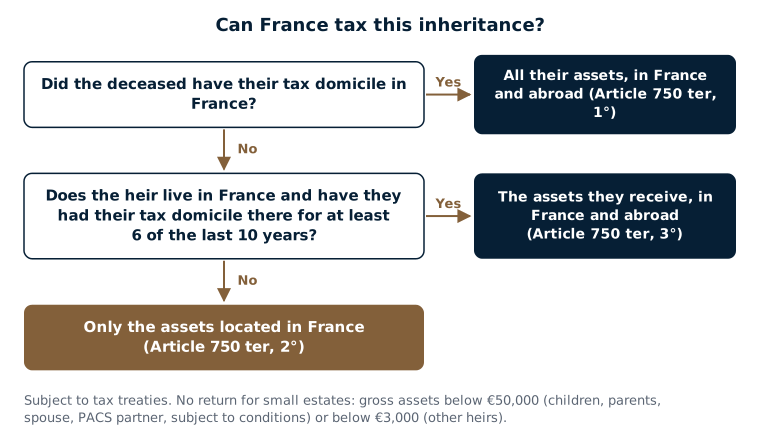
- The deceased had their tax domicile in France: all their assets are in principle concerned, whether located in France or abroad, and wherever the heirs live.
- The deceased lived abroad, but the heir lives in France and has had their tax domicile there for at least 6 of the 10 years preceding the inheritance: the assets that this heir receives, in France as well as abroad, are in principle concerned.
- In other cases: only the assets located in France (a flat in Paris, an account with a French bank, shares in French companies…) are in principle concerned.
These rules may be changed by a tax treaty. France has signed inheritance tax treaties with some thirty countries, which allocate the right to tax according to the domicile of the deceased and the nature of the assets. The table of tax treaties shows whether a treaty exists; for the United States and the United Kingdom, see the guides inheriting from a parent who lived in the United States and inheriting from a relative who lived in the United Kingdom.
“Tax domicile” is determined under Article 4 B of the CGI: home or main place of stay, main professional activity, centre of economic interests. It may be disputed, particularly when the deceased divided their life between two countries.
3. Must a return always be filed?
No. When France has no right to tax (for example a deceased and heirs living abroad, without any assets in France), no return is in principle due in France. It may nevertheless be useful to keep evidence of the deceased’s domicile and of where the assets were located.
In addition, the law exempts small estates from filing (Article 800 of the CGI):
- for children, grandchildren, parents, the spouse or the PACS partner: when the gross assets (the value of the assets, before deduction of debts) are below €50,000, provided that they have not received from the deceased a gift that was not declared or registered;
- for other heirs: when the gross assets are below €3,000.
Heirs who renounce the estate do not have to file a return.
4. Who must file the return?
The return is in principle filed by the heirs, legatees and recipients of gifts who accept the estate, including when they live abroad. A single return is filed for the whole estate: it is in principle sufficient for it to be signed by one of the heirs liable for payment, the heirs being jointly liable for payment of the tax.
In practice, the return is often prepared by the notary in charge of the estate, who then acts as the heirs’ agent. The heirs nevertheless remain liable towards the tax authorities. In an international estate, the involvement of a tax lawyer alongside the notary can be useful to determine what France can tax, apply the treaty and calculate the tax credit.
5. By when?
The deadline runs from the day of death (Article 641 of the CGI):
- 6 months when the death occurred in metropolitan France;
- 12 months when the death occurred abroad;
- special deadlines exist for certain deaths in the French overseas territories and for certain properties.
Being late does not prevent the return from being filed, but it has a cost, which increases over time, as the diagram shows.
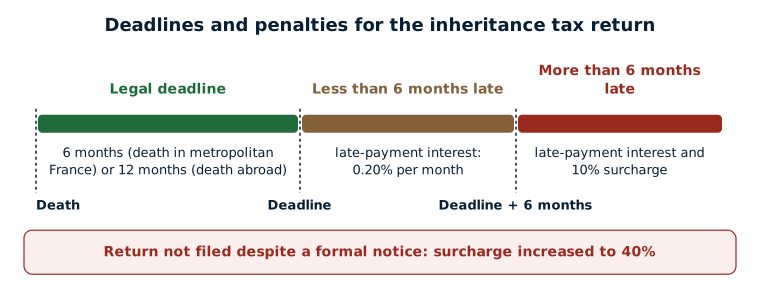
- from the end of the deadline: late-payment interest of 0.20% per month on the tax due;
- if the return is filed more than 6 months after the end of the deadline: in addition, a 10% surcharge;
- if the return is not filed despite a formal notice from the tax authorities: a 40% surcharge.
When the value of certain foreign assets is not yet known as the deadline approaches, an estimated return accompanied by a provisional payment, completed later, may, depending on the case, be a way of limiting penalties. Whether it is appropriate should be examined with your lawyer or notary.
6. Where should the return be filed?
| Situation of the deceased | Competent office |
|---|---|
| Domicile in France | The registration office covering their last domicile (departmental registration office or registration unit of the tax office) |
| Domicile abroad | The non-residents’ tax collection office (recette des non-résidents): 10 rue du Centre, TSA 50014, 93465 Noisy-le-Grand Cedex |
The return is in principle filed in two signed copies, together with payment of the tax.
7. The forms and the documents to gather
The forms
- No. 2705-SD: the return itself (identity of the deceased, family situation, will, prior gifts, life insurance contracts);
- No. 2705-S-SD: the detailed schedule (identity of the heirs, assets, liabilities, division and calculation of the tax);
- No. 2705-A-SD: life insurance contracts and their beneficiaries;
- No. 2740-SD: the calculation of the tax paid outside France that may be credited against the French tax.
Useful documents
- the death certificate, the acte de notoriété or any document establishing the status of heir, the will if any;
- the statements of accounts and portfolios on the date of death, in France and abroad;
- valuations of the properties, in France and abroad;
- evidence of debts and funeral expenses;
- the list of gifts made by the deceased during the last 15 years;
- evidence of the tax paid abroad, if a tax credit is claimed;
- where applicable, translations of documents drawn up in a foreign language.
Amounts are expressed in euros, rounded to the nearest euro; foreign assets are in principle converted at the exchange rate on the date of death.
8. How is the tax calculated?
The calculation in principle follows the same path, illustrated by the following diagram with Sophie’s example (see below).
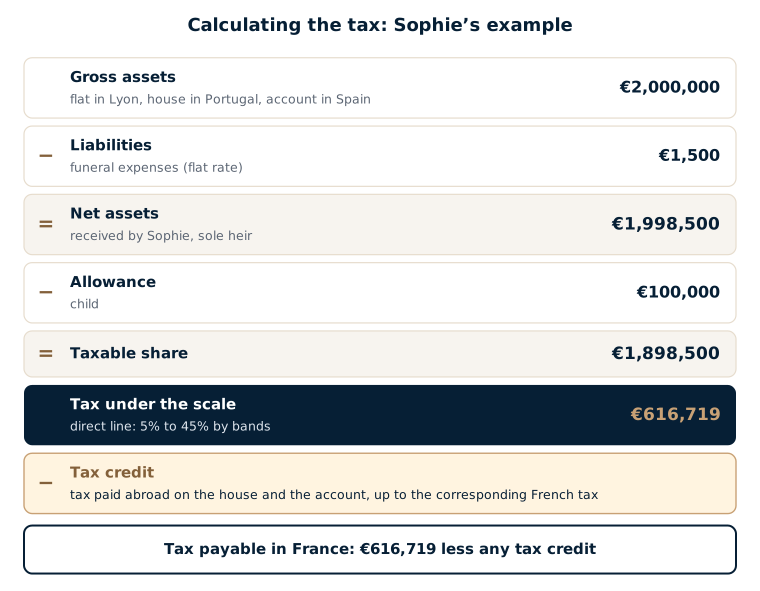
- Gross assets: the value of all assets taxable in France on the date of death (accounts, investments, real estate, movable property — for the latter, a flat rate of 5% of the assets may apply —, certain life insurance contracts, in particular contracts taken out abroad when they fall outside the life insurance regime).
- Liabilities: the deceased’s debts existing on the date of death and supported by evidence, taxes due, funeral expenses (accepted without evidence up to €1,500).
- Net assets = gross assets − liabilities, then divided among the heirs.
- Allowance according to the family relationship: for example €100,000 for each child; the spouse and the PACS partner are exempt from inheritance tax.
- Scale: in the direct line (parents and children), from 5% to 45% by bands; rates are higher between brothers and sisters (35% and 45%) and between unrelated persons (60%).
- Tax credit: the tax paid abroad on assets located outside France may in principle be deducted, up to the French tax corresponding to those assets (Article 784 A of the CGI or tax treaty).
Example 1: a deceased domiciled in France, with assets abroad
Sophie’s father lived in Lyon. He leaves a flat in Lyon (€1,200,000), a house in Portugal (€600,000) and an account in Spain (€200,000). Sophie, an only child, is the sole heir; her father had not made her any gift.
| Step | Amount |
|---|---|
| Gross assets (assets in France and abroad, because the deceased was domiciled in France) | €2,000,000 |
| Liabilities: funeral expenses (flat rate) | −€1,500 |
| Net assets received by Sophie | €1,998,500 |
| Direct-line allowance | −€100,000 |
| Taxable share | €1,898,500 |
| Tax under the direct-line scale | €616,719 |
Breakdown of the scale: 5% on the first €8,072 (€403.60), 10% from €8,072 to €12,109 (€403.70), 15% from €12,109 to €15,932 (€573.45), 20% from €15,932 to €552,324 (€107,278.40), 30% from €552,324 to €902,838 (€105,154.20), 40% from €902,838 to €1,805,677 (€361,135.60) and 45% from €1,805,677 to €1,898,500 (€41,770.35), i.e. €616,719.30, rounded to €616,719. If tax was paid in Portugal or Spain on the house or the account, it may in principle be deducted, up to the share of the French tax corresponding to those assets. The return is in principle to be filed within 6 months of the death (which occurred in France), with the Lyon registration office that covered the deceased.
Example 2: a deceased domiciled abroad, an heir living in France
Ana’s mother lived outside France, in a country that has not concluded an inheritance tax treaty with France. Ana has lived in Paris for nine years. She inherits a bank account and a flat located in that country.
- Ana has lived in France for at least 6 of the last 10 years: the assets she receives are in principle taxable in France, even though they are located abroad.
- The death occurred abroad: the return is in principle to be filed within 12 months, with the non-residents’ tax collection office, since her mother was not domiciled in France.
- Any tax paid in her mother’s country may in principle be credited against the French tax corresponding to those assets, with supporting evidence (form no. 2740-SD).
If Ana had only lived in France for three years, only the assets located in France would in principle be taxable in France: here, none. The result therefore depends a great deal on dates: the exact length of residence in France deserves to be checked.
Example 3: a deceased and an heir outside France, a flat in Paris
An uncle living abroad leaves a flat in Paris to his nephew, who also lives abroad. The flat, located in France, is in principle taxable in France (subject to a treaty). The nephew must in principle file a return with the non-residents’ tax collection office, within 6 or 12 months depending on where the death occurred. Between uncle and nephew, the allowance is only €7,967 and the rate 55%: the stakes can be high.
9. Payment of the tax
The tax is in principle paid when the return is filed (bank transfer, cheque, bank card). On a request attached to the return, payment in instalments or deferred payment may be granted, subject to guarantees and the payment of interest; special rules exist for the transfer of businesses and for estates consisting mainly of assets that are difficult to sell.
When heirs are domiciled abroad, a French bank or insurer may require, before releasing the funds to them, a certificate of payment or non-liability for the tax issued by the tax authorities (Articles 806 and 807 of the CGI). Obtaining this certificate can take a long time: it is useful to plan for it.
10. After the estate: the obligations of an heir resident in France
Once the inheritance has been received, an heir living in France in principle has new obligations:
- declaring every year the foreign accounts received by inheritance (see the guide form 3916: how to declare a foreign account, step by step);
- declaring the income from these assets (rent, dividends, interest) in France: see the page declaring foreign income in France;
- if an asset inherited abroad is sold, declaring the capital gain under French rules: see the article sale of a property abroad: what tax?;
- where applicable, taking the inherited assets into account for the real estate wealth tax (IFI).
What I see in my cases
In most of the international estates I handle, the difficulty first comes from the foreign country, where the procedure is often long. The French deadline, however, is in principle twelve months when the death occurred abroad. The whole question is how to handle the French return without waiting for the foreign procedure to end: depending on the case, a provisional return, supplemented later, or another solution may be considered.
Two other points often make the difference. First, tax treaties, which frequently exempt assets in France: the tax authorities know them poorly, and the file benefits from explaining them very clearly. Second, tax paid abroad: to credit it against French duties, the presentation must be flawless; otherwise the credit may be refused, and recovering the tax overpaid becomes long and uncertain.
When a provisional return is filed, it is generally well received and, if the file is well presented, rarely followed by questions. When the estate does not include any real estate located in France, I handle the French return from A to Z, without going through a French notary, and I work, when useful, with the foreign notaries; where there is real estate in France, the matter in principle falls to a notary, and I cannot act. A delicate situation is that of duties being payable while the funds remain blocked abroad: depending on the case, a request for payment in instalments or deferred payment (see part 9) or the negotiation of a payment schedule with the tax authorities may be considered, which is not straightforward.
The most common mistakes
- Thinking that an estate settled abroad means no return at all in France.
- Forgetting that an heir who has lived in France for 6 of the last 10 years may be taxed in France on foreign assets.
- Forgetting a flat or an account located in France when the deceased lived abroad.
- Missing the 6- or 12-month deadline, and then the date from which the 10% surcharge applies.
- Not keeping evidence of the tax paid abroad, which is essential for the tax credit.
- Forgetting gifts received from the deceased during the previous 15 years.
- Not declaring, every year afterwards, the foreign accounts received by inheritance.
FAQ
My father lived abroad and died there; I live in France. Must I file an inheritance tax return in France?
It depends on how long you have lived in France, on the assets left and on whether there is a tax treaty. If you have lived in France for at least 6 of the last 10 years, the assets you receive may be taxable in France, even if they are located abroad, subject to a treaty. In that case, the return is in principle to be filed within 12 months, with the non-residents’ tax collection office. An analysis of your situation by a lawyer makes it possible to check this.
The foreign notary has settled the estate: is there still something to do in France?
Formalities completed abroad do not, in principle, replace the French return when one is due. It is therefore useful to check whether France has the right to tax all or part of the assets.
I live abroad and I am inheriting a flat in Paris: what should be done?
A property located in France is in principle taxable in France, wherever the deceased and the heir were domiciled, subject to treaties. A return is in principle filed with the non-residents’ tax collection office if the deceased lived abroad, or with the office covering their domicile if they lived in France. In practice, a French notary is needed for the formalities relating to the property.
What happens if the return is filed late?
Late-payment interest of 0.20% per month applies from the end of the deadline. If the delay exceeds 6 months, a 10% surcharge is added, and it may be increased to 40% after a formal notice that has not been complied with. In certain situations, an estimated return filed within the deadline can limit these consequences; it is advisable to discuss this with your lawyer before the deadline.
Is the tax paid abroad deducted from the French tax?
In principle yes, for tax paid abroad on assets located outside France, up to the French tax corresponding to those assets (Article 784 A of the CGI), or under the rules of the applicable tax treaty. Evidence of payment is required.
Can the tax be paid in several instalments?
Payment in instalments or deferred payment may be requested with the return, subject to guarantees and the payment of interest. The conditions depend on the composition of the estate.
Reference texts
- French General Tax Code: Article 750 ter (assets taxable in France), Article 4 B (tax domicile), Article 641 (deadlines), Article 800 (obligation to file and exemptions), Articles 777 and 779 (scale and allowances), Article 775 (funeral expenses), Article 784 (recall of prior gifts), Article 784 A (credit for tax paid abroad), Article 796-0 bis (exemption of the spouse and the PACS partner), Articles 806 and 807 (certificate of payment), Article 1717 (payment in instalments or deferred payment), Articles 1727 and 1728 (late-payment interest and surcharges).
- Notice to the inheritance tax return no. 2705-NOT-SD and forms no. 2705-SD, 2705-S-SD, 2705-A-SD and 2740-SD (impots.gouv.fr).
- Bilateral inheritance tax treaties.
A disputed domicile of the deceased, an heir who recently settled in France, assets in several countries, a treaty to interpret, a tax credit to calculate: an international estate requires a precise analysis before taking any step. Maître Uzan, a tax lawyer in Paris, examines your situation, determines what France can tax and prepares the inheritance tax return with the notary. See also the page international inheritance and French inheritance tax and the article taxation of foreign estates, or book an appointment.