Is your account in Switzerland, Portugal, Singapore, Dubai or China reported to the French tax authorities? The answer depends largely on a list: the list of countries and territories that apply the automatic exchange of information on financial accounts, known by its acronym CRS (Common Reporting Standard, in French « norme commune de déclaration »), and that, in principle, send this information to France.
This article gives that list in full, in a simple table, up to date on 2 November 2026, and explains it step by step: what the foreign bank does, what the French tax authorities receive, how long they usually take to react, and the special case of the United States. It deals only with French taxation. If you hold a foreign account that has not been declared, an analysis of your situation by a lawyer helps determine, before taking any step, the most appropriate solutions.
In brief
- Under the CRS, banks and other financial institutions in a very large number of countries in principle identify every year the accounts of their customers resident in France and send information to the French tax authorities, through their own tax authorities.
- On 2 November 2026, the official French list includes 119 countries and territories, among them the 26 other European Union countries, Switzerland, the United Kingdom, Monaco, Singapore, Hong Kong, the United Arab Emirates, China, Israel and Canada: see the table below.
- The French tax authorities in principle receive the account holder’s identity, the account number, its balance at 31 December and the income of the year, by 30 September of the following year at the latest, with no minimum amount for accounts held by individuals.
- The United States does not apply the CRS: it sends, in principle, more limited information under the agreement known as “FATCA” concluded with France in 2013.
- A country that is not on the list does not, in principle, exempt you from declaring the account in France every year (form 3916).
- In my practice, the French tax authorities usually react one to two years after receiving the information. If an account has not been declared, it is advisable to have the situation analysed by a lawyer before taking any step.
Contents
- What is the CRS?
- The list of countries whose banks report to the French tax authorities
- What information do the French tax authorities receive?
- The United States: a case apart
- My country is not on the list: what should I make of it?
- Two worked examples
- What if an account has not been declared?
- What I see in my cases
- The most common mistakes
- FAQ
- Reference texts
What is the CRS?
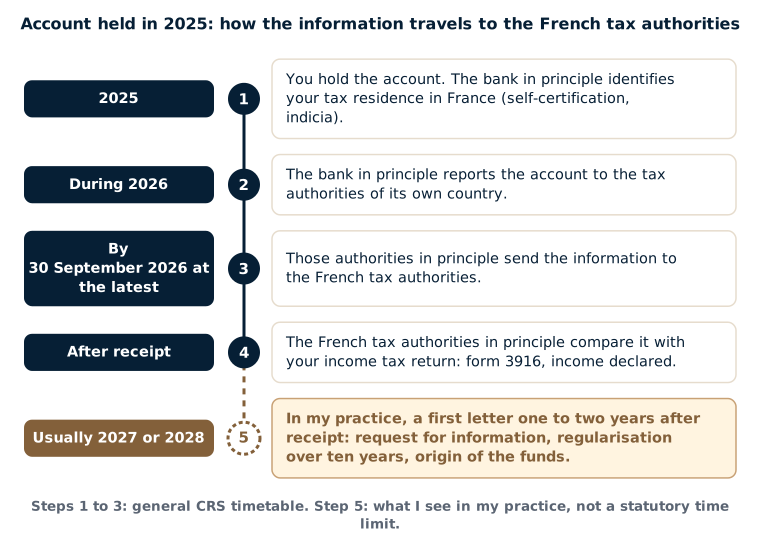
The CRS is a common rule, adopted in 2014 under the aegis of the OECD (Organisation for Economic Co-operation and Development), which organises an automatic exchange of bank information between tax authorities. “Automatic” means that nobody needs to ask for anything: every year, the information is in principle sent of its own accord, for all the accounts concerned.
The principle is simple. A foreign bank must in principle know in which country each of its customers is tax resident. When a customer is resident in France, the bank in principle reports information on his or her accounts every year to the tax authorities of its own country, which pass it on to the French tax authorities. For the French tax authorities, it is a little as if every foreign bank filled in, every year, a record in the name of each of its customers resident in France.
Banks in the everyday sense are not the only ones concerned: brokers holding securities accounts, some insurers (for life insurance policies taken out abroad that have a surrender value), investment funds and certain structures, such as companies or trusts, are also, in principle, covered. An account held through a company with no real activity may thus be reported in the name of the persons who control it.
In France, this system is based on article 1649 AC of the French General Tax Code (CGI); in the European Union, on the directive known as “DAC 2” of 2014. How the exchange works in detail (who reports, when, how) is explained in the article on the automatic exchange of bank account information; this article focuses on the question “which countries?”.
How does the bank know that you live in France?
Since 2016, when an account is opened, the bank in principle asks for a self-certification: a form in which the customer states his or her country of tax residence and tax identification number. For older accounts, it in principle looks for indicia in its files: an address in France, a French telephone number, regular transfers to an account in France, a power of attorney granted to a person living in France… Tax residence does not, in principle, depend on nationality: put simply, it is the country where your home, your main activity or the centre of your economic interests is located (see can you be tax resident in two countries?).
The list of countries whose banks report to the French tax authorities
The table below reproduces the official French list of “partner States and territories” (« États et territoires partenaires »), that is, the countries and territories bound, in principle, to send France the information provided for by the CRS. This list is laid down by an order (arrêté) of 9 December 2016, updated every year; the latest update dates from 12 March 2026. It has been cross-checked with the data published by the OECD on the exchanges actually carried out.
| Region | Countries and territories whose banks in principle report to the French tax authorities |
|---|---|
| European Union (26) | Austria, Belgium, Bulgaria, Croatia, Cyprus, Czech Republic, Denmark, Estonia, Finland, Germany, Greece, Hungary, Ireland, Italy, Latvia, Lithuania, Luxembourg, Malta, Netherlands, Poland, Portugal, Romania, Slovakia, Slovenia, Spain, Sweden |
| Rest of Europe (22) | Albania, Andorra, Armenia, Azerbaijan, Faroe Islands, Georgia, Gibraltar, Greenland, Guernsey, Iceland, Isle of Man, Jersey, Liechtenstein, Moldova, Monaco, Norway, Russia*, San Marino, Switzerland, Türkiye, Ukraine, United Kingdom |
| The Americas (12) | Argentina, Belize, Brazil, Canada, Chile, Colombia, Costa Rica, Ecuador, Mexico, Panama, Peru, Uruguay |
| Caribbean and Atlantic (20) | Anguilla, Antigua and Barbuda, Aruba, Bahamas, Barbados, Bermuda, British Virgin Islands, Caribbean Netherlands (Bonaire, Sint Eustatius and Saba), Cayman Islands, Curaçao*, Dominica, Grenada, Jamaica, Montserrat, Saint Kitts and Nevis, Saint Lucia, Saint Vincent and the Grenadines, Sint Maarten, Trinidad and Tobago*, Turks and Caicos Islands |
| Asia (14) | Brunei Darussalam, China, Hong Kong (China), India, Indonesia, Japan, Kazakhstan, Macao (China), Malaysia, Maldives, Pakistan, Singapore, South Korea, Thailand |
| Middle East (8) | Bahrain, Israel, Kuwait, Lebanon, Oman, Qatar, Saudi Arabia, United Arab Emirates |
| Africa (9) | Ghana, Kenya, Mauritius, Nigeria, Rwanda, Senegal, Seychelles, South Africa, Uganda |
| Oceania and Pacific (8) | Australia, Cook Islands, Marshall Islands, Nauru, New Zealand, Niue, Samoa, Vanuatu |
| Total | 119 countries and territories |
List up to date on 2 November 2026: order of 9 December 2016, last amended by the order of 12 March 2026; data of the OECD (Global Forum on Transparency and Exchange of Information for Tax Purposes) of January and September 2026. * Special cases: see the next table. According to the OECD, Nauru and Niue have no financial institution required to report.
Special cases
A few countries call for a comment: those on the list whose transmissions are suspended or have only just started, the United States, which has its own system, and the countries that have committed to joining the exchange without having done so yet.
| Country | Status | In practice |
|---|---|---|
| United States | No CRS: exchange agreement known as “FATCA”, signed with France on 14 November 2013 | In principle, more limited information; in my practice, more haphazard transmissions, often by brokers holding employee share plans |
| Russia | On the French list | According to the OECD, no information sent since 2022 |
| Curaçao | On the French list | Exchanges temporarily suspended according to the OECD (January 2026) |
| Trinidad and Tobago | Added to the French list in March 2026 | First exchanges planned for 2026 according to the OECD |
| Cabo Verde, Mongolia, Papua New Guinea | Committed to joining the exchange | First exchanges planned for 2027 according to the OECD |
| Morocco, Tunisia, Cameroon, Fiji, Liberia, Paraguay, Zambia | Committed to joining the exchange | First exchanges expected by 2028 according to the OECD |
| Jordan, Montenegro | Committed to joining the exchange | No exchange yet: legal framework not yet in place according to the OECD |
Since when has the information been arriving?
The first exchanges took place in 2017, on the accounts of 2016, between some fifty countries and territories, including France, most of the other European Union countries, the United Kingdom, Jersey, Guernsey, the Isle of Man and Liechtenstein. A second group started exchanging in 2018, on the accounts of 2017, notably Switzerland, Monaco, Andorra, Singapore, Hong Kong, the United Arab Emirates, Canada, Australia, Japan and China. For a given country, the first transmissions to France sometimes started a year or two later. The French list keeps growing: Armenia, Georgia, Moldova and Ukraine were added in 2025, Uganda, Rwanda, Senegal and Trinidad and Tobago in 2026.
For an account held for a long time in one of the first countries, the French tax authorities may therefore have information going back to 2016 or 2017. This matters: when a foreign account has not been declared, income tax may in principle be claimed over ten years instead of three, unless the total balance of the foreign accounts did not exceed €50,000 during the year concerned (see the article on the limitation periods for an undeclared foreign account).
What information do the French tax authorities receive?
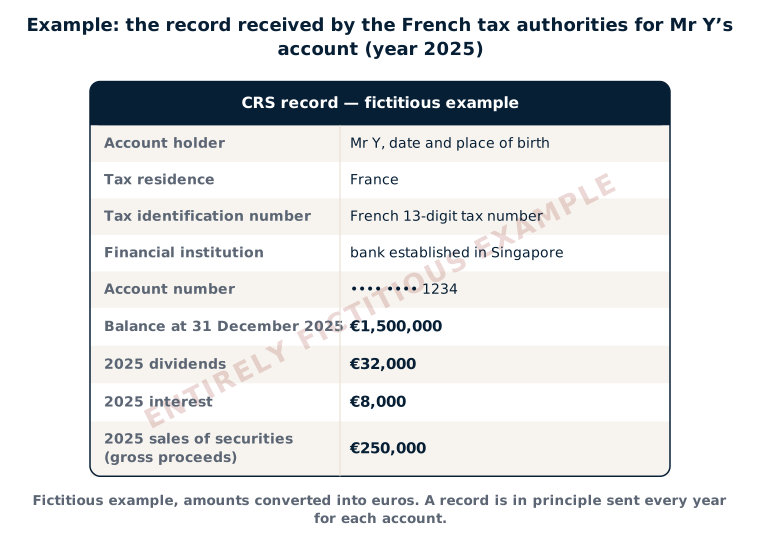
For each account, the foreign institution in principle sends:
- the account holder’s identity: name, address, country of residence, tax identification number, date and place of birth;
- the identification of the account: account number, name and identification number of the institution;
- the balance or value of the account at 31 December, or the fact that the account was closed during the year;
- the income of the year: gross amounts of interest, dividends and other income, and the gross proceeds from sales of securities.
For accounts held by individuals, there is in principle no threshold: an almost empty account may be reported. Beyond this information sent every year, the French tax authorities may also, depending on the case, question the foreign authorities about a specific account (exchange “on request”) or rely on other sources, such as transfers received in France.
The French tax authorities then, in principle, compare this information with your returns: form 3916, used to declare foreign accounts, and the income declared. When a reported account does not appear in them, they may in particular pre-tick box 8UU of the income tax return or send a request for information; in my practice, they always ask for the origin of the funds to be justified (see the article on the request to justify the origin of the funds in a foreign account).
The United States: a case apart
The United States does not apply the CRS. It has its own law, known as “FATCA”, and signed with France, on 14 November 2013, an agreement on the automatic exchange of information, which came into force in 2014. This agreement is reciprocal in principle, but the information that the United States sends to France is, in principle, more limited than under the CRS: it covers certain income paid into the account, such as interest and dividends from US sources.
In my practice, information from the United States arrives more haphazardly. The US institutions that report are often brokers holding the securities accounts of employees resident in France, opened by their employer under a share award plan (RSUs, free shares, stock options or share purchase plan).
Whether or not an exchange takes place, an account opened in the United States must in principle be declared in France every year, like any foreign account, and its income and gains declared under French rules.
My country is not on the list: what should I make of it?
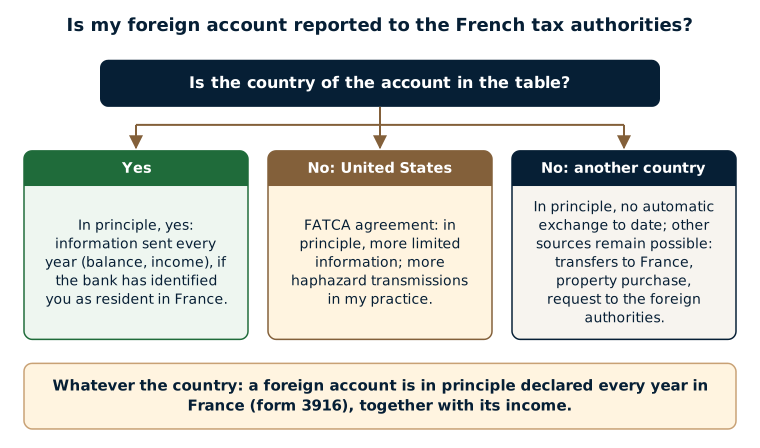
A country that is not in the table does not, in principle, send information to France under the CRS, at least to date. Two points are nevertheless essential.
- The obligation to declare does not, in principle, depend on the exchange. A French resident in principle declares all his or her foreign accounts every year, whatever the country (see which foreign bank account must be declared?). An omission is in principle penalised by a fine of €1,500 per account and per year, raised to €10,000 when the country has not concluded with France a convention allowing access to bank information.
- Other sources of information exist. A large transfer from abroad into an account in France, the purchase of a property in France or a request for assistance sent to the foreign authorities are all ways in which the French tax authorities may learn that an account exists.
Several countries have also committed to joining the exchange: Morocco and Tunisia, in particular, by 2028 according to the OECD (see the table of special cases).
Two worked examples
Example 1 (entirely fictitious): a securities account in Singapore
Mr Y worked in Singapore for ten years before coming back to live in France in 2016. He kept there a securities account worth €1,500,000, which yields about €40,000 a year in interest and dividends. He has never declared this account in France, nor its income, thinking that this account was no concern of the French tax authorities.
Singapore is in the table. Every year, his bank therefore in principle sends, through the Singapore tax authorities, the account number, its balance and its income: for 2025, by 30 September 2026 at the latest. In my experience, a letter from the French tax authorities could then arrive in 2027 or 2028.
What could be at stake, in orders of magnitude:
- the tax on the undeclared income, which may in principle be claimed over ten years since the balance exceeds €50,000: 10 × €40,000 = €400,000 of income; assuming, for simplicity, an overall taxation of about 30% (income tax and social contributions), about €120,000 of tax;
- late-payment interest (0.20% per month) and, depending on the case, an 80% surcharge on the tax, i.e. about €96,000, which then replaces the fines of €1,500 per year;
- the origin of the €1,500,000: in my practice, the French tax authorities always ask for it to be justified. Failing justification, these assets could, in some cases, be subject to gift tax at the rate of 60%, i.e. up to €900,000. If he can prove that they come from his salaries in Singapore (payslips, bank statements), this taxation may in principle be ruled out.
These figures give an order of magnitude, not the outcome of a real case: the tax depends on each year, on the nature of the income and, where applicable, on the tax treaty with Singapore, which may sometimes reduce French tax, something only an analysis of the situation by a lawyer can establish. The way the file is presented may also, depending on the case, weigh on the outcome.
Example 2 (entirely fictitious): shares from a US employer
Ms Z works in France for the subsidiary of a US group. Since 2019, she has received shares from her employer under an RSU plan. The shares are held in a securities account that the employer opened in her name with a US broker. At the end of 2025, the account is worth €1,200,000. In 2025, Ms Z sold shares for €900,000, with a capital gain of €400,000, which she did not declare.
The United States is not in the table: the broker in principle sends nothing under the CRS. It may, however, send information under the FATCA agreement and, in my practice, it is precisely the brokers of these share plans that report most often. Above all, the absence of an exchange changes, in principle, nothing in Ms Z’s obligations in France: declaring the account every year on form 3916, and declaring her gains.
For the 2025 capital gain alone, the tax at stake would in principle be, at the flat tax of 31.4% (12.8% income tax and 18.6% social contributions for disposals made since 2025), €400,000 × 31.4% = €125,600, not counting the acquisition gain on the shares, which follows its own rules (see the guide to the taxation of RSUs). Before taking any step, an analysis of the plan and of the returns already filed by a lawyer helps determine the appropriate solutions.
What if an account has not been declared?
Finding out that one’s country is in the table is often worrying. There is no single answer: everything depends on the number of years, the amounts, the origin of the funds, whether or not the income has already been declared, and whether a letter has been received from the French tax authorities. Before taking any step, it is advisable to have the situation analysed by a lawyer, in order to determine the most appropriate actions.
Depending on the case, this may mean first gathering supporting documents, in particular on the origin of the funds, considering a regularisation, or waiting to learn the conditions of the scheme announced for 2027 (see should you wait for 2027 to regularise?). When a letter has already arrived, the response deadlines matter and the answer in principle commits you for what follows. These questions are developed in the article on regularising an undeclared foreign account and in the one on the penalties for failing to declare a foreign account.
What I see in my cases
In the cases I handle, when the French tax authorities write about a foreign account, they already know a great deal. They usually know the account numbers, their balance, the annual amount of financial income (interest, dividends and proceeds from sales of securities, from which capital gains are calculated), the names of the account holders and of the persons who hold a power of attorney over the account, as well as debit or credit movements when they are large.
The French tax authorities do not react immediately: in my experience, one to two years usually pass between the receipt of the information and their first letter. My clients rarely realise that this letter is the direct consequence of the information sent by their foreign bank. Since the first letters linked to the automatic exchange, which I saw arriving from 2019, the request has always been the same: a regularisation over ten years and the justification of the origin of the funds.
The accounts concerned are mainly securities accounts, life insurance policies and retirement accounts, located in all European Union countries, in China, Singapore, Hong Kong, the United Kingdom, Israel and, increasingly, in Argentina and Canada: all these countries are in the table. For the United States, it is more haphazard: the US institutions that report are often brokers holding the securities accounts of employees resident in France, opened by their employer under a share award plan.
These cases require careful preparation: every document and every word counts, and the way the situation is presented may, depending on the case, weigh significantly on the outcome, although no result can ever be guaranteed.
The most common mistakes
- Thinking that one’s country “does not report” without checking: the list includes 119 countries and territories, among them most of the major financial centres.
- Believing that an almost empty, dormant or closed account escapes the exchange: for accounts held by individuals, there is in principle no threshold. The closure of an account is, likewise, in principle reported.
- Thinking that a foreign address given to the bank offers protection: the bank must in principle identify its customer’s real tax residence (self-certification, indicia).
- Believing that a country not on the list exempts you from declaring the account in France.
- Forgetting the securities account opened by a foreign employer with a broker, particularly in the United States.
- Not connecting the letter from the French tax authorities with the automatic exchange, then answering it alone, too quickly or with far more detail than requested.
FAQ
How many countries send bank information to the French tax authorities?
On 2 November 2026, the official French list of CRS partner States and territories includes 119 countries and territories, among them the 26 other European Union countries, Switzerland, the United Kingdom, Singapore, Hong Kong and the United Arab Emirates. This list is updated every year by an order (arrêté), most recently on 12 March 2026. The United States is not on it: it sends, in principle, more limited information under the FATCA agreement.
Does Switzerland send bank information to the French tax authorities?
In principle, yes. Switzerland is on the list and has exchanged information with France since 2018, on the accounts of 2017, under its agreement with the European Union. A Swiss bank therefore in principle sends every year the balance and the income of the accounts of its customers resident in France.
Does Dubai send bank information to the French tax authorities?
In principle, yes. Dubai is part of the United Arab Emirates, which are on the French list of CRS partner States and territories. Financial institutions in the Emirates therefore in principle send every year information on the accounts of their customers resident in France.
Are accounts opened in the United States reported to the French tax authorities?
The United States does not apply the CRS. It does, however, in principle send certain information to France under the agreement known as “FATCA” of 14 November 2013. In my practice, these transmissions are more haphazard and often come from brokers holding the securities accounts of employees who receive shares from their employer. Whether or not an exchange takes place, an account in the United States is in principle declared every year in France.
My foreign account is closed: can the French tax authorities find out?
In principle, yes. Under the CRS, the closure of an account is in principle reported for the year in which it occurs, and the information for previous years may already have been sent. An account closed during the year must also, in principle, still be declared in France for that year. Closing an account therefore does not, in principle, make past obligations disappear: an analysis of the situation by a lawyer helps measure the consequences.
Do Morocco and Tunisia send bank information to the French tax authorities?
In principle, not yet under the CRS: according to the OECD, their first automatic exchanges are expected by 2028. The French tax authorities may nevertheless, depending on the case, obtain information by other means, in particular through a request sent to the tax authorities of those countries. Above all, an account in Morocco or Tunisia is in principle declared every year in France, whether or not an automatic exchange exists.
How long after the information is sent do the French tax authorities react?
There is no time limit set by law. Information on a given year in principle arrives by 30 September of the following year at the latest; in my practice, the French tax authorities then usually react one to two years after receiving it. For the accounts of 2025, a letter could therefore arrive in 2027 or 2028, within the limitation periods.
How can I find out whether my bank has sent my information?
In the European Union, financial institutions are in principle required to inform each customer concerned that his or her information will be collected and transferred; elsewhere, practices vary. In my cases, the first sign is often the letter from the French tax authorities, which clients rarely realise results from the automatic exchange. In case of doubt about an undeclared account, an analysis by a lawyer makes it possible to take stock before taking any step.
Reference texts
- French General Tax Code (CGI): article 1649 AC (automatic exchange of information on financial accounts), article 1649 A (declaration of accounts opened, held, used or closed abroad), article 1736, IV (fines), article 1729-0 A (80% surcharge), article 755 (assets whose origin is not justified).
- French Book of Tax Procedures (LPF): article L23 C (justification of the origin of assets), article L169 (ten-year time limit for reassessment).
- Decree no. 2016-1683 of 5 December 2016 laying down the rules and procedures for the automatic exchange of information on financial accounts (Common Reporting Standard); order of 9 December 2016 as amended, most recently by the order of 12 March 2026 (list of partner States and territories).
- Council Directive 2014/107/EU of 9 December 2014 (known as “DAC 2”).
- Multilateral Competent Authority Agreement on Automatic Exchange of Financial Account Information of 29 October 2014 (OECD).
- Agreement between France and the United States of 14 November 2013 (known as the “FATCA agreement”), approved by Law no. 2014-1098 of 29 September 2014.
- OECD, Global Forum on Transparency and Exchange of Information for Tax Purposes: status of commitments (30 September 2026) and of the exchanges carried out (23 January 2026).
Every situation is specific: the country of the account, how long it has been held, the origin of the funds, whether or not the income has been declared. Me Uzan, a tax lawyer in Paris, analyses your situation and examines with you, before any step is taken, the most appropriate solutions. See also the page declaring a foreign bank account in France (form 3916), the article do the French tax authorities have access to your foreign bank accounts? and, for an account that has not been declared, the page on regularising an undeclared foreign account. To discuss it, book an appointment.