
The tax regime for inbound expatriates (régime fiscal des impatriés) is a scheme intended for people who come to work in France after having lived abroad for a certain period. This regime was introduced to encourage expatriates to return to France and work on French territory. In this article, we will explain the tax regime for inbound expatriates, to whom it applies and the advantages it provides, as well as its limits and the obligations that arise from it.
Definition of the tax regime for inbound expatriates
The tax regime for inbound expatriates is a specific tax regime intended for people who come to work in France after having lived abroad for a certain period.
The term “inbound expatriate” (impatrié) refers to a person who was tax resident outside France and who comes or returns to work in France, for a company established in France. This regime allows inbound expatriates to benefit from very advantageous tax treatment for income related to their professional activity in France.
This regime was introduced in 2003 to encourage expatriates to return to work in France. It makes it possible to offset differences in taxation between countries and to facilitate the return of expatriates. The tax regime for inbound expatriates is therefore a tool for promoting France’s attractiveness to expatriates.
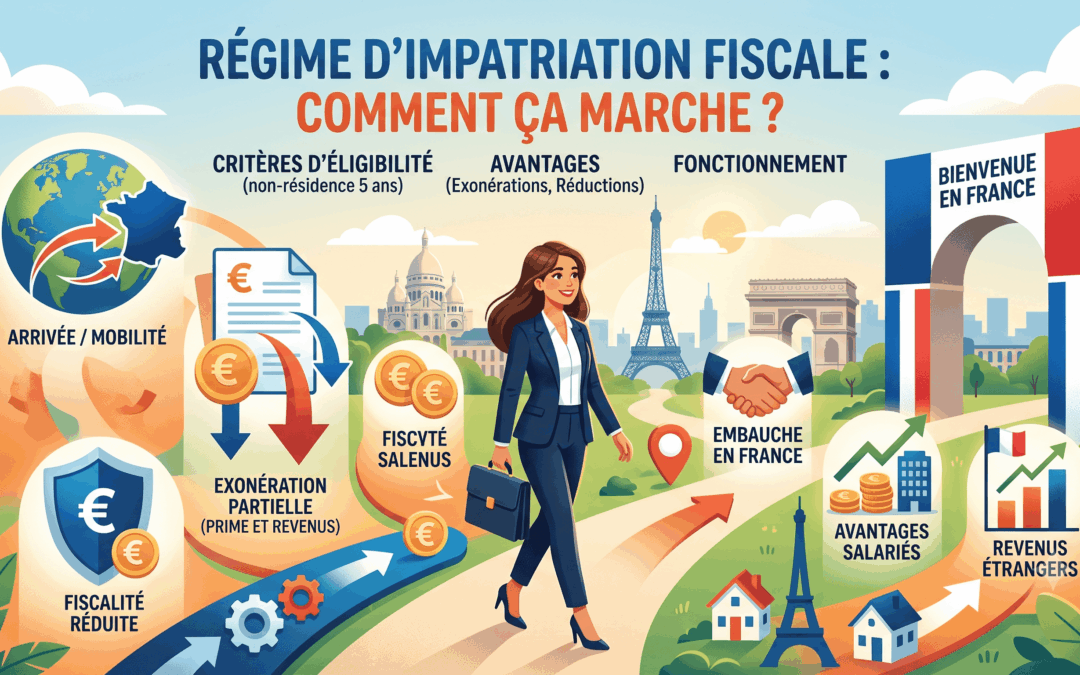
Eligibility conditions for the tax regime for inbound expatriates
In order to benefit from the tax regime for inbound expatriates, certain eligibility conditions must be met. The main ones are:
- Having been tax domiciled abroad for at least 5 years before returning to work in France.
- Carrying on a professional activity in France on behalf of a company established in France (head office or establishment in France). The activity must be carried on regularly and continuously in France
- Not having been tax domiciled in France during the 5 years preceding the return.
- Being an employee or corporate officer of the company concerned
- Being able to prove that the remuneration received is related to the professional activity carried on in France.
- Being able to show that the return to or arrival in France is directly related to the professional activity carried on in France.
- Having signed an employment contract
- Being subject to all tax obligations in France
If all these conditions are met, the beneficiary may then, in principle, benefit from the tax regime for inbound expatriates.
The advantages of the tax regime for inbound expatriates
The tax regime for inbound expatriates offers numerous advantages to those who are eligible for it.
Income tax exemption
The tax regime for inbound expatriates provides for an exemption from tax on the impatriation bonus (prime d’impatriation) (and, where applicable, on the portion of remuneration relating to activity carried on abroad) for the 8 years following the return to France. This exemption is capped at 50% of the total remuneration received in France.
Exemption from social security contributions
It also allows, by election, an exemption from compulsory old-age insurance contributions (Article L. 767-2 of the French Social Security Code (code de la sécurité sociale)) for a certain period, subject to certain conditions being met. The conditions for this exemption are precise and must be examined carefully by the employing company.
Reduction of professional expenses
Like any employee, the inbound expatriate may deduct his or her professional expenses, either through the standard deduction of 10% (capped) or by opting for actual expenses: this is not an advantage specific to the inbound expatriate regime.
IFI exemption
The possibility of benefiting from an exemption from real estate wealth tax (impôt sur la fortune immobilière, IFI) on real estate located outside France for the first 5 years following the return to France is also one of the advantages of the tax regime for inbound expatriates.
Passive income
The regime also allows the following exemptions:
50% of investment income from foreign sources (from States that have concluded with France a tax treaty containing an administrative assistance clause aimed at combating tax fraud or evasion);
50% of certain foreign-source income from intellectual or industrial property (from States that have concluded with France a tax treaty containing an administrative assistance clause aimed at combating tax fraud or evasion);
50% of gains on the sale of foreign-source shares.
These tax advantages are very attractive for inbound expatriates and make it possible to offset differences in taxation between countries. They also help to facilitate the return of expatriates to France by offering them a favourable tax framework for their professional activity.
The limits of the tax regime for inbound expatriates
Despite the many advantages of the tax regime for inbound expatriates, there are also limits and constraints to this regime.
First, the tax regime for inbound expatriates applies only to income related to the professional activity carried on in France. Foreign-source income in principle remains taxable in France (subject to tax treaties and to the partial exemption of passive income mentioned above).
The tax regime for inbound expatriates is also limited in time. The tax advantages apply only for a period of 8 years for income tax and 5 years for IFI.
Inbound expatriates must comply with all tax obligations in France, in particular as regards income tax returns and the payment of income tax.
They must also be able to prove that their return to France is directly related to their professional activity. In particular, they must show the existence of an employment contract.
Inbound expatriates must be tax domiciled in France throughout the duration of their professional activity in France.
These limits and constraints may affect the appeal of the tax regime for inbound expatriates for certain people. It is therefore important to fully understand the eligibility conditions and advantages of the tax regime for inbound expatriates before deciding to return to work in France.
The advantages for companies
The tax regime for inbound expatriates also offers advantages for companies wishing to attract foreign talent to France.
Indeed, the tax and social security exemptions make it possible to significantly reduce payroll costs for employers, which can be a major competitive advantage in an increasingly globalised labour market. Companies can thus offer more attractive salaries while remaining competitive internationally.
In addition, the tax regime for inbound expatriates can also facilitate the integration of expatriates into the company. By benefiting from advantageous tax treatment, inbound expatriates can focus on their professional activity and adapt more quickly to their new working environment. This can help to boost productivity and the motivation of expatriates, as well as improve the company’s overall performance.
The tax obligations of inbound expatriates
Although inbound expatriates benefit from advantageous tax treatment, they must nevertheless comply with all tax obligations in France.
In particular, they must declare all of their income received in France, as well as any foreign-source income subject to taxation in France under international tax treaties.
Inbound expatriates must also pay income tax in France, even if they benefit from an exemption from tax on income related to their professional activity.
Tax and social security audits
The tax regime for inbound expatriates is subject to tax and social security audits in order to prevent abuse and fraud. Inbound expatriates must therefore be able to show that their return to France is directly related to their professional activity, and that their remuneration is consistent with their level of qualification and experience.
The tax and social security authorities may also carry out checks on the eligibility conditions for the tax regime for inbound expatriates, as well as on all the tax and social security obligations of inbound expatriates.
In the event of non-compliance with tax or social security obligations, inbound expatriates may be subject to sanctions, such as fines, penalties or tax reassessments. It is therefore important to comply with all tax and social security obligations in France in order to avoid any risk of litigation with the authorities.
Conclusion
The tax regime for inbound expatriates offers numerous tax advantages for people who come or return to work in France after having lived abroad. This regime makes it possible to offset differences in taxation between countries and to facilitate the return of expatriates to France. It also enables companies to attract foreign talent to France by offering more attractive salaries while remaining competitive internationally.
However, the tax regime for inbound expatriates is subject to strict eligibility conditions, as well as to significant tax and social security obligations. Inbound expatriates must therefore be well informed of the constraints and limits of the tax regime for inbound expatriates before deciding to return to work in France.
In conclusion, the tax regime for inbound expatriates is a very advantageous tax scheme for people who come or return to work in France after a period abroad. This regime also offers advantages for companies wishing to attract foreign talent to France. However, it is important to fully understand the eligibility conditions and the tax and social security obligations associated with this regime in order to avoid any risk of litigation with the authorities.







0 Comments