You are a beneficiary of a trust set up abroad, or you set it up yourself, and you live in France. One day, your bank, a notary or an adviser tells you that this trust should have been declared to the French tax authorities, on forms that nobody had ever mentioned to you: 2181-TRUST1 and 2181-TRUST2. The first question is then, more often than not, the same: what is the risk with an undeclared trust, and how much could it cost?
This article answers it simply, with diagrams and worked examples: what these two returns are for, what penalty applies if they are forgotten, who may be asked to pay it, over how many years, and what changes when the tax authorities also claim tax. It deals only with French taxation.
In brief
- When a trust has a link with France (settlor or beneficiary domiciled in France, asset located in France, trustee domiciled in France), its administrator, the trustee, must in principle declare it to the French tax authorities, even if established abroad.
- Two forms: 2181-TRUST1, within one month of the creation, each modification or the termination of the trust, and 2181-TRUST2, every year by 15 June at the latest, for the value of the assets on 1 January.
- Each missing return is liable to a fixed penalty of €20,000, whatever the value of the trust and even if no tax has been evaded. The penalties can add up from one year to the next.
- The trustee is targeted first, but the settlor and, after the settlor’s death, the beneficiaries deemed settlors can be held liable to pay the penalty with the trustee.
- On the analysis that seems to me the most solid, the penalty is in principle time-barred after four years, whereas the tax linked to the trust can, as a general rule, be claimed over ten years. When tax is claimed, an 80% surcharge may apply instead of the penalty.
- Every trust and every situation is different: before taking any step with the tax authorities, it is advisable to have the situation analysed by a lawyer, in order to determine the most appropriate solutions.
Contents
- Trust, trustee, settlor: the words to know
- Two returns not to be confused: 2181-TRUST1 and 2181-TRUST2
- How much does a missing return cost? €20,000 each time
- Who may have to pay the penalty?
- Over how many years? The penalty and the tax do not have the same time limit
- Example 1: a trust never declared since 2015
- When tax is claimed: the 80% surcharge
- Not to be confused: the annual 1.5% levy
- What I see in my cases
- The most common mistakes
- FAQ
- Reference texts
Trust, trustee, settlor: the words to know
The trust is an institution that does not exist in French law. A person, the settlor (also called the grantor or trustor; constituant in French), entrusts assets (a securities portfolio, accounts, real estate…) to an administrator, the trustee, who manages them on behalf of one or more beneficiaries, according to the rules set in the trust deed. Trusts are common in the United States and the United Kingdom, for example in the form of a US living trust.
French tax law gives its own definition of the trust (Article 792-0 bis of the French General Tax Code, CGI) and adds an important notion: on the settlor’s death, the beneficiaries are in principle deemed settlors. In the eyes of the French tax authorities, they take the settlor’s place, as it were, which has consequences, in particular for the penalties.
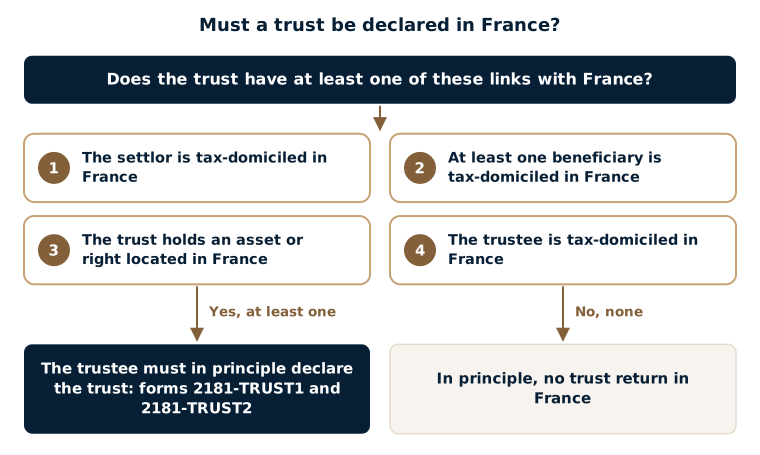
A trust falls within the scope of the French returns only if it has a link with France. The diagram below summarises the main cases provided for by law.
Two returns not to be confused: 2181-TRUST1 and 2181-TRUST2
The law (Article 1649 AB of the CGI) provides for two separate returns, to be filed by the trustee.
Form 2181-TRUST1: at each event in the life of the trust
This is the so-called “event-based” return. It is in principle to be filed within one month of:
- the creation of the trust (its “constitution”);
- each modification, a broad notion: assets added to the trust, distribution of assets or income to a beneficiary, change of beneficiary, settlor or trustee, change in the terms of the trust, death of the settlor or of a beneficiary;
- the end of the trust (its “termination”).
It states, in particular, the identity of the settlor, the beneficiaries and the trustee, as well as the content of the terms of the trust.
Form 2181-TRUST2: every year
This is the annual return. It states the value of the trust’s assets and rights on 1 January, as well as that of its accumulated income, that is to say the income built up in the trust without having been distributed. It is in principle to be filed by 15 June at the latest every year, as long as the trust has a link with France, even if nothing happened during the year.
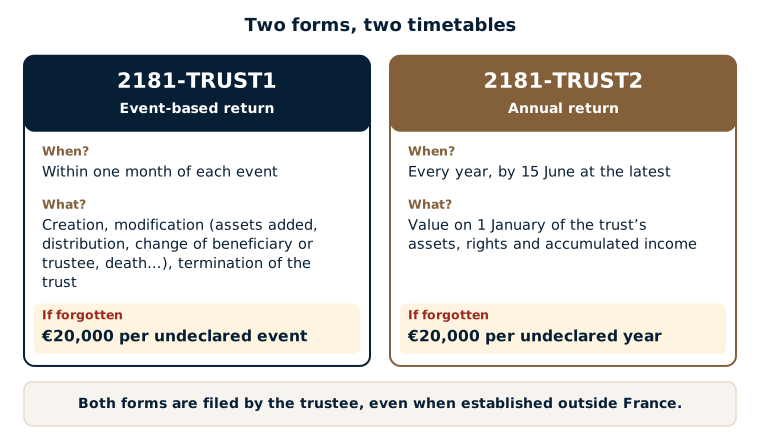
Both forms are the responsibility of the trustee, even when established outside France. In practice, a foreign trustee is often unaware of these French formalities, and it may be useful for the settlor or the beneficiaries living in France to inform the trustee, after reviewing the situation with a lawyer. These obligations are presented, together with those concerning accounts and life insurance policies held outside France, in the article on the declaration of foreign accounts, life insurance policies and trusts.
How much does a missing return cost? €20,000 each time
The penalty is set by Article 1736, IV bis of the CGI: breaches of the reporting obligations of a trust are liable to a penalty of €20,000. Three simple ideas help to understand it.
A fixed amount, whatever the value of the trust
The penalty is the same for a trust worth one million euros and for a trust worth thirty million euros. This has not always been the case: the law previously provided for a proportional penalty, equal to 5%, then 12.5% of the value of the trust where that amount was higher. This proportional penalty was abolished at the end of 2016, and the Constitutional Council (Conseil constitutionnel) held it to be unconstitutional in 2017, while upholding the fixed penalty. For returns due before 8 December 2013, the fixed amount was €10,000.
One penalty per missing return
Each form not filed counts separately: €20,000 per event not declared on form 2181-TRUST1, and €20,000 per year without form 2181-TRUST2. A trust left without returns for several years can therefore, in theory, accumulate several penalties, as the example below shows. A return filed late, or incomplete, may also, depending on the case, be penalised.
A penalty due even without any tax evaded
The penalty sanctions the failure to declare, not a tax that has not been paid. It is therefore in principle incurred even when the trust has not caused any French tax to be avoided. The Constitutional Council held this fixed amount to be constitutional, while striking down the proportional penalty, which applied even when the trust’s assets had been taxed.
The table below summarises the sanctions encountered around an undeclared trust. For a bank account held abroad, the rules are different: see the penalties for failing to declare a foreign account.
| Situation | Penalty or tax provided for, in principle |
|---|---|
| Creation, modification or end of the trust not declared (2181-TRUST1) | Penalty of €20,000 per event |
| Annual value not declared (2181-TRUST2) | Penalty of €20,000 per year |
| Tax claimed on assets of an undeclared trust (income tax, IFI, inheritance or gift tax) | 80% surcharge on the tax claimed, instead of the corresponding penalty, and not less than €20,000 |
| Real estate of the trust not declared for IFI | Annual levy of 1.5% of its value (a tax, not a penalty: see below) |
Who may have to pay the penalty?
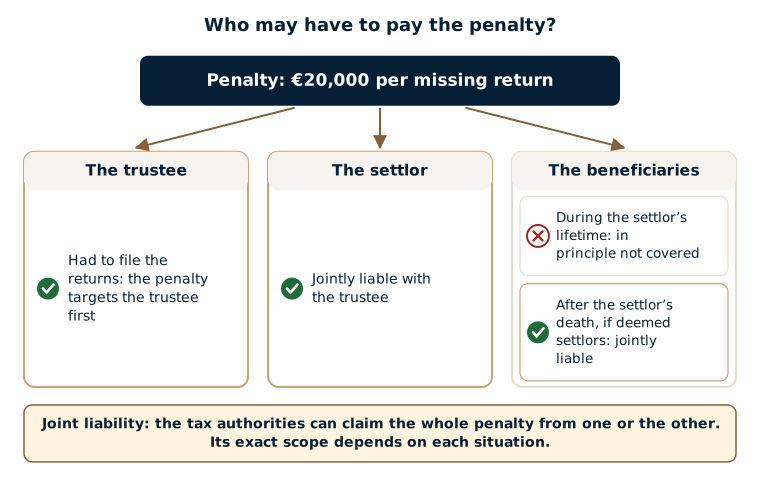
The penalty is aimed first at the person who had to file: the trustee. But when the trustee is established abroad, the French tax authorities may find it hard to collect it. The law therefore provides that certain persons are jointly liable for payment with the trustee (Article 1754, V, 8 of the CGI), which allows the tax authorities to claim the whole penalty from one or the other:
- the settlor of the trust;
- after the settlor’s death, the beneficiaries deemed settlors, who take the settlor’s place in the eyes of the French tax authorities.
More precisely, the texts refer to the settlor and the beneficiaries deemed settlors who come within the scope of the 1.5% levy of Article 990 J: the exact scope of this joint liability therefore depends on each situation. By contrast, a beneficiary who is neither the settlor nor a deemed settlor, for example during the settlor’s lifetime, is in principle not covered. This does not mean that such a beneficiary has no obligations: the distributions received may, for example, be taxable in France (see the article on the beneficiary of a British trust living in France).
Over how many years? The penalty and the tax do not have the same time limit
The limitation period is the time after which the tax authorities can no longer claim a sum. For an undeclared trust, two time limits coexist, and it is important not to confuse them.
The €20,000 penalty: in principle four years
The penalty for failing to declare a trust does not sanction the calculation of a tax: it is a stand-alone penalty. On the analysis that seems to me the most solid, it therefore falls under the general time limit for tax penalties (Article L. 188 of the French Tax Procedure Code, LPF): the tax authorities can in principle claim it until the end of the fourth year following the year in which the return should have been filed. Thus, for a form 2181-TRUST2 that had to be filed by 15 June 2022 at the latest, the penalty can in principle be claimed until 31 December 2026, and would be time-barred from 1 January 2027.
The Conseil d’État (the highest administrative court) has not yet ruled on this precise point for trusts, which calls for caution. This time limit can also be interrupted, for example by a letter from the tax authorities notifying the penalty.
The tax linked to the trust: up to ten years
The tax itself (income tax on distributions, IFI, inheritance or gift tax on the trust’s assets) follows other rules. When the trust has not been declared, the time the tax authorities have to claim it is in principle extended to ten years, for example for income tax (Article L. 169 of the LPF). The general rules are presented in the article on the time limits for tax reassessments.
Example 1: a trust never declared since 2015
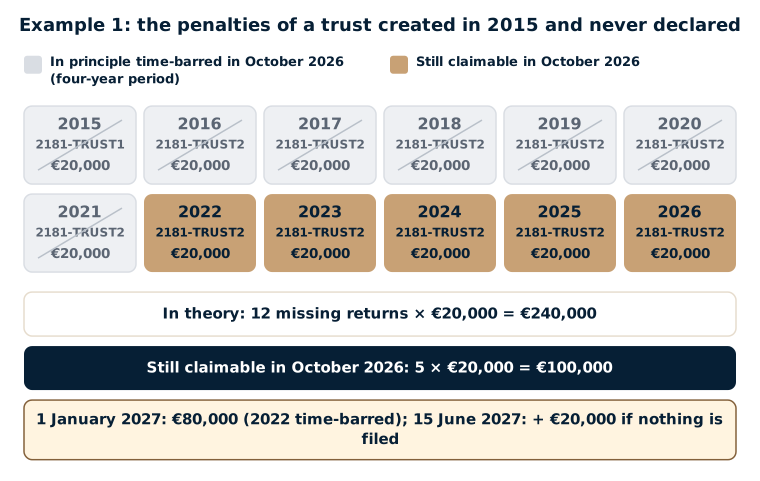
Paul lives in Paris. In May 2015, he placed a €4,000,000 securities portfolio in a trust set up abroad, for the benefit of his two children. The trustee, established outside France, has never declared anything in France. The example is set in October 2026.
- What is missing. Form 2181-TRUST1 for the creation of the trust, which was due in June 2015, and forms 2181-TRUST2 for the years 2016 to 2026, i.e. eleven annual returns: twelve returns in total.
- The theoretical amount. 12 × €20,000 = €240,000, whatever the value of the trust.
- What would be time-barred. With the four-year time limit, the breaches of the years 2015 to 2021 would be time-barred in October 2026. Those of 2022, 2023, 2024, 2025 and 2026 remain: 5 × €20,000 = €100,000, in the absence of any interruption of the limitation period.
- A sliding counter. On 1 January 2027, the 2022 breach would in turn be time-barred: the total would fall back to €80,000. But if nothing has been filed by 15 June 2027, a new €20,000 penalty could be added. The counter slides from one year to the next; it does not empty by itself.
Variant. If, in March 2024, the trustee paid €600,000 to Paul’s daughter, who lives in Lyon, without filing a form 2181-TRUST1 for this distribution, one more penalty is incurred: €120,000 instead of €100,000. This distribution may also have consequences for his daughter’s income tax.
These amounts are maximums provided for by the texts. In my experience, it is possible, in some cases, to negotiate the penalties with the tax authorities, with no guarantee of result (see below, “What I see in my cases”).
When tax is claimed: the 80% surcharge
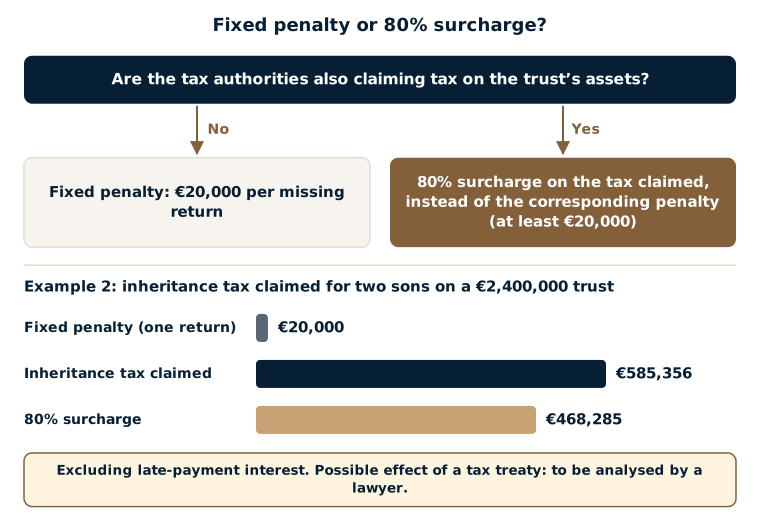
Sometimes the failure to declare the trust goes hand in hand with unpaid tax: distributions not declared for income tax, the trust’s real estate left out of the IFI, or inheritance tax not paid on the settlor’s death. When the tax authorities claim this tax (this is called a “reassessment”), Article 1729-0 A of the CGI provides for an 80% surcharge on the tax claimed.
- This surcharge in principle replaces the corresponding €20,000 penalty: the two are not cumulated for the same breach.
- It cannot be less than €20,000.
- For the same tax, it excludes the other surcharges, for example the 40% surcharge for a deliberate breach.
- Late-payment interest is in principle added to the tax claimed.
- Like the tax, it can as a general rule be claimed over ten years.
Example 2: inheritance tax claimed on an undeclared trust
Hélène, domiciled in France, had placed €2,400,000 of securities in a trust set up abroad, for the benefit of her two sons, who also live in France. The trust was never declared, and no inheritance tax was paid in France on its assets on Hélène’s death. During a tax audit, the tax authorities claim this tax. The trust’s assets are in principle taxed according to the family relationship between the settlor and each beneficiary, as in an ordinary international succession.
| Calculation (general rule) | Amount |
|---|---|
| Each son’s share of the trust | €1,200,000 |
| Allowance in the direct line | − €100,000 |
| Taxable share of each son | €1,100,000 |
| Inheritance tax of each son (scale from 5% to 45%) | €292,678 |
| Inheritance tax claimed for the two sons | €585,356 |
| 80% surcharge, instead of the corresponding penalty | €468,285 |
| Total, excluding late-payment interest | €1,053,641 |
In this example, the surcharge alone represents more than twenty times the €20,000 penalty. The calculation assumes that the trust’s assets are taxable in France with no exemption: when the succession is linked to a country with which France has signed an inheritance tax treaty, the treaty may, in some cases, lead to an exemption of all or part of the assets in France, which only an analysis of the situation by a lawyer can determine.
Not to be confused: the annual 1.5% levy
The 1.5% levy provided for by Article 990 J of the CGI is not a penalty, but an annual tax. As a general rule, it applies to the real estate held by the trust, directly or through companies, when it has not been included in the real estate wealth tax (IFI) return of the settlor or of a beneficiary deemed settlor. Its scope depends on that person’s domicile:
- if the person is tax-domiciled in France, the trust’s real estate located in France and abroad is in principle covered;
- if the person is not domiciled in France, only real estate located in France is in principle covered.
The levy is in principle not due when this real estate has been declared for IFI or, where the person’s wealth does not reach the IFI threshold, in the trustee’s annual return. Otherwise, it may be added to the penalties: an undeclared trust holding a €7,000,000 apartment in Paris could thus cost €105,000 a year on this account. How it works is presented on the page devoted to US trusts.
What I see in my cases
The situation I encounter most often is that of a trust set up abroad, in particular in the United States or the United Kingdom, holding assets outside France, with one or more beneficiaries living in France. Very often, these beneficiaries did not know that there were returns to be filed in France. Forgetting forms 2181-TRUST1 and 2181-TRUST2 is, by far, the first mistake I see, ahead of incorrectly completed returns. These forms are little known, including by many departments of the tax authorities, and the information available, sometimes even the opinions received from different professionals, is often contradictory.
In my cases, the trust usually comes to light in one of two ways. Either a transfer received from abroad triggers questions from the French bank, then from the tax authorities, and the documents provided on the origin of the funds reveal the trust. Or the person, in good faith, decides to disclose the trust to the tax authorities spontaneously.
For a long time, the tax authorities paid relatively little attention to trusts, and were rather understanding in cases of good faith: when a trust was disclosed to them spontaneously, they generally asked for the missing 2181-TRUST1 and 2181-TRUST2 returns to be filed. Today they seem to me to be more attentive to these situations, and they sometimes ask for a ten-year regularisation file, comparable to the one they ask for undeclared foreign accounts.
The penalties are heavy and due even in good faith. In my experience, it is possible, in some cases, to negotiate them with the tax authorities, in particular when the client is acting in good faith, which is often the case, but with no guarantee of result. The limitation period and the regularity of the procedure are among the first points I check. Every case remains different.
Finally, the time limits are very short: only one month to declare the creation of the trust or a modification, such as a distribution. When a beneficiary discovers the situation, quickly reviewing it with a lawyer may, depending on the case, prevent new penalties from being added.
The most common mistakes
- Thinking that the trust concerns only the foreign trustee, and that the people living in France run no risk.
- Believing that a trust in order in the country where it was set up is also in order in France.
- Forgetting the 2181-TRUST1 return for a modification, in particular a distribution to a beneficiary or an addition of assets.
- Thinking that the penalty depends on the value of the trust, or that it is not due when no tax has been evaded.
- Confusing the time limit for the penalty (in principle four years) with that for the tax (up to ten years), or believing that the passage of time is enough to settle the situation: each new year without a return may add a penalty.
- Disclosing the trust to the tax authorities without first having the situation analysed, when such a step may sometimes lead the tax authorities to ask for a ten-year regularisation file.
- Confusing the €20,000 penalty with the annual 1.5% levy on the trust’s real estate.
FAQ
My trust has never been declared in France: what is my exposure?
In principle, €20,000 per missing return: a form 2181-TRUST1 for each undeclared event and a form 2181-TRUST2 for each year. On the analysis that seems to me the most solid, only the penalties of the last four or five years can be claimed. If tax has also been evaded, an 80% surcharge on that tax may apply instead of the corresponding penalty. The real amount depends on each situation: an analysis by a lawyer is advisable before taking any step.
I am only a beneficiary and I live in France: can the penalty be claimed from me?
During the settlor’s lifetime, a mere beneficiary is in principle not liable for the penalty. After the settlor’s death, the beneficiaries in principle become “deemed settlors” and can then be held jointly liable with the trustee. The answer nevertheless depends on the terms of the trust and on each person’s situation.
Is the penalty due if the trust has not caused any tax to be avoided?
In principle, yes: it sanctions the failure to declare itself. The Constitutional Council held this fixed amount to be constitutional, while setting aside the former penalty proportional to the value of the trust.
The trust is managed by a foreign trustee: who has to file the forms?
In principle, the trustee, even if established outside France. In practice, the trustee is often unaware of these formalities, and it may be useful for the settlor or the beneficiaries living in France to inform the trustee, after reviewing the situation with a lawyer.
Can the penalties be reduced?
The law allows, in some cases, a reduction of penalties by way of a settlement (transaction) with the tax authorities, or a remission as a matter of grace (Article L. 247 of the LPF). In my experience, it is possible, in some cases, to negotiate trust penalties, in particular when the person is acting in good faith, with no guarantee of result.
Should one wait for the regularisation scheme announced for 2027?
In September 2026, the French Government announced a scheme for regularising undeclared foreign assets in 2027. At the date of this article, no published text sets out its conditions, or the treatment of trusts. As every situation is different, the decision whether or not to wait deserves an analysis by a lawyer. See the page on the 2027 tax regularisation, updated at each stage.
Is the 1.5% levy a penalty?
No: it is an annual tax (Article 990 J of the CGI), which as a general rule applies to the trust’s real estate not declared for IFI: real estate in France and abroad when the settlor or the beneficiary deemed settlor is domiciled in France, only real estate located in France otherwise. Depending on the case, it may be added to the penalties.
Reference texts
- French General Tax Code (CGI): Article 792-0 bis (definition of the trust, the settlor and the beneficiaries deemed settlors); Article 1649 AB (returns 2181-TRUST1 and 2181-TRUST2); Article 1736, IV bis (€20,000 penalty); Article 1754, V, 8 (joint liability of the settlor and the beneficiaries deemed settlors); Article 1729-0 A (80% surcharge); Article 990 J (annual 1.5% levy).
- French Tax Procedure Code (LPF): Article L. 169 (ten-year assessment period in the case of an undeclared trust, for income tax); Article L. 188 (limitation period for tax penalties); Article L. 247 (settlement and remission as a matter of grace).
- Constitutional Council, decision no. 2016-618 QPC of 16 March 2017 (penalty for failing to declare a trust).
- BOFiP (official tax guidelines): BOI-CF-INF-20-10-50 (penalty for failing to declare a trust, joint liability and 80% surcharge).
- Forms no. 2181-TRUST1 and 2181-TRUST2.
US or British trust, settlor alive or deceased, distributions, real estate in France or abroad: the consequences of an undeclared trust depend on many factors, and the amounts at stake are often high. Maître Uzan, a tax lawyer and member of the Paris Bar since 2008, analyses the trust and its documents, checks the limitation period and the returns to be filed, and assists settlors and beneficiaries in their dealings with the tax authorities, working, where necessary, with the trustee. See also the page on inheritance and trusts linked to the United States or the United Kingdom, the page on British trusts, or book an appointment.